
The Founder’s Guide to Hiring a Head of Product
Hiring a Head of Product is often perceived as a milestone in a company’s evolution. It suggests that product is becoming a formal leadership function rather than an extension of founder intuition.
Companies typically reach this point when:
The roadmap is expanding across multiple initiatives.
Engineering is asking for clearer prioritization.
Go-to-market teams want stronger product narratives.
The founder can no longer personally arbitrate every tradeoff.
The board is asking who owns product strategy.
In many cases, hiring a senior product leader is the right move. In others, it is a response to symptoms rather than root causes.
Organizations frequently conflate different underlying issues:
A lack of explicit product strategy.
Unclear decision boundaries across teams.
Gaps in product management capability.
Founder over-involvement in tactical tradeoffs.
Each of these requires a different intervention. Hiring an executive product leader without diagnosing the real constraint can create additional complexity rather than clarity.
Before deciding whether to hire, it is essential to understand what a Head of Product is responsible for at the executive level — and what structural change this role is meant to create.
What a Head of Product Actually Does (Role, Responsibilities, and Organizational Impact)
The title “Head of Product” is often used loosely. In practice, the executive scope of the role is significantly broader than roadmap ownership or backlog prioritization.
At the executive level, a Head of Product is accountable for the coherence of product direction, the discipline of portfolio tradeoffs, and the design of the product organization itself.
The role typically spans five core dimensions.
1. Defines and Maintains Product Strategy
A Head of Product ensures that product strategy exists as a decision-making framework, not just a presentation artifact.
This includes clarifying:
Which customer problems are in focus.
Which markets or segments matter most right now.
What the organization is explicitly choosing not to pursue.
How product investments support broader business objectives.
Many companies operate with a clear business strategy but lack an operational product strategy that translates intent into tradeoffs. When that translation is missing, teams are forced to interpret goals independently, leading to fragmentation over time.
An effective Head of Product maintains alignment between business intent and product choices, especially as new opportunities and exceptions emerge.
2. Allocates Product Capital Across the Portfolio
Product capacity functions as capital. Engineering bandwidth, design attention, data infrastructure, and increasingly AI experimentation capacity are limited resources that must be allocated deliberately.
A Head of Product makes portfolio-level decisions about:
Where to concentrate investment.
Which initiatives to pause or sunset.
Which risks are acceptable.
Which opportunities should be deferred despite short-term appeal.
In multi-product or platform environments, this discipline becomes more critical. Shared company-level goals can obscure very different product realities. Without portfolio oversight, teams optimize locally and strategic coherence weakens.
Executive product leadership ensures that capital allocation reflects intentional tradeoffs rather than incremental drift.
3. Designs the Product Organization and Decision System
As organizations grow, product challenges shift from individual decisions to systemic clarity.
A Head of Product defines how product decisions are made by:
Structuring the product management team.
Establishing discovery and validation standards.
Clarifying decision rights across product, engineering, and design.
Creating consistent performance expectations for product leaders.
When decision boundaries are unclear, escalations increase and strategy conversations resurface inside delivery forums. Over time, this erodes trust in planning and slows execution.
Designing a scalable decision system is a core executive responsibility, not an operational afterthought.
4. Operates as an Executive Partner
A Head of Product participates as a peer within the executive team.
They connect product direction to:
Revenue and growth models.
Technical investment horizons.
Go-to-market sequencing.
Financial tradeoffs and resource allocation.
In an environment shaped increasingly by AI capabilities, this role expands further. AI reduces the cost of experimentation, accelerates iteration cycles, and introduces new governance and data risks. Product leadership must integrate these dynamics into strategic planning and executive conversations.
This requires fluency not only in feature development, but in how technological shifts alter competitive positioning and investment strategy.
5. Builds Product Leadership Depth
Finally, a Head of Product builds organizational capability.
They:
Raise the hiring bar for product managers.
Develop Directors and future VPs.
Establish standards for product judgment and communication.
Reduce dependency on founder arbitration for routine tradeoffs.
Long-term success is measured by the strength of the product leadership bench, not just by shipped initiatives.
What Changes Inside the Organization After Hiring a Head of Product
When this role is operating effectively, the structural shift is visible.
Strategy is referenced during tradeoffs, not reconstructed in real time.
Portfolio decisions are explicit rather than implied.
Escalations decrease because decision boundaries are clearer.
The founder is no longer the default product arbitrator.
Product narratives align with business objectives across functions.
If you are not seeking this level of change, you may not need a Head of Product. You may need a stronger individual contributor or clearer strategic articulation.
Understanding this distinction is critical before moving into hiring decisions.
When to Hire a Head of Product (and When Not To)
The most common hiring mistake is not candidate quality but timing.
Companies often consider hiring a Head of Product during periods of growth, stress, or complexity. The trigger feels urgent: the roadmap is crowded, engineering wants clearer prioritization, the founder is stretched thin, and the board is asking who owns product strategy.
Those signals matter. They do not automatically indicate that executive-level product leadership is the correct intervention.
The more useful question is not, “Are we busy?”
It is, “Has product complexity outgrown founder-led decision-making?”
Hiring a CPO or VP of Product is appropriate when structural complexity exceeds what informal coordination can handle.
The sections below outline how to evaluate that threshold.
Signals You May Be Hiring Too Early
In early-stage companies, the founder often functions as the de facto Head of Product. This is not a weakness. In many cases, it is an advantage.
You may be too early to hire a Head of Product if:
Product-market fit is still being actively discovered rather than scaled.
You have fewer than three product managers.
Strategic direction changes monthly based on new learning.
The founder’s insight into customers remains the primary competitive advantage.
The organization is small enough that decisions are resolved through direct conversation rather than systems.
At this stage, introducing an executive layer can create artificial process. The company may not yet have enough strategic stability to justify portfolio-level governance.
In these cases, strengthening individual product management capability or clarifying strategy may deliver more leverage than hiring a CPO.
Signals the Organization Is Ready for a Head of Product
The need for executive product leadership becomes clearer as complexity increases.
You are more likely ready to hire a Head of Product if:
You have multiple product lines or major initiatives competing for investment.
Product managers interpret strategy differently across teams.
Prioritization decisions are frequently escalated to the CEO.
Roadmaps function as negotiation tools rather than strategic reflections.
The organization struggles to articulate what it will not build.
Product direction feels reactive to customer requests or competitive pressure.
AI initiatives are emerging across teams without a coherent integration strategy.
At this stage, product decisions begin to shape company trajectory in durable ways. The absence of portfolio discipline creates risk, not just friction.
This is often the point where companies consider hiring their first VP of Product or CPO.
Founder Dependency as a Diagnostic Signal
One of the most reliable signals is founder dependency.
Ask yourself:
Are you the final escalation point for most meaningful product tradeoffs?
Do product managers wait for your interpretation of strategy before acting?
Does the executive team look to you to reconcile conflicting product narratives?
Would progress slow significantly if you stepped back from day-to-day product involvement?
If the answer to most of these is yes, the organization is still founder-centered in its product decision-making.
That is sustainable only up to a certain scale.
The purpose of hiring a Head of Product is not to remove the founder’s influence. It is to institutionalize product judgment so that the company can scale without constant arbitration.
AI as a Complexity Multiplier
In the current environment, AI accelerates the timeline for this transition.
AI reduces the cost of prototyping and increases the speed of iteration. It also introduces new categories of risk: model reliability, data governance, regulatory exposure, and ethical considerations.
As AI becomes embedded in product capabilities, decisions about experimentation, integration, and prioritization multiply. Without executive-level coordination, AI initiatives can fragment quickly across teams.
If your organization is simultaneously:
Scaling product lines, and
Exploring AI-enabled capabilities,
the need for a coherent product leadership layer increases.
Hiring a Head of Product in this context is not about adding process. It is about maintaining strategic coherence under accelerated change.
A Founder Self-Assessment
Before proceeding with a search, consider the following questions:
Can you clearly articulate your product strategy beyond high-level business goals?
Are portfolio tradeoffs explicit, or do they emerge through negotiation?
Do product managers share a consistent understanding of decision boundaries?
Is product capital allocated deliberately across initiatives?
Can you step back from day-to-day product prioritization without slowing the company?
If the answers expose structural ambiguity rather than simple workload strain, the organization may be ready for executive product leadership.
If the answers instead reveal gaps in clarity, discipline, or individual capability, those issues may need to be addressed before hiring a CPO or VP of Product.
VP of Product vs CPO vs Director: Defining the Right Level for Your Stage
Not every company that needs stronger product leadership needs a Chief Product Officer.
Titles often create confusion. Scope and stage matter more than nomenclature.
Before hiring, founders should define the level of leadership required based on organizational complexity, strategic maturity, and portfolio scope — not prestige or optics.
Below is a structured breakdown of the most common leadership levels: Senior Product Manager, Director of Product, VP of Product, and Chief Product Officer (CPO).
Senior Product Manager
A Senior Product Manager is an experienced individual contributor.
They typically:
Own a product area or domain.
Drive discovery and delivery within a defined scope.
Partner closely with engineering and design.
Influence prioritization inside their domain.
They do not:
Own company-level product strategy.
Design the product organization.
Operate as an executive peer.
Allocate portfolio-level investment across teams.
You should hire a Senior PM when:
Strategy still lives clearly with the founder or executive team.
You need stronger execution within a product area.
The organization is small enough that portfolio tradeoffs remain limited.
If you expect a Senior PM to resolve cross-portfolio conflicts or define company-wide product direction, you are mis-leveling the role.
Director of Product
A Director of Product manages product managers and introduces operating discipline.
They typically:
Oversee multiple PMs.
Improve prioritization processes.
Establish consistent discovery practices.
Support roadmap coherence across adjacent teams.
They may contribute to strategy, but they are not usually accountable for defining it at the company level.
You should hire a Director of Product when:
You have 3–6 PMs.
Delivery quality varies across teams.
Execution hygiene needs improvement.
Strategy direction is largely stable but unevenly interpreted.
A Director is primarily an organizational stabilizer.
If your core issue is portfolio tradeoffs across distinct product lines, this level may not be sufficient.
VP of Product
A VP of Product operates at the executive boundary.
They typically:
Own company-level product strategy.
Design the product organization.
Allocate investment across multiple product areas.
Partner directly with the CEO and executive team.
Hire and develop Directors and senior PMs.
In many growth-stage companies, “VP of Product” is functionally equivalent to “Head of Product.”
You should hire a VP of Product when:
Product complexity spans multiple domains.
Tradeoffs across product lines materially impact business outcomes.
Founder-led prioritization is becoming a bottleneck.
Executive alignment around product direction requires a dedicated peer.
A VP of Product must be capable of portfolio thinking, not just roadmap management.
Chief Product Officer (CPO)
A Chief Product Officer operates at the company architecture level.
The scope expands beyond product execution into durable strategic design.
A CPO typically:
Shapes long-term product vision across the entire portfolio.
Defines multi-year investment themes.
Influences company strategy alongside the CEO.
Represents product at the board level.
Integrates product, technology, and increasingly AI strategy cohesively.
This role is most appropriate when:
The company operates multiple product lines or platforms.
Product is the primary driver of enterprise value.
Portfolio allocation decisions materially impact valuation.
AI capabilities are becoming core to competitive positioning.
Hiring a CPO too early can create unnecessary hierarchy. Hiring one too late can leave product direction fragmented at scale.
Comparing Scope Across Levels
The distinction between these roles becomes clearer when viewed across core responsibilities.
| Dimension | Senior PM | Director of Product | VP of Product | CPO |
|---|---|---|---|---|
| Owns domain roadmap | Yes | Yes | Yes | Yes |
| Manages PMs | No | Yes | Yes | Yes |
| Defines company product strategy | No | Limited | Yes | Yes |
| Allocates portfolio capital | No | Limited | Yes | Yes |
| Executive team peer | No | Rarely | Yes | Yes |
| Board exposure | No | No | Sometimes | Yes |
| Multi-year investment design | No | No | Emerging | Yes |
This comparison reinforces a core principle:
Level is defined by scope of impact, not title prestige.
The “Player-Coach” Expectation and Hands-On Execution
A recurring theme in early and growth-stage companies is the desire for a “player-coach” Head of Product.
Founders often describe this as someone who can:
Operate at the executive level
Define product strategy
Align the executive team
And still “get their hands dirty”
By “get their hands dirty,” they typically mean:
Running customer interviews
Writing detailed product requirements
Creating prototypes
Analyzing data directly
Writing SQL queries
Occasionally even contributing to code
At the Senior Product Manager and Director levels, this expectation is reasonable.
These roles should be capable of both leading initiatives and executing discovery work directly. In smaller organizations, Directors may still own complex discovery efforts or step into domain-level execution when needed.
The expectation becomes structurally different at the VP of Product level.
A VP should understand how to conduct discovery and analyze data. They should be capable of stepping into execution when appropriate. However, their primary leverage is not direct output. It is system design and portfolio judgment.
If a VP of Product is regularly:
Writing SQL queries
Running the majority of customer interviews
Building prototypes themselves
Personally owning detailed product specifications
one of three conditions is usually present:
The team below them lacks sufficient capability.
The role has been mis-leveled.
The organization is not yet ready for VP-level scope.
At the Chief Product Officer (CPO) level, the player-coach model becomes even more misaligned.
A CPO is responsible for:
Multi-product portfolio coherence
Long-term investment themes
Executive and board-level alignment
Integration of product, technology, and AI strategy
Their time is most valuable in shaping direction and ensuring disciplined capital allocation across the organization.
When a CPO is routinely engaged in tactical execution, it often indicates missing organizational layers or unclear decision boundaries.
This does not mean executive product leaders should be detached from the work. It means their impact is measured differently.
Leadership maturity is not defined by how much work an executive personally produces. It is defined by how effectively they design systems that enable consistent, high-quality product judgment across the organization.
Understanding this distinction helps prevent one of the most common leveling errors: hiring an executive-level title while expecting senior individual contributor behavior.
Head of Product Skills and Competencies: The Executive-Level Skills Matrix
Defining the correct level is only part of the hiring equation.
Once you have clarified the scope, the next question becomes more important:
What capabilities must this person demonstrate to operate effectively at executive product scope?
Titles can vary. The essential capabilities do not.
An effective Head of Product — whether titled VP of Product or Chief Product Officer — must demonstrate strength across six core capability clusters.
These capabilities reflect structural leadership, not individual contributor excellence.
1. Strategic Thinking and Market Judgment
An executive-level product leader must be able to translate business ambition into durable product direction.
This includes the ability to:
Define coherent product strategy beyond quarterly goals.
Identify which customer problems merit disproportionate investment.
Make explicit tradeoffs between growth, retention, platform stability, and new initiatives.
Connect product investment to competitive positioning.
Clarify what the organization will deliberately not pursue.
Strong signals in interviews include:
Clear articulation of past strategic bets and why they were chosen.
Evidence of explicit tradeoffs, not just initiative lists.
Ability to explain how strategy evolved under changing conditions.
Weak signals include:
Describing strategy as a roadmap.
Overemphasis on execution detail without portfolio framing.
Framing success primarily in terms of feature velocity.
Strategic thinking is not vision articulation alone. It is disciplined choice-making under constraint.
2. Portfolio and Capital Allocation Discipline
At scale, product leadership becomes an exercise in capital allocation.
An effective Head of Product must demonstrate:
Comfort making decisions that deprioritize attractive opportunities.
A framework for evaluating competing investments.
Experience sunsetting or restructuring initiatives.
Discipline in sequencing large bets across multiple domains.
Understanding of how engineering capacity translates into strategic leverage.
In AI-driven environments, this capability expands further. AI lowers experimentation costs but increases strategic complexity. Leaders must distinguish between:
Exploration worth funding,
Tactical experiments that should remain contained, and
Strategic capabilities that require sustained investment.
Strong candidates describe not only what they built, but what they killed — and why.
3. Organizational Design and Decision Systems
Executive product leadership is less about personal output and more about system design.
An effective Head of Product should be able to:
Structure a product organization intentionally.
Define clear decision rights between product, engineering, and design.
Establish discovery standards and operating rhythms.
Create performance criteria for product managers.
Reduce escalation through clarity rather than control.
You are looking for someone who thinks in terms of systems.
Signals of strength include:
Describing how they redesigned org structure to match strategy.
Explaining how decision boundaries reduced friction.
Articulating the tradeoffs between centralized and decentralized product models.
If the candidate frames product leadership primarily as “unblocking teams,” they may still be operating at an operational layer rather than a structural one.
4. Executive Communication and Influence
A Head of Product operates at the intersection of product, technology, revenue, and finance.
This requires:
Translating product bets into business implications.
Communicating tradeoffs clearly to non-product executives.
Engaging constructively in conflict with the CEO.
Articulating strategy at the board level.
Maintaining coherence between product narrative and company positioning.
This capability becomes increasingly critical in volatile environments shaped by AI, shifting customer expectations, and compressed iteration cycles.
You are evaluating not just clarity of speech, but clarity of thought under executive pressure.
Strong signals include:
Concrete examples of executive disagreements and how they were resolved.
Evidence of influencing cross-functional tradeoffs.
Ability to simplify complex product decisions into business impact.
5. Talent Bar and Leadership Development
A sustainable product organization depends on leadership depth.
An effective Head of Product must demonstrate:
A clear hiring bar for product managers.
The ability to coach Directors and senior PMs.
A track record of promoting strong internal talent.
Comfort exiting underperforming leaders when necessary.
A philosophy for what “good product judgment” looks like.
If a candidate has not hired or developed product leaders beyond themselves, their leverage will be limited.
The long-term output of this role is not just strategy clarity. It is leadership bench strength.
6. AI Fluency and Technological Awareness
AI is no longer a niche consideration in product leadership.
An executive product leader must understand:
How AI capabilities reshape product experience design.
The tradeoffs between model performance, reliability, and user trust.
The difference between AI experimentation and AI strategy.
The governance and ethical considerations tied to AI deployment.
How AI investments integrate into long-term architecture.
This does not require hands-on model development.
It does require strategic literacy.
You are looking for a leader who can:
Evaluate AI initiatives beyond hype.
Integrate AI capabilities into durable product direction.
Avoid fragmented experimentation across teams.
In companies where AI is core to differentiation, this capability becomes non-negotiable.
Summary Skills Matrix
The following matrix summarizes the capability clusters and what you should observe during evaluation.
| Capability Cluster | What It Enables | Observable Signals |
|---|---|---|
| Strategic Thinking | Coherent product direction | Clear tradeoffs, explicit choices, strategic evolution |
| Portfolio Discipline | Deliberate capital allocation | Evidence of killing initiatives, sequencing bets |
| Organizational Design | Scalable decision systems | Defined decision rights, structured PM org |
| Executive Influence | Cross-functional alignment | Examples of executive conflict resolution |
| Talent Development | Leadership depth | Track record of hiring and promoting strong PMs |
| AI Fluency | Modern strategic capability | Clear AI investment framing beyond experimentation |
This matrix should guide interview design and evaluation criteria.
A candidate does not need to be equally strong in all six areas. However, executive product leadership requires credible strength across most of them.
Hiring based on polish, charisma, or prior company logos without validating these capabilities increases the risk of structural misalignment.
How to Interview and Evaluate a Head of Product (VP or CPO Level)
Once scope and capability expectations are clear, evaluation must reflect executive-level responsibility.
Hiring a Head of Product is not the same as hiring a Senior PM.
The process should test:
Strategic judgment
Portfolio thinking
Organizational design capability
Executive influence
Leadership maturity
It should not test:
Tactical specification writing
Wireframing speed
SQL fluency
Ability to complete PM-style exercises
Evaluation must match the leverage of the role.
How Many Interviews Are Appropriate?
For an executive-level Head of Product hire, the process typically includes:
Initial CEO alignment conversation
Executive team interviews
Product and Engineering leadership interviews
A structured strategic conversation or presentation
Reference checks (including backchannel where possible)
In total, this often translates to 5–8 conversations.
Fewer than this can create blind spots. Significantly more can indicate internal misalignment about what the role is meant to accomplish.
The goal is signal, not volume.
Who Should Be Involved in the Interview Process?
The composition of the interview group matters.
CEO
The CEO should assess:
Strategic alignment
Comfort with delegation
Intellectual chemistry
Conflict navigation style
Long-term partnership potential
This is the most critical relationship.
CTO or Head of Engineering
They should evaluate:
Technical judgment credibility
Respect for engineering constraints
Ability to balance innovation with architectural discipline
Partnership dynamics
A Head of Product and CTO relationship is foundational.
Go-To-Market Leadership (CRO, CMO, or equivalent)
They should assess:
Market understanding
Positioning clarity
Cross-functional collaboration
Alignment around revenue implications
Product decisions directly impact sales narratives and customer commitments.
Senior Product Leaders (if present)
They should evaluate:
Leadership style
Coaching capability
Organizational design maturity
Decision boundary clarity
If this person will manage Directors or Senior PMs, those leaders must assess credibility and trust.
Should You Use a Case Study?
This is where many companies make a mistake.
PM-style exercises are often applied to VP or CPO candidates. These typically include:
Writing a PRD
Completing a feature prioritization exercise
Designing a prototype
Building a roadmap under time pressure
At the executive level, this approach is often misaligned. It evaluates tactical execution rather than strategic leadership.
The role exists to design the system within which specifications are written, not to demonstrate proficiency in writing them personally. When evaluation centers on artifacts rather than judgment, companies risk selecting strong operators who lack portfolio-level leverage.
Structured evaluation remains valuable. It must assess executive thinking rather than tactical output.
Instead of a tactical case study, consider one of the following:
Option 1: Strategic Deep Dive Discussion
Provide context about your product portfolio and ask the candidate to discuss:
How they would evaluate current investment themes
What information they would need before making tradeoffs
Where they might expect misalignment
How they would structure decision boundaries
This tests judgment and thinking, not slide production.
Option 2: 12-Month Perspective Conversation
Ask the candidate:
“If you joined tomorrow, what would you focus on in your first 90 days? What would you expect to change within 12 months?”
This reveals:
Diagnostic capability
Organizational awareness
Strategic prioritization
Realism about change velocity
Option 3: Portfolio Tradeoff Scenario
Present a real tension your company faces:
A large customer request versus strategic focus
AI experimentation versus core roadmap stability
Short-term revenue versus long-term architecture
Ask them to reason through the tradeoff.
You are evaluating structured thinking under ambiguity.
Structured Interview Format (Recommended)
Below is a sample structure for evaluating a Head of Product candidate.
Stage 1: CEO Strategic Conversation (60–90 minutes)
Focus on:
Product strategy philosophy
Executive conflict examples
Capital allocation decisions
AI perspective
Goal: assess intellectual depth and alignment.
Stage 2: Executive Peer Interviews (45–60 minutes each)
Participants:
CTO
CRO or CMO
CFO (optional but valuable at scale)
Goal: assess cross-functional credibility and influence.
Stage 3: Leadership Assessment Session (60–90 minutes)
Conduct a structured strategic discussion rather than a tactical case.
Ask the candidate to:
Diagnose your current product challenges
Identify likely organizational constraints
Outline potential portfolio priorities
Avoid slide-heavy exercises. Conversation is often more revealing.
Stage 4: Product Team Conversations
Senior PMs or Directors assess:
Coaching style
Leadership presence
Decision clarity
This should not become a popularity vote. It is a credibility check.
Stage 5: Reference Checks
For executive hires, references are critical.
Go beyond provided references where possible.
Ask:
How did this person handle conflict with the CEO?
Did they make explicit tradeoffs?
Did they raise the product talent bar?
What would you hire them for again?
What conditions should be in place for them to succeed?
Patterns matter more than isolated comments.
Red Flags at the Executive Level
Common warning signs include:
Describing strategy primarily as roadmap sequencing
Inability to articulate tradeoffs or killed initiatives
Overemphasis on tactical execution achievements
Avoiding conflict examples with executive peers
Speaking in abstractions without concrete decisions
At this level, you are hiring judgment and leverage, not output volume.
Making the Hire: Selecting and Onboarding a Head of Product
The evaluation process may surface strong candidates.
The decision itself requires a different lens.
At the executive level, hiring is less about who performed best in interviews and more about who can operate at the structural scope the organization requires.
Making the Final Decision
When selecting a Head of Product, the most important question is not:
“Who interviewed best?”
It is:
“Who can carry the weight of this mandate?”
Before extending an offer, founders should be able to answer clearly:
Does this person demonstrate credible strength across the core capability clusters?
Are they comfortable making visible tradeoffs?
Can they operate as a peer within the executive team?
Are they stronger than us in at least one dimension that matters?
Can we imagine them hiring and developing the next generation of product leaders here?
If enthusiasm is conditional — “They’re good enough” or “We need someone soon” — pause.
Structural misalignment at this level compounds over time. Executive product leadership shapes decision systems rather than individual initiatives. A mis-leveled or under-scoped hire alters authority flow, portfolio discipline, and leadership development in ways that are difficult to unwind later.
Defining the Mandate Before Announcing the Role
One of the most common mistakes is announcing the hire before clarifying the mandate.
Before internal communication, founders should define:
What decisions now move under the Head of Product’s authority.
What decisions remain with the CEO.
How tradeoffs will be resolved going forward.
What success looks like in the first year.
What will change — and what will not.
Ambiguity at this stage creates confusion across the executive team and product organization.
If the founder continues to act as the default product arbiter without explicitly redefining decision boundaries, the new leader’s authority will erode quickly.
Introducing the Head of Product to the Organization
The announcement should communicate structural intent, not just biography.
Effective introductions clarify:
Why the role exists now.
What organizational constraint it is meant to address.
How decision-making will evolve.
How product strategy will be reviewed and communicated.
How teams should engage with the new leader.
This is particularly important in organizations transitioning from founder-led product decisions.
Without explicit framing, teams may continue escalating directly to the founder, undermining the intended shift.
A strong announcement emphasizes:
Strategic coherence
Portfolio discipline
Organizational clarity
rather than hierarchy.
Founder Transition and Letting Go
Hiring a Head of Product requires an internal transition for the founder. This transition is frequently underestimated.
The founder’s role shifts from direct product decision-maker to strategic partner and constraint-setter.
Founders must decide intentionally:
Which decisions they will stop making.
Where they will continue to provide directional input.
How they will handle disagreement publicly.
When they will allow the new leader to make visible tradeoffs.
If the founder overrides decisions informally, the organization will learn that authority remains centralized. If the founder withdraws entirely, strategic drift can emerge.
The transition requires deliberate calibration rather than passive adjustment.
The First 30–60 Days of Integration
The first months after hiring are diagnostic for both sides.
An effective integration period typically includes:
A structured listening tour across product, engineering, and go-to-market teams.
A review of current portfolio investments.
Assessment of organizational capability and decision systems.
Alignment sessions with executive peers.
Explicit clarification of decision rights.
During this period, the goal is not immediate change.
It is shared understanding.
If major structural changes occur before context is built, credibility can weaken.
If no structural observations are surfaced after several months, the mandate may be too narrow.
Integration should balance patience with visible directional clarity.
Early Signals of Healthy Integration
Within the first few months, you should observe:
More explicit tradeoff conversations.
Fewer product escalations to the CEO.
Clear articulation of portfolio priorities.
Improved consistency in product narrative across teams.
Emerging clarity around AI-related initiatives and investment themes.
These are early indicators that the structural shift is beginning to take hold.
First 12 Months as a Head of Product: Milestones and Success Metrics
Hiring a Head of Product is not a symbolic move. It is an architectural one.
If the hire is well-leveled and well-integrated, the first year should produce visible structural change.
Not in the form of feature velocity.
In the form of clarity, discipline, and decision coherence.
The framework below outlines what founders should expect across the first 12 months.
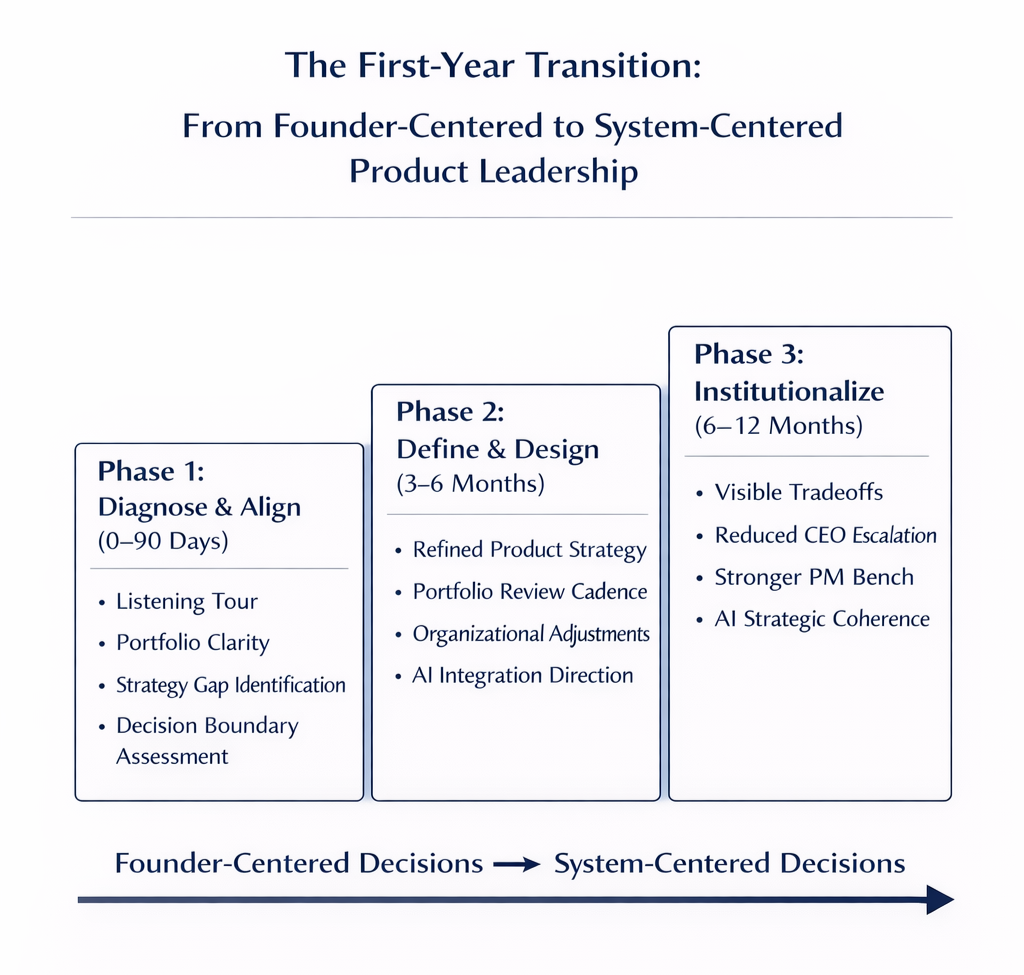
Phase 1 (First 90 Days) — Diagnose and Align
The initial phase is diagnostic.
The goal is not immediate reorganization. It is shared understanding.
During the first 90 days, a strong Head of Product should:
1. Conduct a Structured Listening Tour
Across:
Product managers
Engineering leaders
Design
Go-to-market teams
Customer-facing roles
Executive peers
This is not informal conversation. It is systematic information gathering focused on:
Where strategy is interpreted differently.
Where decision rights are unclear.
Where portfolio tradeoffs are implicit.
Where AI initiatives are emerging without coordination.
2. Assess the Current Portfolio
The Head of Product should produce a clear view of:
Active initiatives.
Resource allocation across products.
Investment themes.
Hidden work and side initiatives.
AI-related experiments or parallel efforts.
At this stage, the output is clarity — not judgment.
Founders should expect a structured articulation of the current state.
3. Clarify Strategy Gaps
Within the first 90 days, the new leader should be able to articulate:
Where product strategy is well-defined.
Where it is ambiguous.
Where business goals are not translating into product choices.
Where tradeoffs are being negotiated rather than decided.
This diagnostic articulation is often the first visible value of the hire.
Phase 2 (Months 3–6) — Define and Design
After diagnostic clarity comes structural design.
Between months three and six, a strong Head of Product should begin formalizing systems.
1. Refine or Formalize Product Strategy
This may include:
Clear product investment themes.
Explicit prioritization criteria.
Defined decision boundaries.
Alignment between product and business objectives.
Integration of AI strategy where relevant.
The output should be actionable, not aspirational.
Strategy should inform tradeoffs, not simply describe ambition.
2. Establish Portfolio Review Cadence
A consistent review mechanism should emerge.
This often includes:
Regular portfolio-level tradeoff discussions.
Transparent resource allocation.
Clear articulation of what is being deprioritized.
Defined criteria for introducing new initiatives.
If tradeoffs remain reactive at month six, structural alignment is still incomplete.
3. Clarify Organizational Design
Depending on stage, this may involve:
Restructuring PM ownership.
Defining product domains more clearly.
Adjusting reporting lines.
Elevating or replacing product leaders.
Formalizing discovery standards.
The emphasis is not change for its own sake. It is alignment between strategy and structure.
Phase 3 (Months 6–12) — Institutionalize and Elevate
The final phase of the first year focuses on durability.
At this stage, the question shifts from “What are we doing?” to “Is the system holding?”
1. Visible Tradeoffs and Strategic Discipline
By month twelve, founders should observe:
Clear examples of initiatives that were stopped or deprioritized.
Resource reallocation based on strategy, not pressure.
Consistent language across teams about product direction.
Reduced escalation to the CEO for routine tradeoffs.
This is evidence that portfolio discipline is functioning.
2. Strengthened Product Leadership Bench
By the end of the first year, you should see:
Clear expectations for PM performance.
Evidence of coaching and leadership development.
Improved quality of product reasoning in reviews.
Stronger Directors or senior PMs emerging.
If the Head of Product remains the sole source of product judgment, the system is not yet institutionalized.
3. AI Integration with Strategic Coherence
In AI-enabled environments, by month twelve you should expect:
Clear definition of AI investment themes.
Alignment between AI experimentation and core product direction.
Guardrails around governance and data considerations.
Reduced fragmentation of AI initiatives across teams.
AI should be integrated into product architecture intentionally, not layered opportunistically.
A Reusable 12-Month Milestone Framework
Founders can use the following high-level framework to evaluate progress.
PhasePrimary FocusExpected Outcomes0–90 DaysDiagnose and AlignClear articulation of strategy gaps, portfolio clarity, decision boundary assessment3–6 MonthsDefine and DesignFormalized product strategy, portfolio review cadence, organizational adjustments6–12 MonthsInstitutionalizeVisible tradeoffs, reduced CEO escalation, strengthened PM bench, AI alignment
This framework should guide performance discussions during the first year.
It does not require perfect execution.
It requires visible structural movement.
What Should Not Be the Primary Measure
In the first 12 months, founders often default to:
Feature output
Roadmap completion
Velocity metrics
These are lagging indicators.
The leading indicators of success are:
Decision clarity
Tradeoff discipline
Portfolio coherence
Leadership depth
Feature velocity may fluctuate during structural transition.
Strategic coherence should increase.
Why Head of Product and CPO Hires Fail (Common Mistakes)
Most failed Head of Product hires follow a predictable pattern.
The candidate was credible.
The compensation was competitive.
The interviews felt strong.
And yet, within 12–24 months, momentum stalls.
The issue is rarely talent alone.
It is structural misalignment.
Below are the most common failure modes.
1. The Role Was Never Clearly Defined
Many companies hire a Head of Product without defining:
Which decisions move under their authority.
What success looks like in the first year.
Whether they are expected to stabilize execution or redesign the system.
How product strategy connects to business strategy.
Ambiguity at the mandate level produces confusion at the operational level.
The result:
Competing interpretations of authority.
Quiet resistance from other executives.
Product managers unsure whose direction to follow.
Executive hires fail quickly when authority is implied rather than explicitly granted.
2. The Level Was Misaligned with the Stage
Hiring a CPO when you need a Director creates unnecessary hierarchy.
Hiring a Director when you need a VP creates invisible bottlenecks.
Hiring a Senior PM and expecting executive leverage creates frustration on both sides.
Title inflation does not compensate for structural complexity.
When scope and level are mismatched, the organization oscillates between overreach and underperformance.
3. The Founder Never Truly Let Go
This is the most common failure mode.
Founders say they want a Head of Product.
But in practice:
Major tradeoffs still route through them.
Product managers bypass the new leader.
Strategic direction shifts informally in side conversations.
Executive disagreements are resolved privately without the Head of Product present.
Authority cannot be partial.
If the founder continues to operate as the de facto Head of Product, the new hire becomes an expensive layer of interpretation.
Over time, credibility erodes.
The organization learns where the real decisions are made.
4. The Hire Was Expected to Fix Structural Problems Alone
A Head of Product cannot compensate for:
Unclear company strategy.
Chronic underinvestment in engineering.
Cultural misalignment across functions.
Founder indecision about market focus.
When executive product leadership is treated as a corrective measure rather than part of an aligned system, expectations become unrealistic.
The role becomes a pressure valve for deeper organizational ambiguity.
That rarely ends well.
5. The Organization Confused Busyness with Leverage
In some cases, friction arises because the new leader is not “hands-on enough.”
Teams expect:
Immediate roadmap rewrites.
Daily tactical involvement.
Direct intervention in execution detail.
But executive product leadership creates leverage through:
Clear decision systems.
Visible tradeoffs.
Portfolio discipline.
Long-term direction.
During the first months, visible structural work may feel slower than tactical output.
If the organization equates productivity with visible execution, it may prematurely judge the hire as ineffective.
This often leads to reversion toward founder-led decision-making.
6. AI Complexity Was Underestimated
In modern product environments, AI amplifies existing ambiguity.
When AI initiatives emerge without executive coordination:
Teams experiment in parallel without integration.
Data governance risks increase.
Product narratives fragment.
Investment becomes reactive.
If the Head of Product is not empowered to integrate AI strategy across the portfolio, fragmentation accelerates.
The organization may misinterpret the resulting confusion as leadership failure rather than mandate limitation.
The Pattern Behind Most Failures
When you step back, most failed Head of Product hires share one root cause:
The organization attempted to install executive leverage without committing to structural change.
Hiring a CPO or VP of Product is not an upgrade to the roadmap.
It is a shift in how product decisions are made, escalated, and communicated.
If that shift is not intentional and supported, even strong candidates will struggle.
If You’re Not Ready to Hire a Head of Product Yet
Not every company needs a Head of Product today.
If, after reading this guide, you conclude that:
Strategy is still emerging.
Portfolio complexity remains limited.
Founder-led decision-making is still efficient.
Product management capability needs strengthening at the IC level.
Then the next step may not be hiring an executive.
It may be:
Clarifying product strategy first.
Hiring a strong Senior PM.
Improving decision boundaries.
Introducing lightweight portfolio discipline.
Bringing in fractional executive guidance to test structural change before committing to a full-time role.
Hiring prematurely is more expensive than waiting.
Structural clarity before executive hiring reduces the risk of misalignment later.
Conclusion: Hiring a Head of Product Is an Architectural Decision
Hiring a Head of Product alters the structure through which product decisions are made. It redistributes authority, formalizes tradeoffs, and introduces portfolio-level capital allocation into the operating system of the company.
When the role is clearly defined and properly leveled, strategy becomes enforceable rather than interpretive. Investment decisions move from negotiation to governance. Product managers operate within defined decision boundaries rather than escalating ambiguity upward. AI initiatives are evaluated against portfolio intent instead of emerging opportunistically.
When the role is introduced without mandate clarity or structural commitment, the opposite occurs. Authority overlaps. Product-level investment remains centralized with the CEO. Product managers adapt to mixed signals. The organization interprets the resulting friction as leadership failure rather than governance ambiguity.
The question is not whether a company should have a CPO or VP of Product. The relevant question is whether product complexity has reached a level that requires executive portfolio design rather than founder-led arbitration.
If that threshold has been reached, the mandate must be explicit, the level must match the scope, and performance must be evaluated based on system installation rather than feature output.
If it has not, strengthening strategic clarity and product management capability may produce more leverage than adding an executive layer prematurely.
Executive product leadership does not add process. It installs structure capable of absorbing complexity without escalating every decision to the top of the organization.
That structural distinction determines whether the hire creates leverage or simply redistributes ambiguity.