

The Hidden Cost of “Alignment” When Product Teams Avoid Real Tradeoffs

Alignment is frequently treated as evidence that a product organization is operating effectively.
The annual strategy is reviewed. Roadmaps are approved. Cross-functional leaders confirm that priorities are reasonable. No major objections surface. The plan moves into execution.
From a governance standpoint, this appears healthy.
Yet many product organizations that feel aligned experience stalled growth, recurring roadmap debates, and difficulty articulating their competitive advantage.
The issue is not alignment itself.
The issue is alignment in the absence of explicit tradeoffs.
Tradeoffs Are the Core of Product Strategy
In product management, a tradeoff is a deliberate exclusion.
It answers questions such as:
Which customer segment will receive primary focus?
Which problems will define this planning cycle?
Which metrics matter most right now?
What will we intentionally not prioritize?
Tradeoffs are not about saying “no” reflexively. They are about concentrating resources.
A product strategy that does not clearly define exclusions cannot guide prioritization. It may describe ambition, direction, and goals, but it does not constrain behavior.
Without constraint, teams revert to negotiation.
When a strategy clearly defines what will not be pursued, roadmap conversations change. New requests are evaluated against explicit boundaries rather than political weight.
Without that clarity, alignment becomes fragile. Agreement exists at the surface, but the constraints underneath are undefined.
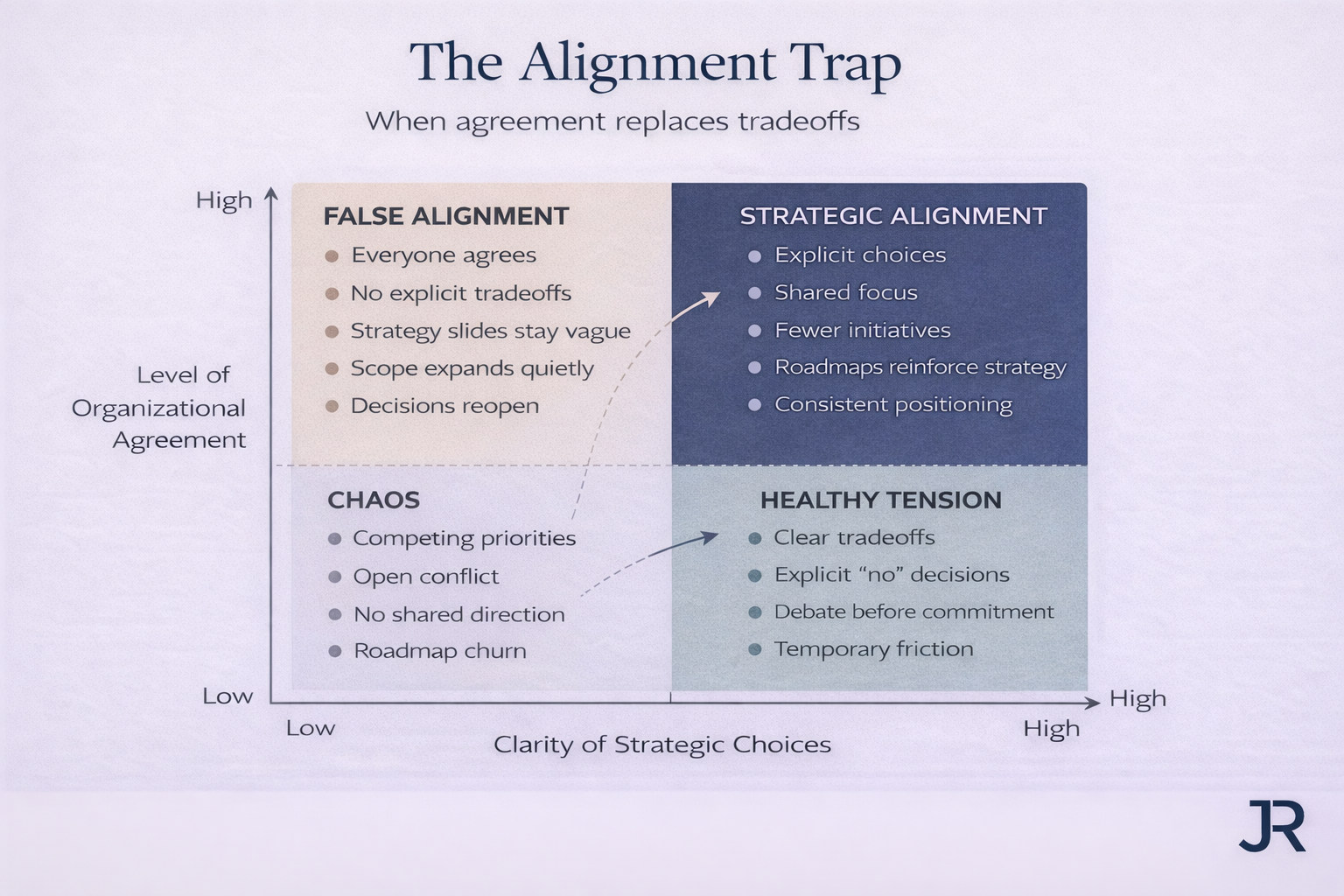
How Alignment Quietly Replaces Strategy
In many organizations, alignment emerges during annual planning through scope expansion rather than focused commitment.
Consider a common pattern.
During strategic planning:
Sales proposes enhancements to support large accounts.
Marketing advocates for differentiation initiatives.
Engineering highlights infrastructure investments.
Leadership introduces a new growth experiment.
Each proposal is rational in isolation. Instead of selecting a primary focus, the roadmap incorporates elements from each.
The resulting plan reflects cross-functional agreement.
It does not necessarily reflect strategic prioritization.
What is often missing is a clear articulation of tradeoffs:
Which of these initiatives defines the year?
Which will receive disproportionate resources?
Which will be postponed even if stakeholders remain dissatisfied?
When these decisions are avoided, alignment becomes a balancing act rather than a commitment.
Over time, roadmap debates resurface because the original exclusions were never documented.
The Incentives That Produce False Alignment
False alignment is rarely caused by incompetence. It is the predictable result of organizational incentives.
Leadership Incentives Favor Inclusion
Executive teams operate under pressure to maintain coordination across functions.
Explicit tradeoffs create friction. They require telling a function that its priority will not be addressed in the current cycle. They concentrate accountability around specific bets.
Broad alignment, by contrast, reduces immediate tension. It signals cooperation. It minimizes escalation.
However, inclusion diffuses focus.
When strategy attempts to satisfy all stakeholders simultaneously, it loses its ability to direct scarce resources toward a limited set of high-leverage bets.
Cross-Functional Pressure Expands Scope
Each function is evaluated on its own objectives.
Sales is measured on revenue attainment.
Marketing is measured on pipeline and positioning.
Engineering is measured on delivery reliability and system health.
Finance is measured on predictability and margin.
During strategy formation, these pressures manifest as proposed initiatives.
If product strategy does not clearly define which outcomes dominate the cycle, the roadmap becomes an accumulation of well-justified requests.
The absence of tradeoffs produces two structural effects:
Capacity is fragmented across parallel initiatives.
No single problem receives sufficient depth to materially change customer behavior.
The organization appears aligned because each function sees its priorities represented. Strategic concentration, however, is diluted.
Diffused Accountability Weakens Commitment
Tradeoffs make strategy testable.
If a product strategy states that improving retention within a defined segment is the primary objective for the year, success or failure can be evaluated clearly.
If the strategy instead balances retention, acquisition, expansion, and platform investments without ranking them, evaluation becomes ambiguous.
Broad alignment distributes responsibility. Concentrated tradeoffs create ownership.
When accountability is diffused, teams are less willing to commit to sharp positioning. Strategic documents become descriptive rather than prescriptive.
What This Looks Like in Day-to-Day Product Management
When tradeoffs are absent, the consequences surface in everyday decisions.
PMs struggle to explain why one initiative outranks another.
Roadmap reviews focus on accommodating new requests rather than reinforcing constraints.
The same prioritization debates reappear each quarter.
Teams deliver incremental improvements across multiple themes without measurable inflection.
Delivery velocity may remain stable. Customer outcomes often plateau.
Without clear tradeoffs, the roadmap becomes a negotiation artifact rather than an expression of strategy.
Case Scenario: The Balanced Roadmap
Consider a mid-sized SaaS company entering annual planning.
The leadership team agrees that the coming year must address:
Enterprise customer expansion.
Self-serve onboarding improvements.
Technical scalability.
AI-driven feature innovation.
Each of these themes is valid.
Rather than selecting a dominant focus, the roadmap allocates resources evenly across all four.
After twelve months:
Enterprise deals increased modestly but churn remained elevated.
Self-serve onboarding improved slightly but did not materially change activation.
Scalability work reduced incidents but introduced migration complexity.
AI features launched but lacked clear adoption metrics.
No initiative failed outright. None fundamentally shifted the business.
The company was aligned. It was not concentrated.
The absence of tradeoffs prevented decisive positioning.
Portfolio Mechanics: Why the Problem Multiplies at Scale
In multi-product environments, the lack of tradeoffs compounds.
At the squad level, teams may feel aligned internally. Each has a roadmap and defined goals.
At the portfolio level, however, tradeoffs determine where shared resources concentrate.
Without portfolio-level tradeoffs:
Engineering investment spreads thinly across products.
Shared infrastructure receives inconsistent prioritization.
Technical debt accumulates across multiple codebases.
Strategic positioning fragments by product line.
For example:
A company managing three product lines may decide to invest in AI capabilities across all three simultaneously.
The result:
Partial AI integration in each product.
Limited depth in any one domain.
Shared data infrastructure strained.
Marketing messaging diluted across use cases.
Had the portfolio-level strategy selected one product as the primary AI expansion vehicle, resource concentration might have produced a stronger competitive signal.
Alignment across products does not equal strategic clarity across the portfolio.
Tradeoffs at scale determine whether resources amplify impact or diffuse it.
The Relationship Between Tradeoffs and Technical Debt
Avoiding tradeoffs also influences technical health.
When multiple initiatives are pursued simultaneously:
Teams implement partial solutions to meet timeline expectations.
Shared components are adapted for parallel use cases.
Refactoring is deferred to accommodate new feature work.
Over time, technical debt grows not because engineers neglect quality, but because strategic boundaries were unclear.
When tradeoffs are explicit, technical investments can align with primary bets. When tradeoffs are absent, engineering architecture must flex across shifting priorities.
The result is compounding complexity.
Why This Is Fundamentally a Product Strategy Issue
This pattern is not a delivery execution failure.
It originates in strategy formation.
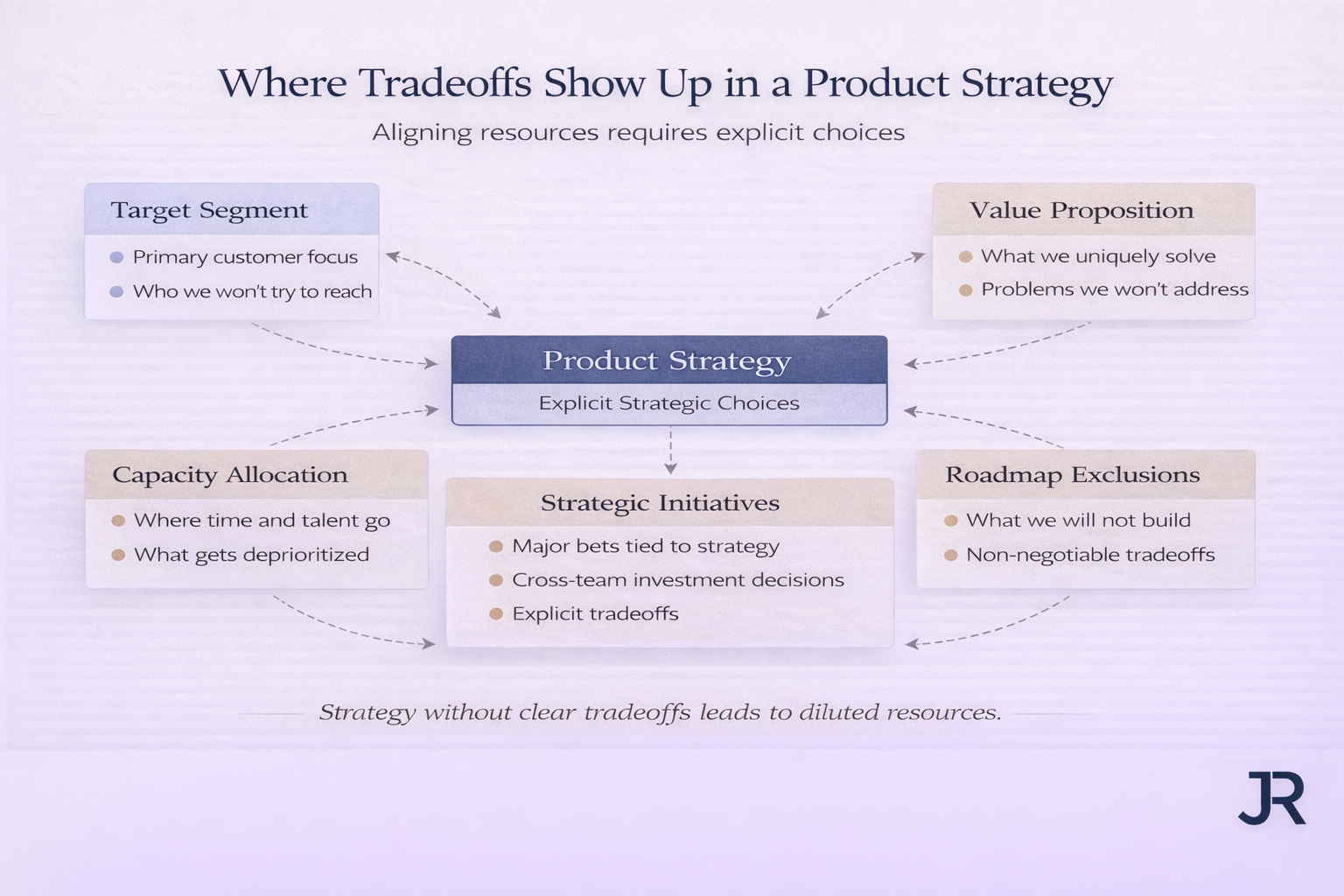
A strong product strategy should explicitly articulate:
Who we serve.
What problems define our focus.
How we intend to win.
What we will not do.
The final component is critical.
Without “what we will not do,” strategy becomes permissive.
Permissive strategy invites scope expansion. Scope expansion erodes concentration.
Tradeoffs create the boundaries that protect focus.
Signs Tradeoffs Are Missing
Organizations that avoid tradeoffs often exhibit consistent signals:
Strategy documents describe ambition but omit exclusions.
Roadmap items accumulate more frequently than they are removed.
Leadership discussions prioritize comfort and consensus over decision sharpness.
Portfolio investment appears evenly distributed across competing objectives.
Customer metrics improve incrementally but lack step-change movement.
These are structural signals, not personality conflicts.
They indicate that strategy lacks constraint.
Reframing Alignment as an Outcome of Tradeoffs
Alignment is valuable when it reflects disciplined choice.
The sequence matters.
Effective planning cycles typically follow this order:
Competing priorities are surfaced transparently.
Tradeoffs are debated explicitly.
Exclusions are documented.
Resources are concentrated around selected bets.
Alignment is established around those commitments.
In this structure, alignment follows constraint.
When alignment precedes tradeoffs, strategy weakens.
The Cost of Avoiding Concentration
The long-term consequences of avoiding tradeoffs are gradual but significant.
Competitive positioning becomes ambiguous.
Customer perception lacks clarity.
Engineering capacity fragments across initiatives.
High-performing PMs spend more time mediating stakeholders than advancing direction.
The organization struggles to articulate its primary advantage.
Strategic clarity requires concentrated effort.
Concentrated effort requires tradeoffs.
Without tradeoffs, alignment becomes a mechanism for preserving optionality rather than building advantage.
Optionality feels safe. It rarely produces category leadership.
Closing Perspective
Alignment is not inherently problematic.
It becomes problematic when it replaces explicit strategic choice.
In product management, tradeoffs are not a sign of rigidity. They are evidence of commitment.
If annual planning produces agreement but roadmap debates persist, if priorities feel balanced rather than sharp, or if resources appear evenly distributed across competing objectives, the issue may not be misalignment.
It may be the absence of tradeoffs within the product strategy itself.
Without tradeoffs, strategy cannot constrain behavior.
Without constraint, alignment cannot produce advantage.