

The Cost of Treating Product Managers Like Project Managers

Most organizations don’t intend to turn Product Managers into Project Managers.
It usually starts with pressure.
Deadlines slip. Dependencies pile up. Leadership wants predictability. Someone needs to “own execution.” And Product Managers, already sitting at the intersection of teams, context, and decisions, become the obvious answer.
It feels efficient. Rational, even.
But over time, something subtle happens.
Product Managers stop spending most of their energy shaping decisions, clarifying problems, and testing assumptions. Instead, they become the connective tissue holding delivery together. Timelines replace tradeoffs. Status replaces judgment. Coordination replaces learning.
The organization still ships. Sometimes faster.
What it loses is product leadership.
The Pattern That Feels Efficient at First
The pattern is familiar.
A Product Manager is asked to:
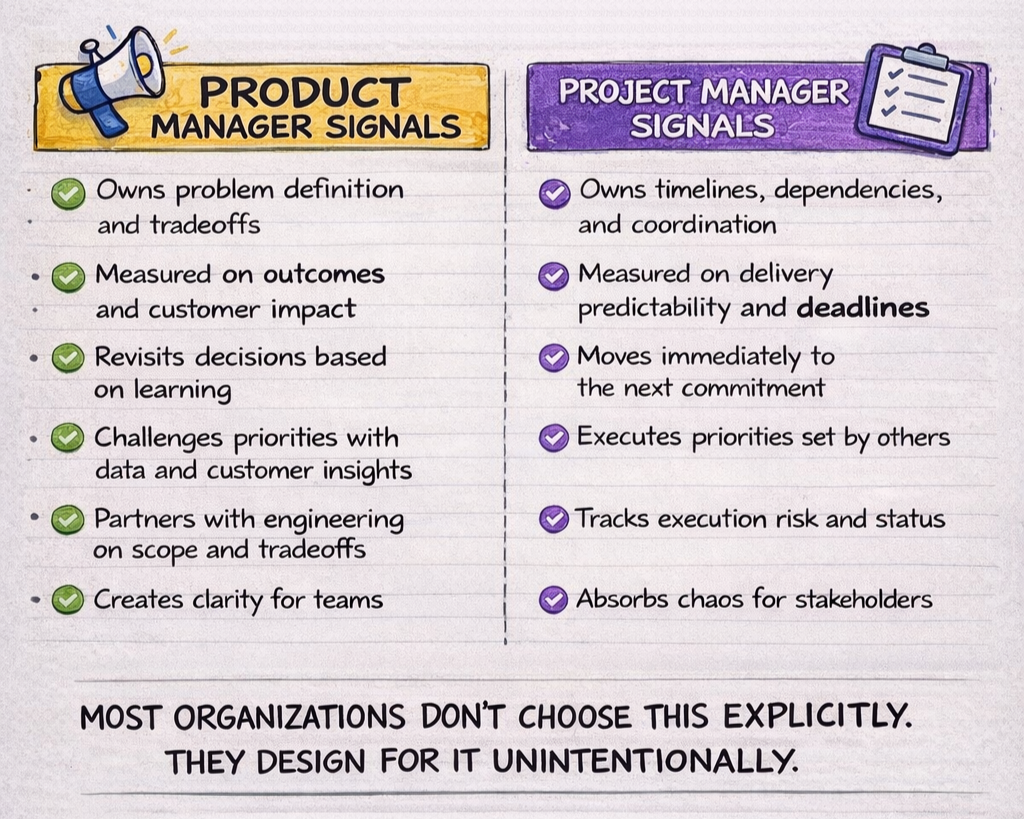
Track timelines and milestones
Manage dependencies across teams
Coordinate delivery plans
Keep stakeholders informed
Ensure things “don’t fall through the cracks”
Leadership relief follows quickly:
There is a single point of accountability
Delivery feels more predictable
Meetings feel more controlled
Risk feels managed
From the outside, this looks like maturity.
From the inside, it’s a quiet trade being made: delivery certainty over product judgment.
The problem is not that this work is unimportant.
The problem is that it is not the primary job of a Product Manager, and when it becomes one, something else is displaced.
Why This Keeps Happening
This pattern doesn’t persist because leaders misunderstand the PM role.
It persists because the organization is compensating for deeper design gaps.
Role confusion is baked into the system
In many companies, the roles of:
Product Manager
Product Owner
Project Manager
Program Manager
have been collapsed over time.
Sometimes this is intentional, to reduce headcount or simplify org charts. Other times it happens accidentally, through titles that solve compensation or leveling problems rather than capability needs.
What’s usually missing is a clear decision-ownership model.
When it’s unclear who owns prioritization, tradeoffs, delivery mechanics, or escalation, the PM becomes the default owner of everything.
That’s not empowerment. That’s absorption.
Delivery pressure crowds out judgment
Most organizations reward visible progress.
Shipping feels tangible. Timelines feel reassuring. Coordination looks like accountability.
Discovery, synthesis, and judgment are quieter. Their impact shows up later. Their value is harder to measure in the moment.
Under pressure, systems reward urgency and motion. PMs adapt accordingly, not because they want to abandon product thinking, but because the organization signals that execution is what matters most.
“Scrappy” becomes a proxy for impact
Feedback to PMs often sounds like:
“You need more urgency.”
“You need to be more scrappy.”
“We need someone who can just get things done.”
These phrases often mask a deeper expectation: be the glue.
Busyness becomes evidence of value. Handling chaos becomes a promotion signal. Over time, PM success is measured by how much friction they absorb rather than how much clarity they create.
The Real Reason PMs Get Pulled Into Project Work
There’s an unspoken executive question behind this entire debate:
“If Product Managers aren’t acting as Project Managers, who is?”
This question reveals the real issue.
PMs aren’t doing project work because it belongs to them.
They’re doing it because someone else isn’t empowered to own it.
When engineering leadership isn’t empowered
In healthy product teams:
Engineering Managers own delivery mechanics
They manage capacity, sequencing, dependencies, and execution health
They partner with PMs on scope and tradeoffs
When that role is weak or underpowered, the work doesn’t disappear. It shifts.
PMs pick up sprint coordination, dependency tracking, delivery sequencing, and execution risk management. This is often how Product Owner roles emerge, not as a deliberate design choice, but as a workaround.
The presence of a Product Owner is frequently a symptom, not a strategy.
It often indicates that engineering leadership has not been given the authority or clarity to own execution.
When leadership optimizes for timelines over outcomes
Legacy executive teams often operate with project expectations:
Dates are requested before problems are understood
Roadmaps are treated as commitments
Success is defined by hitting milestones
In this environment, PMs are pulled into timeline management by necessity. Judgment becomes secondary. Learning feels risky. Saying “we don’t know yet” feels like failure.
This is not a PM capability issue.
It’s an incentive design issue.
When accountability gets confused with control
Leaders want a single point of accountability. That instinct is understandable.
But without careful design, accountability turns into operational control.
PMs inherit dependency management, escalation handling, risk tracking, and delivery reporting, not because they asked for it, but because the organization needs someone to hold the thread.
This is how PMs quietly become Project Managers without anyone explicitly deciding that they should.
When the business doesn’t trust PMs with decisions
There is another, quieter reason PMs get trapped in execution: lack of trust.
In some organizations, leadership is used to telling teams what to build and when to deliver it. Strategy is treated as a business-only domain. Product is expected to execute, not decide.
When PMs push back or surface tradeoffs, the response often sounds reasonable:
“They need to learn the business first.”
“They don’t have enough context yet.”
“Once they’ve proven themselves, we can involve them earlier.”
In practice, this trust is never granted.
Because decision-making authority is withheld, PMs are excluded from strategy by design. Without access to the strategy layer, the only space left for ownership is execution.
This creates a self-reinforcing loop:
PMs aren’t trusted because they aren’t involved in strategy
They aren’t involved in strategy because they aren’t trusted
Execution becomes the only domain where they can demonstrate value
By the time leadership is “ready” to trust them, the PM has already been shaped into a Project Manager.
This is not a capability problem.
It’s an empowerment problem.
Where project and program management actually belong
This is not an argument against project or program management.
Those roles are essential when:
Coordinating large, cross-company initiatives
Managing external vendors or contractors
Running regulatory, compliance, or infrastructure programs
But that is portfolio-level coordination, not modern product development.
Inside empowered product teams:
Delivery should be owned by engineering leadership
Product should own outcomes, decisions, and tradeoffs
Discovery and delivery should be continuous
Project management belongs around the system, not inside the team.
What Gets Lost When PMs Become Project Managers
The cost of this role confusion is not abstract.
It shows up directly in talent, velocity, and long-term competitiveness.
Strategy degrades
When PMs are consumed by coordination, problems stop getting framed and tradeoffs stop getting clarified. Strategy becomes a slide, not a guide.
Roadmaps shift from expressions of intent to delivery plans. PMs stop asking “why this, why now” and start asking “how do we get this done.”
Learning slows down
Discovery becomes something that happens “when there’s time.”
Assumptions go untested. Feedback is collected but not synthesized. The organization ships more while learning less.
Teams optimize locally
Engineering builds what’s asked. Design supports delivery. No one owns whether outcomes improve.
The system optimizes for motion, not impact.
Talent erodes and product leadership disappears
One of the most expensive consequences is also the easiest to miss.
When PMs are reduced to execution managers, two things tend to happen:
Some adapt by doing the minimum required to survive
Others leave
The PMs who care most about outcomes, customer impact, and decision-making burn out first. What remains are roles focused on coordination, not leadership.
Over time, the organization loses product judgment, institutional learning, and internal challengers to weak ideas.
What looks like stability is actually stagnation.
This Is a System Design Problem, Not a People Problem
Most PMs are not failing.
They are responding rationally to the system they’re in.
Performance reviews reward coordination. Promotions reward complexity handling. Delivery heroics are visible. Judgment is quiet.
Organizations get exactly the behavior they design for.
What Treating PMs as Product Leaders Actually Requires
This does not require more roles.
It requires clearer ones.
Clear decision ownership
PMs need explicit ownership of:
Problem definition
Prioritization logic
Tradeoffs
Outcome accountability
Engineering leadership needs explicit ownership of:
Delivery execution
Sequencing
Technical tradeoffs
Capacity management
Ambiguity here is what causes role collapse.
Separation of responsibilities without silos
This is not about handoffs.
It’s about complementary ownership.
Strong product teams distribute responsibility intentionally.
Measuring impact, not motion
If PMs are measured on:
Timelines
Output
Coordination
Stakeholder satisfaction
They will behave like Project Managers.
If they are measured on:
Decision quality
Customer impact
Outcomes
Learning velocity
They will behave like product leaders.
How to Tell If This Is Happening in Your Organization
A few signals show up consistently:
There is no clear owner of product outcomes, only owners of delivery
PMs move from one feature to the next without revisiting impact
Success is framed around participation rather than results
Leadership celebrates activity even when customer metrics don’t change
Roadmaps are dominated by business requests regardless of data
Executives ask primarily about delivery dates, not outcomes or learning
When these patterns exist, the organization isn’t running product.
It’s running a feature factory with a product title.
A Final Reflection
Treating Product Managers like Project Managers feels efficient.
Until you realize you’ve optimized for delivery certainty at the expense of judgment, learning, and outcomes.
This isn’t about titles.
It’s about what your system rewards.
Organizations don’t get the PMs they want.
They get the PMs their structure creates.