Why Product Manager Careers Stall After Senior PM

There’s a moment I’ve seen play out repeatedly, both in my own career and while working closely with product teams at different stages.
A Product Manager reaches Senior PM. They’ve earned trust. They’ve delivered consistently. They’re given broader scope, more stakeholders, and higher-visibility problems. On paper, everything looks like progress.
And then momentum slows.
Growth conversations become less concrete. Promotions feel harder to justify. Feedback starts repeating itself without ever quite resolving. The PM isn’t failing, but they aren’t clearly moving forward either.
This is where many Product Manager careers quietly stall.
Not because PMs stop growing, but because the role evolves before the system around it does.
The Invisible Ceiling After Senior PM
Up to Senior PM, expectations are usually implicit but legible.
You’re rewarded for:
Shipping outcomes reliably
Managing stakeholders effectively
Translating strategy into execution
Owning a defined problem space
Success may not be perfectly documented, but it’s observable. Leaders can point to outcomes and say, “This worked.”
After Senior PM, that clarity often disappears.
Scope expands, but the definition of success doesn’t evolve with it.
The feedback gets vague fast
PMs are told they’re “operating at the next level,” yet when promotion conversations happen, the feedback sounds familiar and frustratingly vague:
You need to show more sense of urgency
You need to be more scrappy
You should operate more like an owner
These phrases sound important, but they’re not actionable. They don’t describe outcomes, decision quality, or scope. They describe how leaders wish things felt, not what the role actually requires.
This is usually the first signal that a company hasn’t defined what comes after Senior PM.
Why this feedback is a red flag
At senior levels, vague feedback is rarely laziness. It’s usually a symptom of missing structure.
Leaders feel a gap, but they can’t articulate it in role-based terms because the role itself hasn’t been clearly defined beyond delivery. Without a shared model for growth, feedback drifts from outcomes and decisions toward personality traits and working style.
“More urgency” often means: I want you to push harder on decisions, but I don’t know how to frame that expectation.
“More scrappy” often means: I want you to navigate ambiguity better, but we haven’t agreed on what good looks like.
This puts PMs in an impossible position. They’re expected to change something about how they operate, but they’re not told what success would look like if they did.
When career progression isn’t mapped, feedback becomes subjective by default.
And subjective feedback is almost impossible to act on consistently.
How the system creates the stall
Once expectations lose clarity, a few predictable dynamics start reinforcing each other. None of these are rare. Most are the natural result of a team scaling without a defined growth model.
Doing more becomes the wrong signal
Strong PMs respond to ambiguity by taking on more responsibility.
They step into delivery coordination, project management, dependency tracking, and stakeholder alignment that others avoid. Not because they misunderstand their role, but because gaps exist and they care about outcomes.
In the short term, this works:
They become indispensable
Teams move faster
Leaders trust them
Over time, it backfires.
Growth beyond Senior PM requires leverage: improving decision quality, enabling others, and shaping systems that outlast the individual. That means letting go of certain responsibilities.
But now letting go feels risky to everyone involved:
The PM worries outcomes will suffer
Leaders worry effectiveness will drop
The organization has learned to rely on the PM as glue
Without a clear ladder, doing more is rewarded until it becomes a ceiling.
Team outcomes turn into individual penalties
This is one of the most damaging dynamics in PM career progression.
When team goals or OKRs are missed, the miss is often framed as an individual performance issue. Ownership is emphasized. Promotions are paused until results improve.
When team goals are met, credit becomes diffuse. It was a team effort. Leaders want consistency. The bar is higher.
In organizations without explicit career criteria, outcomes are used selectively to justify decisions that were never clearly defined.
PMs are told to own outcomes, but they don’t control all inputs, dependencies, or decisions. They’re penalized for misses they couldn’t fully control and denied recognition for wins because ownership is shared.
Over time, PMs learn that stretch goals are risky and ambiguity is dangerous. Playing it safe becomes the rational choice.
At this point, it’s reasonable to wonder whether the problem is performance or structure.
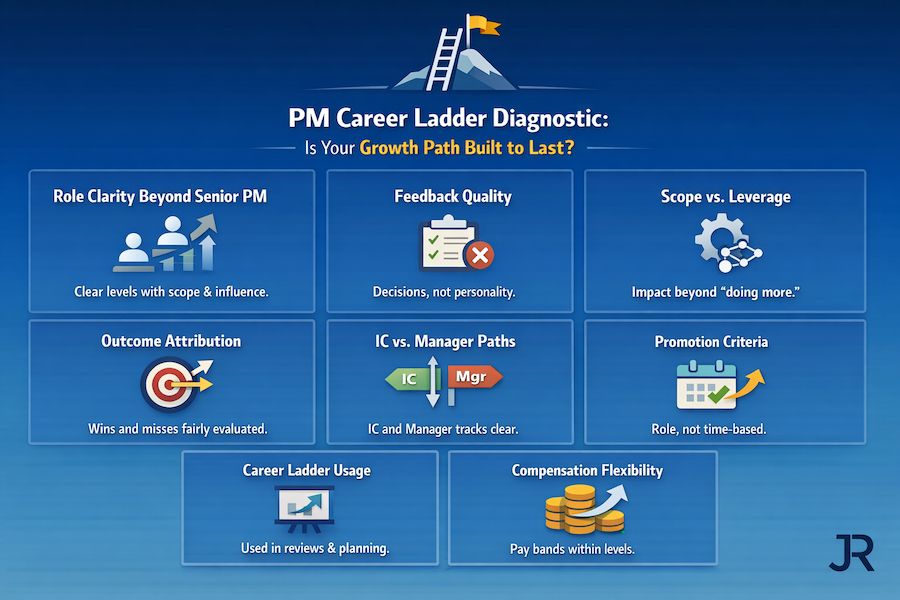
The diagnostic below helps distinguish between individual growth challenges and missing career infrastructure.
Title inflation hides the lack of a growth model
Many companies create this situation unintentionally.
They hire PMs before defining a ladder. They assign “Senior” titles based on salary requirements, previous titles, or retention pressure. They assume they’ll figure growth paths out later.
This works when the team is small and expectations live in leaders’ heads. It breaks as soon as the team grows.
Senior PM stops meaning one thing. Expectations vary by manager. Promotions feel inconsistent or political. Growth slows even as the business scales.
The stall isn’t about individual capability. It’s about missing structure.
What actually changes beyond Senior PM
The turning point in this conversation is recognizing that growth beyond Senior PM is not a single step. In most healthy product organizations, there is room for two or three Individual Contributor levels beyond Senior PM, each with meaningfully different expectations.
Management should be a choice, not the default next move.
The core reason many PMs stall is simple: the way impact is created changes, but expectations don’t.
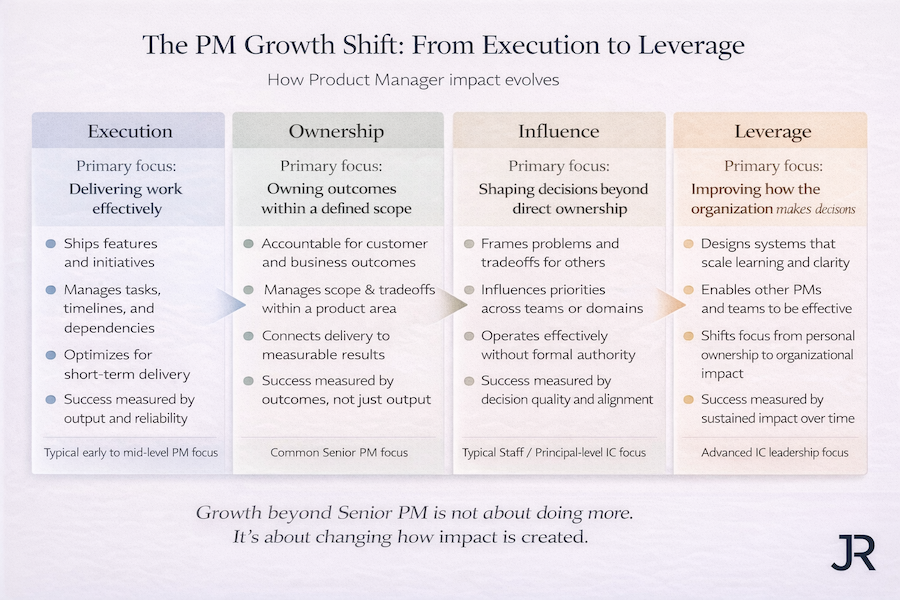
The shift from execution to leverage
Beyond Senior PM, the nature of the work changes.
The focus moves from executing within a defined scope to shaping how decisions get made. From owning delivery to making tradeoffs clear. From personal output to organizational leverage.
At higher IC levels, PMs are expected to:
Frame ambiguous problems before they become roadmap items
Make tradeoffs visible so leaders can decide intentionally
Improve how teams learn, prioritize, and align
Let go of ownership in order to scale others
Treating this as one “next level” recreates the same stall one step higher.
Individual Contributor growth vs management growth
The IC path and the Manager path are different jobs with different skills.
IC growth is about:
Increasing scope and influence
Shaping strategy through decisions, not authority
Creating leverage across teams
Management growth is about:
Developing people
Setting context and direction
Scaling decision-making capacity
Pushing PMs into management too early often creates new problems. Strong IC judgment is lost, and new managers default to task oversight instead of coaching.
Healthy organizations make both paths explicit and equally valued.
What levels above Senior PM” typically means
Titles vary, but the progression usually looks like some version of:
Senior PM: owns outcomes in a defined domain
Staff PM: influences decisions across adjacent domains and teams
Principal PM: shapes portfolio-level tradeoffs and product direction
Distinguished PM (less common): sets patterns and systems that scale product judgment org-wide
The point isn’t the titles. The point is that scope and leverage expand in stages, and each stage needs defined expectations.
Career ladders are product infrastructure
Career ladders are often treated as something to clean up later. That’s a mistake.
PM career ladders are product operating infrastructure. They clarify how the organization expects product work to scale.
What a real PM career ladder clarifies
A strong ladder is not a checklist or a job description. It’s a matrix that differentiates levels across dimensions such as:
Problem scope
Decision ownership versus influence
Impact horizon
Collaboration model
Leverage
Each level should make clear:
What the PM owns
Where they influence
How performance is evaluated when outcomes are mixed
What “good” looks like in ambiguous situations
Without this structure, PMs optimize for survival instead of growth, managers rely on intuition instead of criteria, and promotions feel arbitrary even when intentions are good.
How to use career ladders without breaking them
A ladder is only useful if it drives consistent conversations and decisions.
What Product Managers should ask for
PMs should ask for:
Explicit expectations at each level, not just titles
Clarity on how performance is evaluated when outcomes are mixed
Separation between role growth and temporary workload increases
These conversations are about clarity, not entitlement.
Common mistakes PMs and leaders make
Career ladders are not checklists. Hitting every mark does not automatically trigger promotion.
Promotions tied to calendar time or a single delivery milestone often become a delay tactic rather than a growth plan. “Give it another six months” without concrete expectations usually postpones growth instead of enabling it.
Growth should be evaluated as sustained operating patterns at the next level, not a one-time achievement.
Separate career growth from compensation
Needing a raise is not, by itself, a reason to be promoted. Budget constraints should not be a reason to deny role progression.
Healthy organizations use salary bands to allow flexibility within levels and treat compensation and career growth as related but not identical.
When promotions become proxy battles for pay, ladders lose credibility and trust erodes.
Designing growth with intent
Most Product Manager careers don’t stall because PMs lack ambition or skill.
They stall because expectations evolve faster than the systems designed to support them.
When feedback is vague, outcomes are selectively attributed, and growth paths are implicit, even strong PMs end up stuck.
The PMs who break through aren’t always the most talented. They’re the ones operating in environments where growth is made explicit.
If this resonates, the work isn’t about trying harder. It’s about designing growth with the same intent you design products.