

The Books That Shaped How I Think as a Product Leader
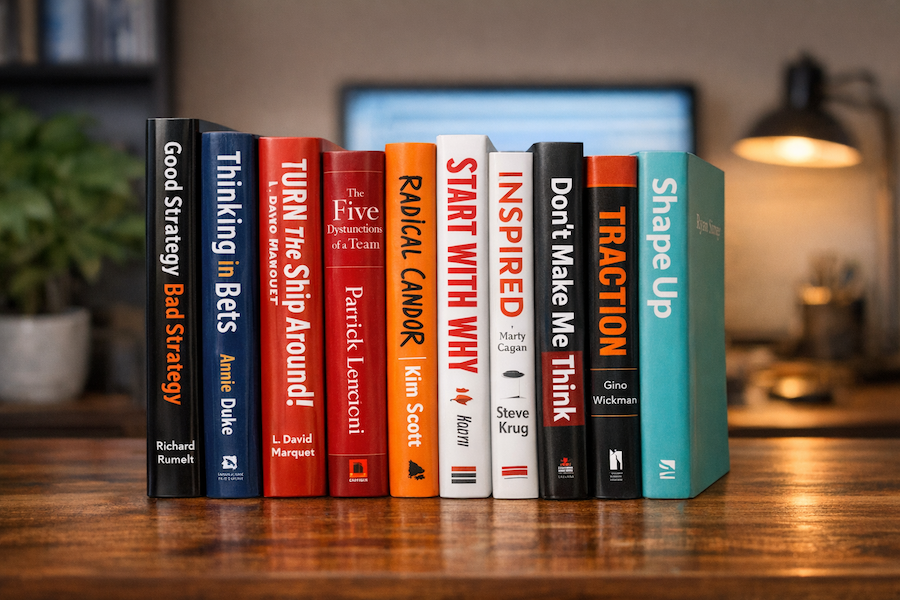
People often ask what books they should read to become a better Product Manager or Product Leader.
My answer is rarely a straight list.
What usually matters more is where they’re stuck. Different challenges require different lenses, and the wrong book at the wrong moment often creates more confusion than clarity.
The books below shaped how I think as a product leader because they met me at specific points in my career. If you’re facing similar challenges, these are the books I tend to recommend — not as answers, but as thinking tools.
Strategy, Judgment, and Decision Quality
Good Strategy / Bad Strategy
By Richard Rumelt
If you feel like your roadmap is full, but direction is still unclear, this is where I’d start.
Most teams I work with aren’t lacking effort or ambition. They’re lacking a shared diagnosis of the problem they’re actually trying to solve. Rumelt’s core insight is simple but uncomfortable: strategy starts with saying no and making tradeoffs explicit.
This book helps when:
Strategy conversations keep drifting into initiative lists
OKRs feel disconnected from real priorities
Leadership agrees on goals but not on direction
You won’t walk away with templates. You’ll walk away with sharper questions — the kind that expose whether a plan is real or just activity dressed up as intent.
Thinking in Bets
By Annie Duke
If you’re being judged by outcomes rather than decisions, this book can change how you think about leadership entirely.
Product work lives in uncertainty. Markets shift. Customers surprise you. Experiments fail for reasons you couldn’t predict. This book reframes decision-making as a probabilistic process rather than a search for certainty.
I recommend this when:
Teams are afraid to make bets without perfect data
Retrospectives focus on blame instead of learning
Leaders struggle to change course without losing credibility
It’s especially relevant now, as AI increases the speed of iteration while reducing the tolerance for shallow thinking.
Leadership, Trust, and Human Systems
Turn the Ship Around!
By David Marquet
If everything still funnels through you, this book is worth your time.
As teams scale, leaders often become bottlenecks without realizing it. Marquet’s concept of intent-based leadership offers a practical alternative: push decision-making to the edges by raising context and clarity at the center.
I tend to recommend this when:
Leaders feel overwhelmed by decisions
Teams wait for approval instead of acting
Autonomy exists in theory but not in practice
This book is less about empowerment slogans and more about redesigning how authority actually works.
The Five Dysfunctions of a Team
By Patrick Lencioni
If meetings feel polite but decisions feel weak, this book will feel uncomfortably familiar.
Product teams often struggle not because of lack of skill, but because disagreement feels unsafe. Lencioni’s model exposes how fear of conflict quietly undermines trust, commitment, and accountability.
I often point people to this book when:
Teams avoid hard conversations
Alignment feels forced or superficial
Decisions get revisited repeatedly after being “made”
It’s not about team-building exercises. It’s about understanding why good people make bad decisions together.
Radical Candor
By Kim Scott
If feedback is either missing or mishandled, this book gives you a vocabulary for fixing it.
Product organizations rely on constant feedback across functions. When that breaks down, performance and trust erode quickly. Radical Candor doesn’t solve this magically, but it does clarify why avoiding discomfort creates bigger problems later.
This book resonates most when:
Performance issues linger without resolution
Feedback feels either too soft or too harsh
Managers struggle to balance empathy and accountability
It’s not a formula, but it’s a useful compass.
Start With Why
By Simon Sinek
If purpose sounds inspiring but doesn’t guide decisions, this book helps clarify the gap.
“Why” is often treated as branding or culture work. At its best, it’s a filter for making tradeoffs when priorities collide. At its worst, it’s a slogan disconnected from reality.
I recommend this book when:
Teams struggle to explain why they’re doing something
Strategy sounds good but feels hollow
Vision exists, but execution drifts
Used carefully, it can ground decisions instead of floating above them.
Product Craft and Shipping Reality
Inspired
By Marty Cagan
If discovery and delivery feel disconnected, this is a solid reference point.
Inspired paints a picture of what effective product teams look like when discovery informs execution continuously. Where teams get stuck is assuming this model applies cleanly everywhere without adaptation.
This book is most useful when:
PMs feel stuck between stakeholders and engineers
Discovery exists, but doesn’t influence delivery
Teams ship features without clear learning
It’s a model, not a prescription — and works best when treated that way.
Don’t Make Me Think
By Steve Krug
If users struggle to understand what you built, this book is still relevant.
No matter how advanced products become, confusion remains expensive. Krug’s insistence on simplicity cuts through complexity and reminds teams that usability is not a “nice to have.”
I often recommend this when:
Conversion or adoption stalls without obvious reasons
Teams overestimate user understanding
Design discussions get overly abstract
It’s a fast read with long-lasting impact.
Shape Up
By Basecamp
If planning feels endless and momentum is slipping, this book offers a different lens.
Shape Up challenges traditional agile assumptions by fixing time and flexing scope. It’s not universally applicable, but it’s incredibly useful for questioning default behaviors.
This book helps when:
Roadmaps keep slipping
Scope creep feels inevitable
Teams struggle to finish meaningful work
Even if you don’t adopt the framework, the thinking often leads to better constraints.
Execution, Measurement, and Scale
Measure What Matters
By John Doerr
If OKRs feel like reporting instead of alignment, this book explains why.
Metrics don’t create strategy. They reflect it. This book is most valuable when it reinforces that OKRs only work when direction and tradeoffs are already clear.
I tend to recommend it when:
Teams track metrics without changing behavior
OKRs feel disconnected from strategy
Leadership expects alignment to emerge from measurement
Read this after strategy, not instead of it.
Traction
By Gino Wickman
If growth has plateaued despite strong execution, this book can help surface constraints.
As organizations scale, informal coordination breaks down. EOS provides structure for prioritization, accountability, and rhythm, even if you don’t adopt it wholesale.
This book resonates when:
Teams feel busy but stuck
Priorities shift constantly
Execution lacks consistency across functions
It’s less about product and more about the system product operates within.
A Final Thought
What ties these books together isn’t their subject matter, but the moments they addressed.
Many entered my life through people I trusted — founders, partners, teammates — which is probably why their lessons stuck. Early in a career, product craft matters most. Over time, strategy, systems, and leadership take precedence.
Books won’t make you a great product leader. But the right book, at the right moment, can help you see the challenge in front of you more clearly — and that’s often enough to change how you act.