

Why Most Product Strategies Fail Before Teams Start Building

A product strategy for the upcoming year is presented.
Slides are polished. The vision makes sense. Leadership is aligned. Heads nod. The strategy is approved.
And then the year starts.
New opportunities emerge. Market signals shift. A large customer asks for something compelling. A competitive move creates urgency. Exceptions get made, often with good intent.
None of these decisions feel unreasonable in the moment.
But slowly, the strategy that looked so clear during planning begins to weaken. Teams start interpreting priorities differently. Roadmaps drift. Decisions get revisited. What once felt aligned now feels reactive.
What’s often blamed next is execution.
But in most cases, execution isn’t the problem.
The strategy was already failing before teams ever started building.
The Strategy That Looks Right on Paper
Most product strategies don’t fail because they are poorly articulated.
They fail because they sound complete while leaving critical questions unanswered.
At the executive level, strategies often include:
A clear vision
Business goals and growth targets
Market positioning
North Star metrics
From a distance, this looks like alignment. Leadership agrees on where the company is going and what success should look like.
But alignment at the presentation level is not the same as alignment at the decision level.
Once teams begin working, they still need to answer questions like:
Which problems matter most right now?
Which customers are we prioritizing?
What tradeoffs are acceptable?
What are we explicitly choosing not to do?
If the strategy does not answer these questions clearly, teams are forced to interpret intent on their own.
That’s where strategy begins to fracture.
Most Companies Don’t Actually Have a Product Strategy
This is the uncomfortable reality behind many strategy failures.
Many organizations operate with a Business Strategy, but not a Product Strategy.
The business strategy defines:
Where the company wants to compete
How it plans to grow
What success looks like financially
But product teams are expected to translate those goals into product decisions without a shared framework to guide them.
Product teams are often asked to execute against business strategy without a product strategy that connects intent to action.
Business Strategy Is Not a Substitute for Product Strategy
Business strategy explains why the company exists and how it wins.
Product strategy explains:
Which customer problems are worth solving
Which bets matter most right now
How product investment supports business goals
Where the organization will say no, even when opportunities look attractive
Without a product strategy, teams are left to reverse-engineer intent from goals. Different teams make different assumptions. Alignment becomes interpretive instead of deliberate.
That is not a failure of execution.
It’s a failure of translation.
Why This Breaks Down Faster in Multi-Product Environments
This gap becomes exponentially more costly as organizations scale.
In multi-product or platform environments:
Shared business goals mask very different product realities
Teams compete for priority through narratives instead of strategy
Roadmaps become negotiation tools rather than planning tools
The more products you have, the more dangerous it is to rely on implicit strategy.
Without an overarching Product & Engineering Strategy, alignment becomes a series of conversations rather than a system. Decisions feel contextual instead of consistent. Strategy erodes through a thousand reasonable exceptions.
Strategy Has to Exist at Multiple Levels
A single strategy document is never enough.
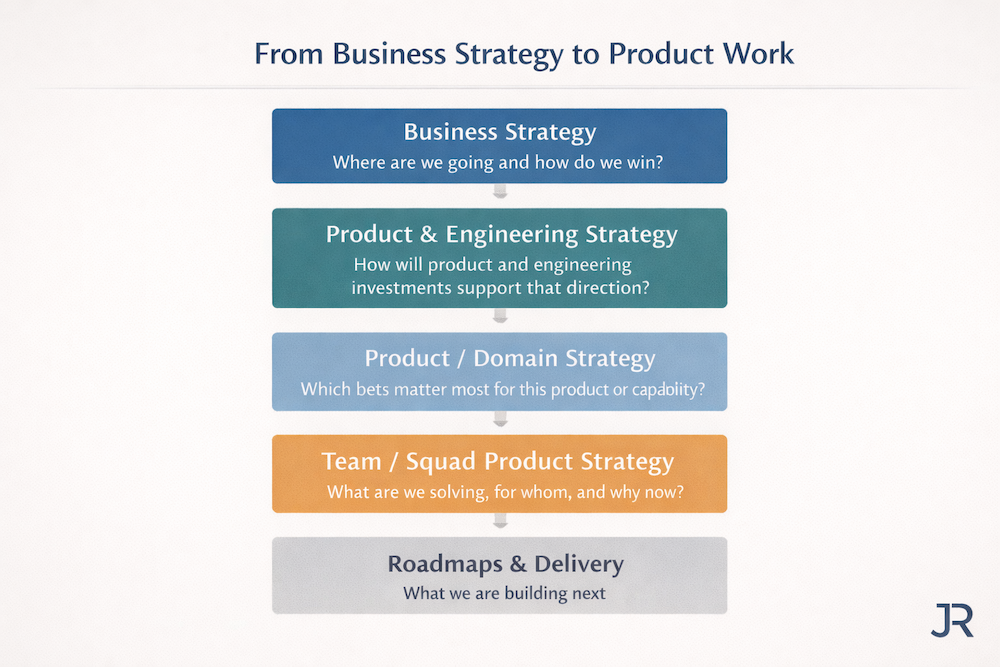
Effective product organizations deliberately define strategy at multiple levels:
Product & Engineering Strategy (company level)
Sets direction, investment themes, and major tradeoffs across the portfolio.Product-line or domain strategies
Translate that direction into focused bets for a specific set of products or capabilities.Team or squad-level product strategies
Clarify what this team is solving, for whom, and why now.
Alignment does not come from one strategy.
It comes from strategies that intentionally reinforce each other.
Much of how I think about this gap between intent and execution has been shaped by work like Start With Why and Good Strategy / Bad Strategy, both of which emphasize that strategy is about making deliberate choices, not just setting goals. I’ve written more about the books that shaped my thinking as a product leader separately.
The Hidden Gap Between Strategy and Work
When product strategy is missing or underdefined, teams still have to make decisions.
They just make them without shared constraints.
Strategy Without Explicit Choices
Many strategies avoid hard decisions.
They list priorities instead of choosing between them. Everything is important. Every initiative aligns somehow. Tradeoffs are implied but never made explicit.
Without clear choices:
Teams optimize locally
Conflicting priorities coexist
Strategy becomes descriptive rather than directive
This is how strategy slowly loses authority.
Strategy Without Constraints
Constraints are what make strategy actionable.
Without them:
Teams don’t know what not to do
Escalations increase
Decisions are constantly revisited as context shifts
What looks like indecision is often a lack of boundaries.
Strategy Without Decision Ownership
When strategy does not define who decides what, alignment depends on escalation.
Leaders become bottlenecks. Strategy discussions resurface in delivery forums. Decisions slow down not because teams are incapable, but because authority is unclear.
This is how strategy collapses under its own ambiguity.
Why Teams Are Forced to Interpret Strategy
From the outside, it can look like teams are ignoring strategy.
In reality, teams are often forced to interpret it.
Interpretation Is Not Alignment
Different teams interpret the same strategy through the lens of:
Their customers
Their metrics
Their incentives
Without shared decision principles, interpretation becomes fragmentation. Teams act rationally and still diverge.
Why Roadmaps Absorb the Ambiguity
When strategy is not operational, roadmaps inherit the burden.
They are asked to:
Explain priorities
Resolve tradeoffs
Communicate intent
Justify decisions to leadership
This is why roadmaps become overloaded and lose trust. They are being used as a substitute for strategy instead of a reflection of it.
What Effective Product Strategy Actually Does
Good product strategy does not try to answer every question.
It makes the important ones easier to answer.
Strategy Narrows the Field
Effective strategy clarifies:
Which problems matter most
Which customers are in focus now
Which opportunities are explicitly deprioritized
This is where discipline shows up.
Saying no becomes a strategic act, not a political one. Teams gain confidence that deprioritization is intentional, not arbitrary.
Strategy Defines Decision Boundaries
Strategy should tell teams:
What decisions they can make autonomously
When escalation is required
Which tradeoffs are acceptable under pressure
This is what enables speed without chaos.
Without decision boundaries, teams either hesitate or over-escalate. Both slow the organization down.
Strategy Connects Outcomes to Choices
Outcomes alone are not strategy.
Revenue targets, activation rates, or retention goals describe what success looks like, but not how the organization believes it will get there.
Strategy makes explicit:
Which choices the organization is betting on
Which risks it is knowingly accepting
Which tradeoffs are being made in pursuit of outcomes
When outcomes are disconnected from choices, success and failure both become ambiguous. Teams can hit numbers while drifting strategically, or miss numbers without understanding whether the bet itself was flawed.
That ambiguity is corrosive.
Strategy as an Operating System
Strategy fails when it only exists in decks.
Effective strategy functions like an operating system. It shapes how decisions are made when pressure is applied.
When a large customer asks for an exception, strategy should help answer whether that request reinforces or undermines the current direction.
When a competitive move creates urgency, strategy should guide whether to respond immediately or stay the course.
When new opportunities emerge mid-year, strategy should provide a way to recalibrate intentionally, rather than making silent exceptions.
The goal is not rigidity.
The goal is coherence under change.
Without this, reactive leadership behavior slowly erodes alignment, even when intentions are good.
How to Tell If Your Strategy Is Already Failing
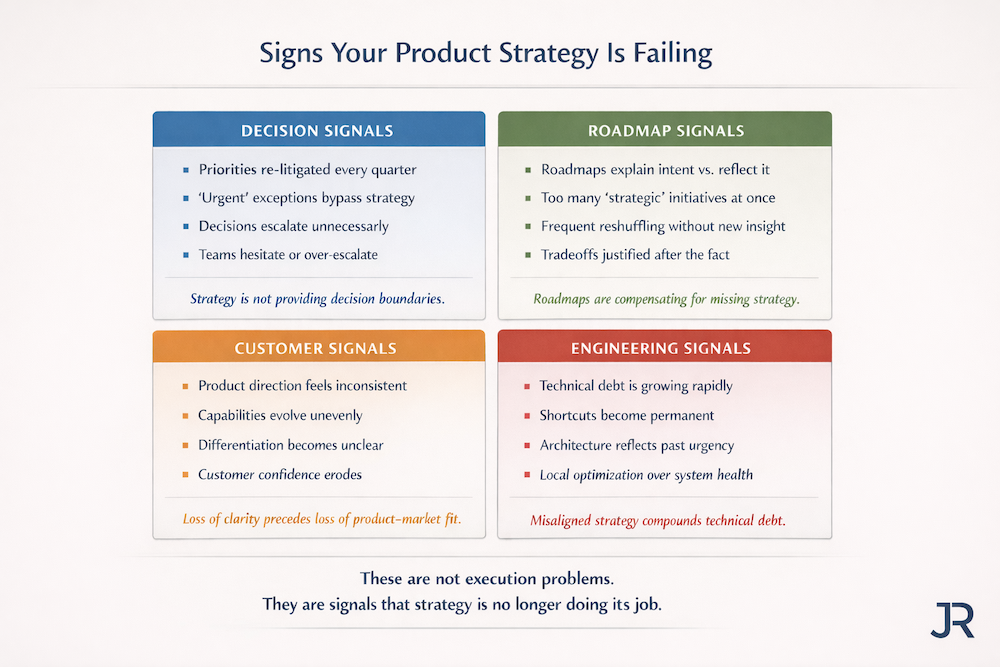
There are clear signals when strategy is no longer doing its job.
Priorities Are Constantly Re-litigated
When the same decisions resurface quarter after quarter, strategy is not providing sufficient guidance.
Re-litigation is usually a symptom of missing decision boundaries, not poor discipline.
Roadmaps Are Doing Explanatory Work
If roadmaps are used to justify intent rather than reflect it, strategy has already failed upstream.
Roadmaps should communicate what is planned, not compensate for unclear why.
Strategy Disappears After Planning
If strategy decks are rarely referenced once execution begins, they were never operational.
Strategy that cannot survive contact with real tradeoffs is not strategy.
Customers Feel the Inconsistency
Eventually, customers notice.
Product direction feels unclear. Capabilities evolve unevenly. Promises shift. The product no longer feels decisively better at what it claims to do.
The longer an organization deviates from its product strategy, the higher the risk of losing product-market fit. Customer satisfaction erodes. Attrition increases. Competitive differentiation weakens.
This is not a theoretical risk. It shows up in churn and lost trust.
Technical Debt Keeps Growing
Misaligned work almost always produces technical debt.
Shortcuts are taken to accommodate exceptions. Temporary solutions become permanent. Architecture reflects past urgency rather than deliberate design.
A balanced product strategy creates the space to pay down technical debt intentionally. When strategy erodes, technical debt compounds quietly until it constrains future options.
A Final Reflection
Strategy does not fail when teams miss deadlines.
It fails when teams never had enough clarity to make good decisions in the first place.
Product strategy is not optional. It is the connective tissue between business intent, product direction, and engineering investment.
When that connection is missing, execution takes the blame for problems that were baked in from the start.