

Product–Market Fit Isn’t Enough: Why Adoption and Retention Stall

Product–market fit is often treated as a milestone. Something you reach, announce, and then move past. In practice, most teams don’t lose momentum because they never found product–market fit. They lose momentum because they thought they had it.
I’ve worked with many teams who could point to evidence that looked convincing on the surface: customers signing contracts, users activating accounts, positive feedback from early adopters, even steady revenue. And yet, underneath that progress, something wasn’t holding. Adoption slowed. Retention flattened. Growth became harder to explain and harder to repeat.
When this happens, the instinct is usually to push forward. Add features. Expand the roadmap. Invest more in distribution. Rarely does the team pause and question whether their understanding of product–market fit is still valid.
That pause is often where the real work begins.
Why Product–Market Fit Breaks After Early Success
Early traction can be misleading. Not because it’s fake, but because it’s incomplete.
In the early stages of a product, interest and commitment are often conflated. People sign up because they’re curious, because the problem resonates in theory, or because the solution feels directionally right. Sales can compensate for gaps. Support can smooth over friction. Founders can personally ensure customers feel heard.
None of that guarantees that the product has become meaningfully embedded in a customer’s life or workflow.
Adoption answers a narrow question: Will someone try this?
Retention answers a much harder one: Will they keep using it when no one is nudging them?
Most teams discover the gap between those two answers later than they’d like. By the time retention becomes a concern, the product organization is already scaling, expectations are set, and the roadmap is full. Walking back assumptions at that point feels risky, even though not doing so is usually worse.
The PMF Alignment Loop
Instead of treating product–market fit as a static achievement, I think of it as a system that requires continuous alignment. When that alignment drifts, adoption and retention suffer, even if individual metrics still look healthy.
I call this system the PMF Alignment Loop.
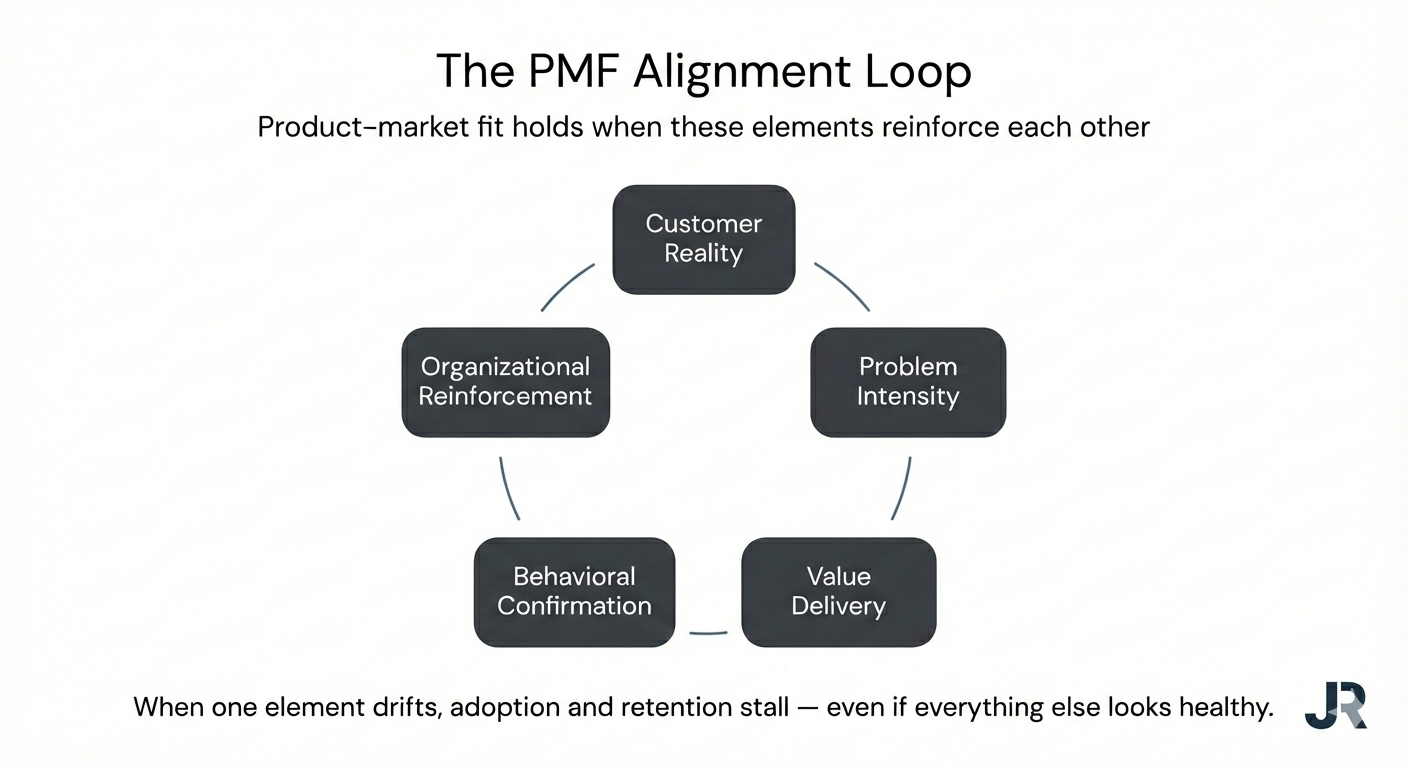
The loop consists of five interconnected elements. When they reinforce each other, product–market fit strengthens. When one breaks down, the entire loop weakens.
Customer Reality
Many PMF issues begin with a quiet mismatch between who the product was designed for and who is actually using it.
Early on, teams describe their customer broadly. This feels reasonable when you’re still learning. Over time, though, that broad definition becomes a liability. Different segments have different constraints, buying triggers, and expectations of value.
A product can work exceptionally well for one segment and poorly for another, even if both initially show interest. When teams ignore this reality, they end up optimizing for no one in particular.
Customer reality forces a harder question: Who consistently gets value from this product without special handling?
The answer is often narrower than expected. Accepting that narrowing is one of the most difficult and important moments in establishing real product–market fit.
Problem Intensity
Not all problems are equal.
Some are inconvenient. Some are aspirational. Some are painful enough that people will actively seek a solution and change their behavior to adopt it.
Problem intensity isn’t about how well a problem can be articulated in interviews. It’s about how often it occurs, how disruptive it is, and what people do today to cope with it.
A strong signal of problem intensity is substitution behavior. If users already spend time, money, or effort solving a problem with imperfect tools, that problem matters. If they acknowledge the problem but haven’t taken action, it probably doesn’t.
Products stall when teams build elegant solutions to low-intensity problems and then wonder why adoption never turns into habit.
Value Delivery
Value delivery is where many teams believe they’re strongest—and where subtle misalignment often hides.
It’s easy to equate value with features shipped. But customers don’t retain products because of features. They retain products because those features reliably produce outcomes they care about.
When value delivery is weak, teams often compensate by adding more functionality. Over time, this creates complexity without clarity. Users engage sporadically, but the product never becomes essential.
A useful test here is simple: Can users describe the value they get without referencing how the product works?
If not, the product may be impressive, but its value isn’t yet durable.
Behavioral Confirmation
Behavioral confirmation is where product–market fit becomes undeniable.
This is where you stop listening to what users say and start observing what they do. Do they return on their own? Do they incorporate the product into existing workflows? Do they notice when it’s unavailable?
Behavioral confirmation often exposes uncomfortable truths. Features that tested well go unused. Use cases teams were excited about never materialize. Retention varies dramatically across cohorts.
These signals aren’t failures. They’re feedback. The danger is ignoring them because they complicate the roadmap or contradict earlier narratives.
Organizational Reinforcement
The final element of the loop lives inside the organization itself.
Sales promises, onboarding flows, support processes, and internal incentives all shape how customers experience value. When these elements reinforce the product’s core value, fit strengthens. When they diverge, cracks appear.
A common pattern I see is a product that works well for a specific use case, paired with a go-to-market strategy that oversells its breadth. Customers arrive with expectations the product can’t meet, churn increases, and teams blame execution instead of alignment.
Product–market fit is not just a product problem. It’s an organizational one.
How PMF Misalignment Shows Up in Practice
When the PMF Alignment Loop weakens, it tends to show up in predictable ways:
Revenue without retention, driven more by effort than sustained value
Feature velocity masking unclear value
Validation by anecdote rather than behavior
A widening gap between what sales promises and what product delivers
A lot of teams interpret these symptoms as “we need to ship more” or “we need to market better.” Sometimes that’s true. More often, those moves increase activity without addressing the root issue: misalignment somewhere in the loop.
Market reality as a constraint on PMF
Product–market fit always exists inside a market. Teams get into trouble when their market story gets broader while their product reality stays narrow.
A big Total Addressable Market can justify ambition, but PMF lives in the Serviceable Addressable Market: the customers you can realistically win and retain with the product you have today.
When teams overestimate that breadth too early, they dilute focus, split the roadmap, and take longer to become essential to any one segment. A smaller market with strong retention is usually a better foundation than a huge market with weak pull.
Diagnosing and Correcting PMF Misalignment
Once teams accept that product–market fit is an alignment problem, the natural question becomes: How do we know where it’s breaking down?
This is where many teams either overcomplicate the work or avoid it entirely. They jump straight to solutions—new features, new positioning, new markets—without first understanding what’s actually misaligned.
When I work with teams on this, the goal isn’t to score product–market fit. It’s to surface uncomfortable truths quickly, while there’s still room to act.
What follows is a practical way to do that.
A Practical Way to Evaluate Product–Market Fit
This is the kind of session I typically run with product and leadership teams. You don’t need perfect data or elaborate tooling to get value from it—but you do need honesty.
Step 1: Establish customer and segment truth
Start by grounding the conversation in reality, not aspiration.
Look at:
Which customer segments retain consistently
Which segments churn early or require heavy support
Where usage patterns diverge meaningfully
The goal isn’t to defend your original ICP. It’s to understand who the product is actually working for today.
If your best-retained users don’t match the segment you’re optimizing for, that’s not a messaging problem. It’s a product–market fit signal.
A simple exercise that works well here is to build a “retention-first segment table”:
Segment name
Primary job-to-be-done
Activation behavior (what they do in week 1)
“Aha” moment (what indicates value)
30/60/90-day retention trend
Typical churn reason or failure point
You don’t need to perfect this. You need to stop debating based on opinions.
Step 2: Map intended value vs actual behavior
Next, compare what you believe users come to the product for with how they actually use it.
Ask:
What outcome do we think we deliver?
What do retained users actually do repeatedly?
What do churned users do once or twice and then stop?
Where do users fall back to spreadsheets, email, or manual workarounds?
Workarounds are especially revealing. They often point to gaps between promised value and delivered value—even when engagement metrics look healthy.
If you want one practical output from this step, build a simple two-column map:
“We believe value is…”
“Behavior suggests value is…”
The delta between those two is where PMF work lives.
Step 3: Identify the break(s) in the PMF Alignment Loop
Now explicitly tie what you’ve learned back to the loop.
Is customer reality too broad or drifting?
Is problem intensity lower than assumed (or only intense in narrow cases)?
Is value delivery partial, inconsistent, or hard to reach?
Is behavioral confirmation weak, uneven, or dependent on nudging?
Is organizational reinforcement creating expectation debt?
Most teams discover only one or two elements are truly broken. But those breaks are enough to stall adoption and retention.
A useful framing here is:
“Where are we asking customers to do extra work to get value?”
That extra work often lives exactly where the loop is misaligned.
Step 4: Define the smallest high-leverage correction
This is where teams tend to overreact. The goal isn’t a full strategy reset. It’s a focused correction that strengthens the loop.
Examples of high-leverage corrections:
Narrow the target segment (even temporarily) to strengthen Customer Reality
Simplify the core workflow to strengthen Value Delivery
Redesign onboarding around the real “Aha” moment to strengthen Behavioral Confirmation
Tighten sales promises to reduce expectation debt and strengthen Organizational Reinforcement
The best PMF corrections are usually boring on paper and powerful in practice.
Using AI to Accelerate Learning (Without Short-Circuiting Judgment)
AI can dramatically speed up PMF discovery, but only if it’s used in service of learning—not certainty.
Used well, AI helps teams see patterns they’d otherwise miss. Used poorly, it creates false confidence and accelerates the wrong decisions.
Where AI is genuinely useful
AI is particularly effective at:
Synthesizing qualitative feedback at scale
Combine churn notes, call transcripts, NPS verbatims, support tickets, and open-text surveys. AI can cluster themes and give you a first-pass taxonomy.Detecting patterns across cohorts
With the right data, AI can help you spot correlations: “retained users do X in week 1,” or “customers in segment Y churn after Z event.”Accelerating research synthesis
AI can summarize interviews, highlight repeated language, and surface contradictions worth exploring.Building a faster insight loop
Teams often have the data; they just can’t process it fast enough. AI shortens the distance between “we have signals” and “we have hypotheses.”
Where AI creates false confidence
The risk is treating AI outputs as conclusions.
Common failure modes:
Over-indexing on summaries without sampling raw inputs
Mistaking correlation for causation (“users who do X retain” isn’t always “X causes retention”)
Letting the tool define the narrative instead of testing hypotheses
Using AI to justify what the team already wants to believe
AI can tell you what shows up often. It can’t tell you what matters most.
How strong teams combine AI with judgment
Teams that use AI well follow a simple pattern:
AI surfaces themes and anomalies
Humans validate by sampling raw data and talking to users
Leaders choose a small set of bets and tradeoffs
Teams measure behavioral confirmation, not sentiment
AI strengthens the PMF Alignment Loop by improving visibility. It does not replace judgment.
What to Do After the Diagnosis
The hardest part of PMF work isn’t analysis. It’s restraint.
Once misalignment is visible, the instinct is to act everywhere at once—new features, new segments, new positioning, new experiments. That usually creates motion, not progress.
In practice, the most effective moves are often the narrowest:
Saying no to segments that are high-effort, low-retention
Simplifying the value proposition so users can internalize it quickly
Removing features that dilute focus or confuse first-time users
Realigning sales and onboarding around what actually works today
These decisions feel risky because they reduce optionality in the short term. In reality, they increase the odds of durable growth.
Product–Market Fit as a Leadership Responsibility
Product–market fit isn’t something teams “figure out” once. It’s something leaders continuously protect.
As products evolve, markets shift, and organizations scale, alignment degrades unless it’s actively maintained. Adoption and retention don’t stall because teams stop working hard—they stall because assumptions quietly drift out of sync with reality.
The work of product leadership is noticing that drift early, creating space to correct it, and keeping the loop intact.