
Hiring Your First Product Manager: What Most Get Wrong

One of the most common questions I hear from founders is whether it’s time to hire their first Product Manager. The question usually comes after something starts to feel off. Decisions take longer. Teams lose alignment. Roadmaps exist, but they no longer inspire confidence.
What’s interesting is that very few companies get this decision wrong because they hired a Product Manager too early. More often, they struggle because they hired one too late, hired the wrong profile for their stage, or expected a single person to fix problems that were never clearly defined.
Early on, it’s completely reasonable for founders, engineers, or project managers to carry product responsibilities. In fact, many successful companies start that way. The problem isn’t that those models are wrong. It’s knowing when they stop working — and what needs to change when they do.
This article breaks down the most common mistakes companies make when hiring their first Product Manager, how to recognize when you’re actually ready, and why structure and leadership matter just as much as the hire itself — especially in today’s AI-accelerated product environment.
The Early-Stage Illusion: “We Don’t Need a Product Manager Yet”
In the early days, not having a dedicated Product Manager often feels like a strength.
Founders are close to customers. Engineers move quickly. Decisions are made in real time. Roadmaps feel obvious, even if they’re informal. Shipping happens.
This works — until it doesn’t.
The illusion is subtle. Velocity remains high, but clarity starts to erode. Decisions require more meetings. Engineering asks why more often than what. Sales and customer success interpret priorities differently. The founder becomes the default bottleneck.
None of these are dramatic failures. They’re early signals that product decision-making has outgrown its original shape.
The problem isn’t that you lack product management. It’s that product management has become everyone’s secondary job.
Who’s Playing the Product Role Instead (And When It Works)
Before hiring a Product Manager, most companies rely on other roles to absorb product responsibilities. This is normal — and sometimes effective — as long as it’s temporary and intentional.
Founders Acting as Product Managers
This often works at the very beginning. Founders have vision, customer access, and authority. They can make fast, opinionated decisions.
It starts to break when context switching becomes constant, when strategy competes with execution, and when the founder becomes the only person who can resolve tradeoffs. The product doesn’t stall because the founder lacks insight, but because they lack bandwidth.
Engineers Acting as Product Managers
Strong engineering teams often step into product decisions naturally, especially in technically complex products. This can work when the problem space is clear and the customer is well understood.
It breaks down when customer empathy, prioritization across stakeholders, or long-term strategy becomes central. Engineering optimizes for solutions. Product leadership optimizes for outcomes.
Project Managers or Product Owners Filling the Gap
This model can improve execution discipline and delivery predictability. It’s useful when teams are struggling to ship.
But when product direction is unclear, this approach often turns roadmaps into task lists. The product becomes a delivery mechanism rather than a decision-making system.
All of these roles can temporarily absorb product responsibilities. None replace product leadership.
The Clear Signs You’re Ready for a Dedicated Product Manager
Companies rarely decide to hire a Product Manager because of a clean organizational milestone. The need usually shows up as friction.
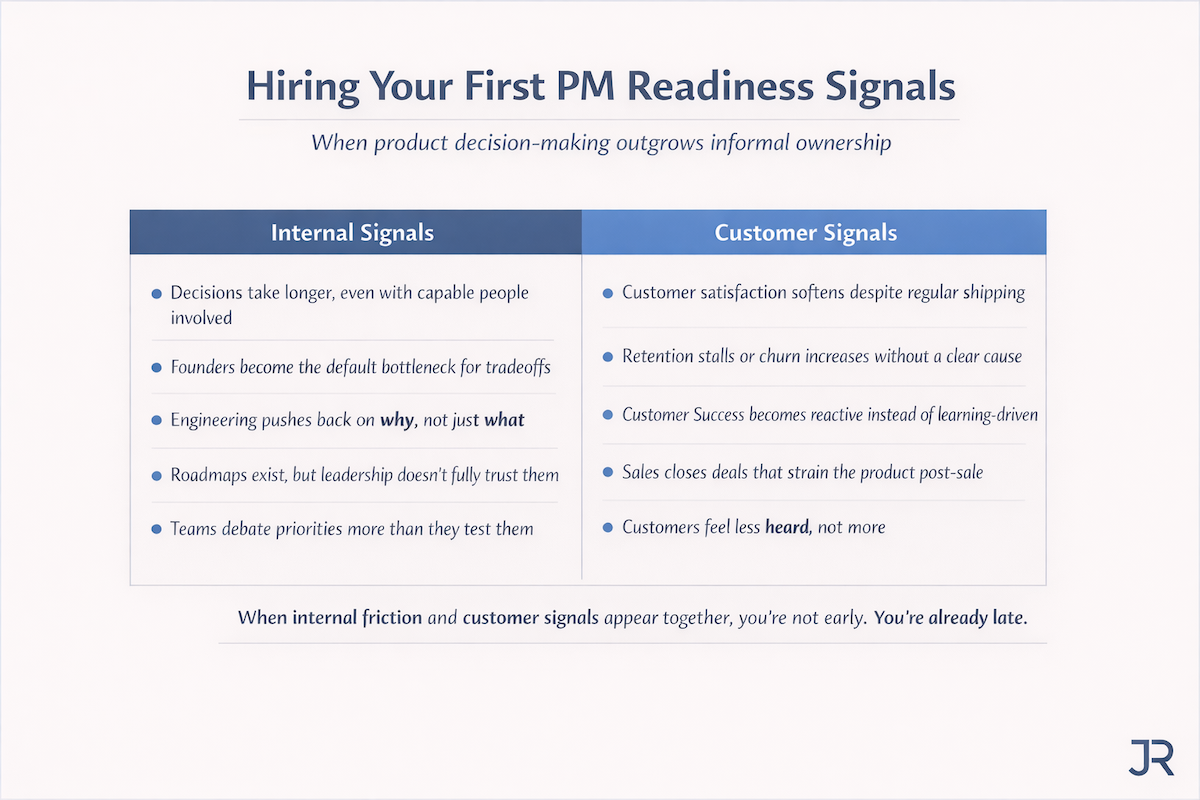
Internally, that friction looks familiar:
Decisions take longer, even with capable people involved
Engineering pushes back on priorities more often
Roadmaps exist, but leadership doesn’t fully trust them
Sales and customer success tell different stories about what matters
Founders feel pulled into every product decision
Teams debate priorities instead of testing them
But the clearest signals often show up outside the company first.
Customer satisfaction starts to soften, even though the team is shipping regularly. Retention stalls or churn creeps up without a single obvious cause. Customer success becomes reactive, spending more time explaining decisions than learning from customers. Sales closes deals that technically fit, but strain the product once onboarded.
This is usually where teams misdiagnose the problem.
They assume they need better execution, more features, or tighter delivery. In reality, they’re missing a system for turning customer signal into coherent product decisions. That’s the moment when product management stops being a shared responsibility and needs to become a dedicated one.
If several of these patterns feel familiar, you’re not early. You’re already late.
Product Manager or Product Leader First? The Question Everyone Gets Wrong
Once teams accept they need product management, the next question is whether to hire a Product Manager or a Head of Product first.
In most early-stage organizations, hiring a hands-on Product Manager is the right move. Early teams need someone doing the work: talking to customers, framing problems, making tradeoffs, and turning ambiguity into decisions. What they don’t need yet is distance.
Where companies get into trouble is hiring a senior, hands-off product executive too early and expecting strategic clarity to emerge by default.
I’ve seen this play out more than once. The Product Leader is disconnected from customers almost immediately. Their primary output becomes org design instead of product decisions. The most consistent request is to hire additional layers beneath them. Meanwhile, a lack of technical fluency makes it difficult to engage credibly with engineering, and trust erodes quietly.
The result isn’t stronger product leadership. It’s heavier structure without better outcomes.
That doesn’t mean product leadership isn’t needed early. It means the shape of that leadership matters. Early teams need judgment, context, and direction more than hierarchy. This is where fractional product leadership often fits best: setting strategy, establishing decision guardrails, and transferring judgment while PMs stay close to the work.
The goal isn’t to avoid leadership. It’s to avoid abstraction before fundamentals exist.
The Most Common First-PM Hiring Mistakes
Many companies already hired their first Product Manager — and it didn’t go well. That doesn’t mean hiring a PM was the wrong decision.
It usually means the hire didn’t match the reality of the job.
Mistake #1: Hiring for Seniority Instead of Fit
One of the most common traps is equating seniority with readiness.
Titles don’t translate cleanly across companies, especially in product. A “Senior PM” from a scaled organization may be highly effective within clear strategy, mature processes, and stable teams, yet struggle when faced with ambiguity, missing context, and constant tradeoffs. At the same time, a mid-level PM from a smaller environment may thrive precisely because they’re used to operating without guardrails.
The mistake isn’t hiring someone who is too junior or too senior. It’s hiring someone whose experience doesn’t map to the problems you actually need solved.
Early product roles are rarely about optimization. They’re about sense-making. They require comfort with incomplete data, the ability to navigate conflicting inputs, and the judgment to decide without consensus. When a PM’s prior experience has been shaped primarily by execution within an existing system, the transition can be disorienting.
This is why many first PM hires look strong on paper but struggle in practice. Not because they lack talent, but because the role demands a different kind of maturity than their resume signals.
Mistake #2: Hiring the Wrong Type of Product Manager
Product Managers are not interchangeable, especially early on.
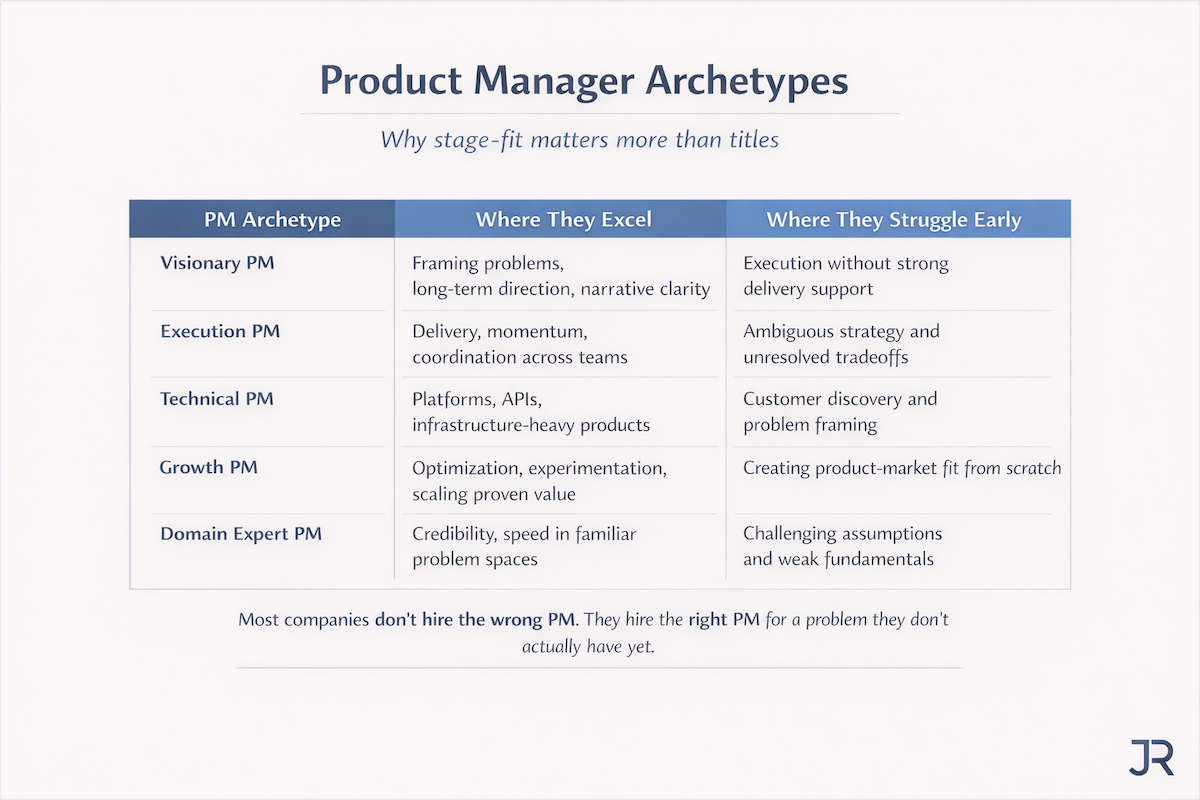
Most companies underestimate how much the shape of the PM role changes based on stage. Different environments reward different strengths, and hiring without acknowledging this often leads to quiet misalignment.
Some common archetypes show up repeatedly:
Visionary PMs excel at framing problems and long-term thinking, but often struggle when execution systems are weak or support is limited.
Execution PMs drive momentum and delivery, but falter when strategy is unclear or tradeoffs require deeper product judgment.
Technical PMs thrive in platform-heavy or infrastructure contexts, but may underinvest in discovery or customer-facing problem spaces.
Growth PMs are effective once product-market fit exists, but are poorly suited for creating it from scratch.
Domain Expert PMs bring credibility and speed early on, but can unintentionally mask weak product fundamentals or shortcut discovery.
The failure here isn’t misjudging talent. It’s misdiagnosing the problem.
Most companies don’t hire the wrong PM. They hire the right PM for a problem they don’t actually have yet. By the time the mismatch becomes obvious, trust has eroded and momentum has already been lost.
Early on, getting the type right matters more than getting the title right.
Mistake #3: Treating the First PM as a Structural Fix
One of the most common and least discussed mistakes is hiring a first PM to compensate for deeper organizational gaps.
A single Product Manager cannot fix unclear strategy, misaligned incentives, or unresolved leadership tension. They can’t create authority where none exists, or alignment where decisions are constantly revisited. When these conditions are present, the PM role quietly turns into an absorber of organizational debt.
At first, this looks manageable. The PM documents more, runs more meetings, and tries to create clarity through process. Over time, frustration builds on both sides. Progress feels slower, not faster. The PM becomes a messenger instead of a decision-maker.
This is where many companies make the second mistake: blaming the PM.
Roadmaps stall. Discovery feels shallow. Stakeholders bypass product to get work done. From the outside, it looks like a hiring failure. In reality, the system never gave the PM a chance to succeed.
Replacing the PM without changing the environment rarely fixes the problem. It just resets the clock.
How These Mistakes Show Up in Real Teams
When the underlying system isn’t designed to support product decision-making, the signals are easy to miss but hard to ignore.
Roadmaps change constantly, but outcomes don’t improve
Priorities shift based on the loudest voice, not the strongest evidence
Discovery exists, but it doesn’t meaningfully influence direction
Stakeholders go around product instead of through it
The PM is busy, exhausted, and increasingly ineffective
These are often interpreted as performance issues. More often, they’re symptoms of missing context, unclear authority, and unresolved leadership decisions.
If you recognize these patterns, the question isn’t whether your PM is strong enough. It’s whether the environment you’ve built allows any PM to do the job you’re asking them to do.
A Practical Framework for Hiring Your First PM
Before opening a role, it’s worth slowing down and designing the system this person will operate within.
Start by getting clear on a few fundamentals:
Your stage and near-term goals
The types of problems you actually need solved
The decisions this PM will own outright
What success looks like six months in
Clarity here reduces failure far more than interview rigor.
From there, evaluate candidates based on how well they match the reality of the role, not the title on their resume.
The PM Skills That Matter on the Job (AI or Not)
Some skills have always mattered and still do:
Framing ambiguous problems
Developing real customer empathy
Owning decisions and their consequences
Making and communicating tradeoffs clearly
Others have become more important as tools evolve:
Rapid prototyping to make ideas tangible
Synthesizing research and signal at scale
Using AI to explore options, not shortcut thinking
What matters less than it used to are memorized frameworks, tool-specific expertise, or feature ideation without context. Early PMs are paid for judgment, not output volume.
What to Evaluate When Hiring a PM in the AI Era
AI hasn’t changed what makes a great PM, but it has changed how great PMs work.
The question isn’t whether candidates “use AI.” It’s how they use it.
Strong PMs use AI to:
Synthesize research faster
Explore multiple solution paths
Prototype flows and concepts quickly
Stress-test assumptions
Prototyping has become especially important. PMs don’t need to design production interfaces, but they do need to make ideas concrete quickly enough to drive meaningful conversations with customers, design, and engineering.
Case Studies Matter More Than Ever
Case studies still matter, but only if they evolve.
AI should not only be allowed, but expected. What you’re evaluating is judgment:
How they frame the problem
What assumptions they surface
How they make tradeoffs
How they respond to feedback
In an AI-enabled world, case studies should reveal thinking, not artifacts.
Setting Your First PM Up for Success After They Join
The fastest way to fail a first PM is to hire them and then disappear.
Early PMs need:
Strategic context
Decision guardrails
Regular coaching and feedback
Air cover while learning the organization
They need to know where authority lives and how tradeoffs get resolved.
This is another place where fractional product leadership fits naturally, not as a replacement for PMs, but as scaffolding. Direction, mentorship, and judgment early on create space for PMs to build momentum instead of absorbing chaos.
Getting the First Hire Right Is About Design, Not Timing
Hiring your first Product Manager isn’t about following a playbook or hitting a milestone. It’s about designing the right system for product decisions to happen well.
When that system exists, the right PM thrives. When it doesn’t, even great PMs struggle.
The goal isn’t to hire faster. It’s to hire someone who can succeed in the organization you’ve actually built — or are willing to build.