

When Roadmaps Stop Working: Why Leadership Doesn’t Trust the Plan

There’s a moment I’ve seen play out in almost every company I’ve worked with.
A roadmap is presented to leadership. Slides are clean. Timelines are clear. Initiatives are neatly grouped by quarter. Heads nod. A few clarifying questions get asked.
And then—quietly—the roadmap stops being used.
Decisions start happening elsewhere. Priorities shift in side conversations. Executives override plans they approved weeks earlier. Teams leave frustrated, convinced leadership lacks discipline or keeps changing its mind.
What’s actually happening is more uncomfortable.
Leadership doesn’t distrust roadmaps because they hate planning. They distrust them because experience has taught them that shipping what’s on the roadmap doesn’t reliably lead to customer impact.
The roadmap isn’t wrong. It’s unanchored from reality.
The Roadmap Trust Gap
When leaders say they want a roadmap, they usually mean something simple: clarity. They want to understand where the product is headed, why those bets matter, and what success would look like if things go well.
What they often get instead is a list of work.
On paper, the roadmap looks reasonable. Initiatives are prioritized. Dependencies are mapped. Delivery windows are defined. From the team’s perspective, this is the plan.
But trust starts to erode when leaders can’t answer a few basic questions by looking at it:
Why this work, for these customers, right now?
What problem is actually being solved?
What changes if this succeeds?
How will we know if it didn’t?
When those answers aren’t visible, leaders do what they’ve learned to do. They hedge. They ask for changes. They inject new priorities. They bypass the roadmap entirely when pressure mounts.
From the outside, this looks like chaos. From the inside, it’s a rational response to uncertainty.
Trust breaks not because the roadmap is incomplete, but because it explains what will be built without explaining why it should matter to customers.
Roadmap Theater vs. Product Strategy
Roadmap theater is easy to spot once you know what to look for. What’s harder—and more important—is understanding what it’s replacing.
What Roadmap Theater Looks Like
Roadmap theater is polished and reassuring.
It’s feature-heavy. Timelines are precise. Everything feels accounted for. Each quarter is full, and nothing looks risky.
What’s missing is substance.
Outcomes are vague. Customer problems are implied rather than named. Discovery work is invisible or assumed. Success is defined as delivery, not adoption or retention.
The roadmap is designed to signal alignment and confidence, not to guide real decisions.
What Product Strategy Actually Does
Product strategy exists to make choices visible.
A real product strategy is not a vision statement or a list of goals. It’s a set of explicit decisions about who the product is for, which problems matter most, and which tradeoffs the company is willing to accept.
Where roadmap theater tries to eliminate uncertainty, product strategy acknowledges it—and narrows it.
Strong product strategy does a few critical things:
It names the customer segment that matters now, not eventually
It clarifies which problems are worth solving and which are consciously ignored
It defines what success should change for the customer
It creates constraints that make prioritization possible
When strategy is absent or implicit, roadmaps fill the void. They become artifacts of reassurance instead of expressions of intent. The more uncertain the organization feels, the more detailed the roadmap becomes.
That detail doesn’t create trust. Direction does.
The Missing Voice: Customers Aren’t in the Roadmap
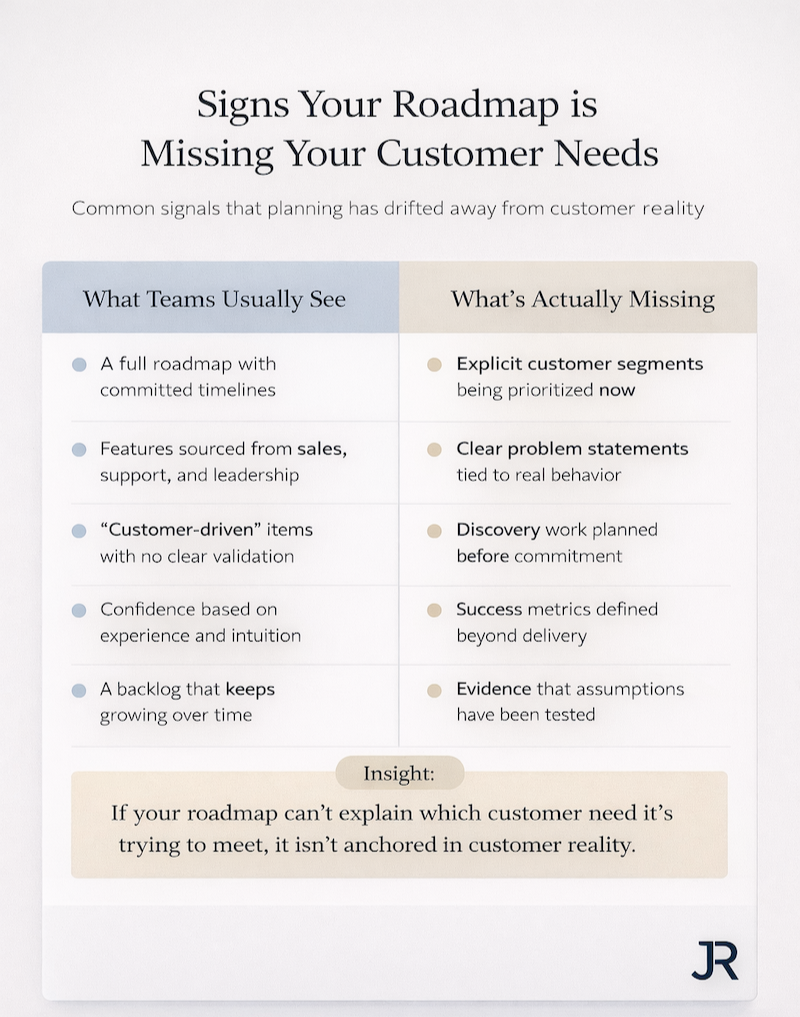
Most teams believe their roadmap is customer-driven.
Items come from sales requests, support tickets, executive ideas, and feedback collected over time. Everything feels grounded in “real input.”
The problem isn’t intent. It’s proximity and bias.
Teams are not their customers—no matter how experienced they are, how long they’ve worked in the industry, or how confident they feel about the problem space. Even founders who stay close to customers inevitably see the world through a partial lens.
One pattern I see often is over-indexing on the loudest customers. A single large client. A vocal design partner. A CEO’s trusted relationship. These connections feel valuable—and they are—but they’re also dangerously distorting when they become proxies for the broader customer base.
In one company I worked with, the CEO had a deep, direct relationship with a single customer. The intention was good: staying close to real pain. The outcome was biased prioritization. Requests from that one customer consistently outweighed signals from quieter segments that represented far more long-term value.
Over time, the roadmap optimized for familiarity, not impact.
This is how roadmaps drift away from customer reality without anyone explicitly deciding to do so.
Discovery is treated as optional. Validation happens after commitment. PMs are expected to execute plans, not challenge whether the right problems are being solved.
The result is predictable: features ship, customers don’t change their behavior, and leadership starts questioning why the roadmap didn’t deliver what it promised.
A roadmap without structured customer discovery isn’t a strategy artifact. It’s an execution plan built on untested assumptions.
What a Product Roadmap Actually Is (and Isn’t)
Once the customer gap is visible, it becomes easier to reset expectations.
What a Product Roadmap Is
A real product roadmap is a decision artifact, not a delivery checklist.
Calling it a decision artifact means it captures what the organization has decided to bet on, given what it knows today. It makes tradeoffs explicit. It shows intent, not certainty.
This is where roadmaps differ from product strategy.
Product strategy defines the playing field: who the customer is, which problems matter, and what success should change. The roadmap translates those strategic decisions into a sequence of bets the team is willing to stand behind.
A good roadmap answers:
Why these problems, for these customers, now?
What are we choosing not to do?
Where are we intentionally leaving room to learn?
How Flexible a Roadmap Should Be
Roadmaps need commitment, but not false precision.
In most organizations, meaningful confidence rarely extends beyond a quarter. Planning further than that is possible, but it requires discipline, shared context, and trust in how decisions are made.
Teams that struggle with roadmap trust often jump straight to six- or twelve-month plans without having built the muscle to commit credibly at a shorter horizon. The result is predictable: plans look comprehensive, but reality forces constant rewrites once execution begins.
Strong teams earn longer planning horizons over time. They start with quarterly clarity. As the organization learns to honor commitments, revisit assumptions explicitly, and protect discovery, extending to six and eventually twelve months becomes feasible.
Flexibility doesn’t mean instability. It means acknowledging what is known, what is assumed, and what must be validated.
What a Product Roadmap Is Not
A roadmap is not a backlog. It’s not a project plan. It’s not a delivery contract.
If your roadmap is indistinguishable from your task tracker, you don’t have a roadmap. You have a list of work with dates attached.
And lists of work don’t earn trust.
The Strategy → Roadmap → Discovery → Execution → Launch Cascade
When roadmaps fail, it’s rarely because teams skipped planning. It’s because they skipped layers—or confused them entirely.
A common source of confusion is the word strategy itself.
Many companies say they have a product strategy when what they actually have is a business strategy or an operating plan. Revenue targets, market expansion goals, and growth plans matter—but they don’t substitute for product strategy.
Product strategy exists at the intersection of customer value and business intent. It translates business goals into product decisions.
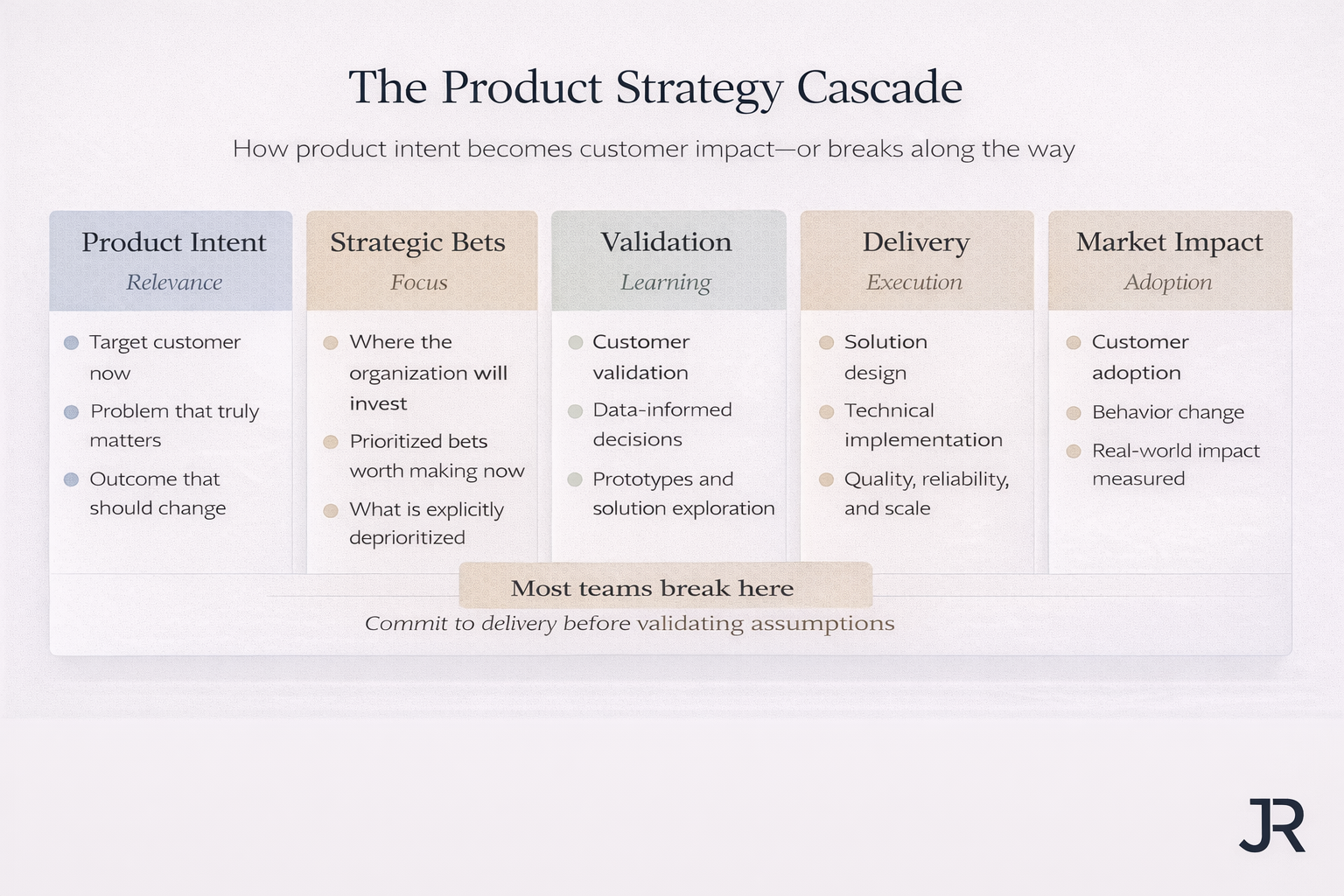
I think of this as a cascade, where each layer depends on the one above it. In practice, I think about these layers as intent, bets, validation, delivery, and impact—each reducing a different kind of risk as decisions move closer to customers.
1. Product Strategy
Product strategy answers why—and for whom.
Who are we building for right now? What problem matters most to them? Why is this problem worth solving at this moment? What outcome would meaningfully change their behavior?
Without explicit product strategy, teams inherit assumptions they never agreed to—and roadmaps become reactive.
2. Product Roadmap
The roadmap translates product strategy into prioritized bets.
It answers where we will focus and what we are deliberately deprioritizing. It communicates intent, not guarantees.
When strategy is weak or implicit, roadmaps turn into collections of ideas competing for attention.
3. Validation & Shaping (Discovery & PRDs)
This is where customer reality and data must enter decisively.
Discovery exists to validate assumptions before execution. It combines qualitative insight, quantitative data, and clear success metrics. PRDs, when used well, define the problem to be solved, the constraints that matter, and how success will be measured.
Decisions here should be informed by data whenever possible—not to eliminate judgment, but to ground it.
When discovery is rushed or skipped, execution becomes efficient at delivering the wrong thing.
4. Solution Delivery (Execution)
Execution builds the solution.
This is where teams are usually strongest—and where they’re often over-relied on. Great execution cannot compensate for weak discovery or unclear strategy.
5. Product Launch
Launch is where assumptions meet reality—and impact becomes visible.
It’s not the end of the process. It’s a learning checkpoint. Without success metrics defined earlier, launches generate activity but little insight.
Most roadmap failures trace back to missing or undervalued product strategy and discovery. The consequences simply surface later.
How Leaders Actually Evaluate Roadmaps
Leaders rarely say this explicitly, but when they review a roadmap, they’re asking a small set of questions:
Why this, not something else?
Why now?
What are we betting on?
How will we know if it worked?
If it fails, will we understand why?
Completeness doesn’t answer these questions. Clarity does.
Roadmaps earn trust when they reduce decision fatigue—when leaders can stop re-litigating priorities because the reasoning is visible and shared.
Rebuilding Trust in a Broken Roadmap
Trust isn’t rebuilt by adding more detail or tightening timelines. It’s rebuilt by reintroducing shared understanding.
A Roadmap Reset Session (90 Minutes)
Inputs
Current roadmap
Key customer segments
Recent adoption and retention data
Known assumptions
Who Must Be in the Room
Product
Engineering
Leadership
At least one GTM or Customer Success representative
Outputs That Matter
Clear strategic intent
Explicit assumptions
Discovery work visible on the roadmap
Defined success metrics
Signals You’re Back on Track
Fewer escalations and overrides
Better questions instead of more requests
Discovery work planned and protected
Roadmap referenced, not bypassed
Teams talking about outcomes, not just delivery
Closing Reflection
Roadmaps don’t fail because teams can’t plan.
They fail because strategy is implicit, learning is undervalued, and customer reality is assumed rather than tested.
Trust isn’t rebuilt with more certainty. It’s rebuilt through shared understanding—of who the customer is, what problem matters, and how success will be measured.
When roadmaps become tools for learning, not just planning, leadership starts trusting the plan again.