

Free Trial to Paid: Why Most Software Products Lose Users Before They See Value
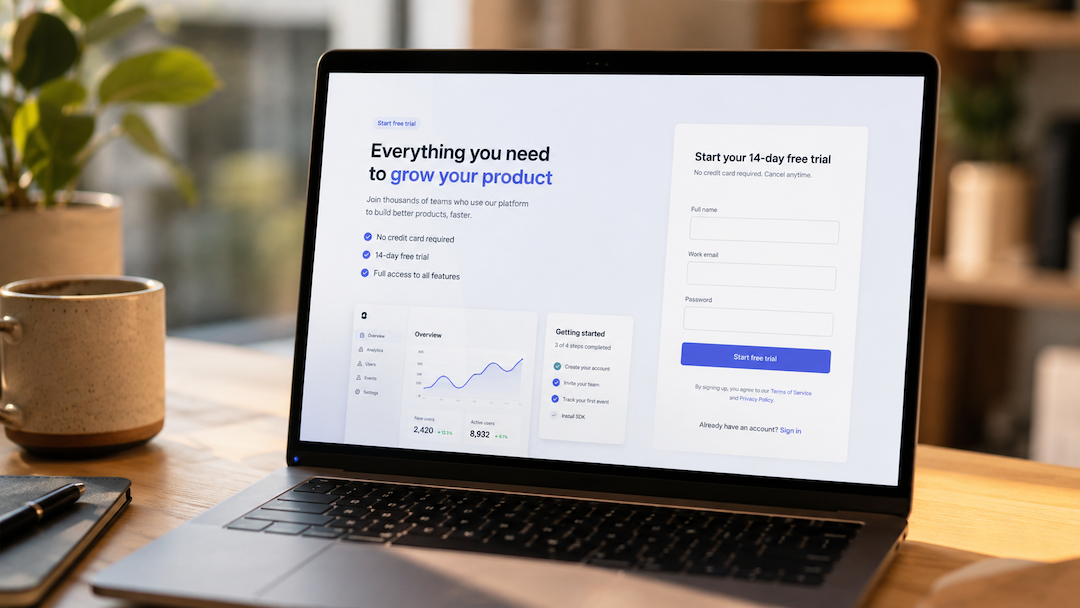
Most teams treat free trial to paid conversion as a pricing or paywall problem. They redesign the upgrade screen, add a discount, send a "your trial ends soon" email, and watch the number barely move. The reason it barely moves is that the decision to convert was lost days earlier — in the gap between when a user signs up and when they understand why your product exists for them. That gap is where trials die. This article breaks down the three failures that produce a low SaaS trial conversion rate, compares the five trial models you can actually choose between, and gives you a way to diagnose which gap is costing you the most.
What a Healthy Free Trial to Paid Conversion Rate Looks Like
Before diagnosing a problem, you need a baseline. Free trial conversion rates vary widely by motion, and comparing yourself to the wrong benchmark leads to the wrong fixes.
Opt-in free trial (no credit card): 1%–10% of signups convert to paid. The wide range reflects how much unqualified traffic enters the top.
Opt-out free trial (credit card required): 30%–60% convert, but you start with far fewer trials because the card requirement filters intent up front.
Freemium: 1%–5% of free users convert to paid over time, with conversion measured on a longer horizon than a fixed trial window.
Reverse trial (premium access that downgrades to free): typically lands between opt-in and freemium, depending on how much value sits behind the paid tier.
The number itself matters less than the comparison. A 4% opt-in conversion rate is healthy; a 4% opt-out rate signals a serious problem. The diagnostic question is not "is our rate good" but "is our rate good for the motion we chose."
The Activation Gap: Why Users Quit Before Free Trial Conversion Happens
Activation is the point at which a user experiences the value your product promised. Conversion is a lagging indicator of activation — users who reach value convert at a high rate, and users who never reach it convert at close to zero regardless of how good your pricing page is. When trial conversion is low, the problem almost always sits in one of three activation gaps.
The Value Gap: Users Never Reach the "Aha" Moment
The value gap is the distance between signup and the first experience of real usefulness. A user who imports a dataset but never runs the analysis, or who creates an account but never invites a teammate, has not reached value. They will let the trial expire because nothing in their experience told them what they would lose.
The mechanism is straightforward: the product optimizes for breadth of features rather than a clear path to a single meaningful outcome. The fix is to define the one action that correlates with retention and engineer the trial to drive every user toward it.
The Friction Gap: The Path to Value Is Too Long or Too Hard
The friction gap is the accumulated cost of getting from signup to value: setup steps, integrations, data entry, configuration, and approvals. Each step loses a percentage of users. A trial that requires connecting three systems before anything works will lose most users at the connection stage, no matter how strong the eventual payoff.
Friction is not always removable, but it is almost always reducible. Sample data, templates, guided setup, and progressive disclosure all shorten the path. Strong onboarding best practices exist precisely to compress this gap rather than decorate it.
The Expectation Gap: Users Activate, but Not on the Thing They Came For
The expectation gap is the mismatch between what marketing promised and what the product delivers first. A user who arrives expecting one outcome and is routed toward a different one will disengage even after technically "activating." This is the most overlooked gap because the usage metrics can look fine while conversion stays flat.
This failure usually traces back to misaligned inputs across teams: marketing sets one expectation, product delivers another, and no one owns the contradiction. It is the same structural problem that appears when customer feedback fails to influence product decisions — signal exists, but the organization is not wired to act on it.
Closing the friction gap starts with the first session. See the SaaS onboarding best practices that shorten time-to-value.
The 5 Free Trial Models (and Which Fits Your Product)
There is no universally correct trial model. Each one trades volume for intent, or speed-to-value for qualification. The right choice depends on how long your product takes to deliver value and how your buyers expect to evaluate software.
| Trial Model | How It Works | Best Fit | Pros | Cons |
|---|---|---|---|---|
| Opt-in free trial | Time-boxed full access, no card | Fast time-to-value, self-serve SMB | High top-of-funnel volume | Low intent; many tourists |
| Opt-out free trial | Card required up front, auto-converts | Products with clear, immediate value | High conversion %; qualified users | Smaller funnel; trust cost |
| Freemium | Free tier forever, paid unlocks more | Network or usage-based products | Continuous adoption; long runway | Long, low conversion; support load |
| Reverse trial | Premium first, downgrades to free | Value lives in paid features | Shows full value before asking | Users may settle on free |
| Sales-assisted trial / POC | Scoped pilot with success criteria | High-ACV, complex Enterprise | High close rate; aligned expectations | Expensive; does not scale unattended |
Two rules narrow the choice quickly. First, the longer your product takes to deliver value, the more you should bias toward models that guarantee a human or a structured path gets the user there — freemium and unattended opt-in trials punish slow-to-value products. Second, the higher your price, the more your buyer expects evaluation to be a process rather than a self-serve click, which pushes you toward reverse trials or sales-assisted pilots.
Self-Service vs. Sales-Led Trials: Matching the Model to Your ICP
The same product can need two different trial motions for two different customer segments. Forcing one motion onto both is a common cause of a depressed blended conversion rate.
Self-service / PLG trials for SMB:
Public pricing, instant signup, no human in the loop.
Low average contract value, high volume, conversion measured in days.
Success depends entirely on closing the value and friction gaps, because no salesperson is there to bridge them.
Sales-led / POC trials for Enterprise:
Scoped pilots with defined success criteria, security and compliance review, and negotiated terms.
High ACV, low volume, evaluation measured in weeks.
Success depends on aligning expectations up front, which is where the expectation gap is closed deliberately rather than hoped away.
If your ICP spans both, run both motions and measure them separately. A blended trial conversion rate that mixes self-serve SMB tourists with sales-qualified Enterprise pilots will hide which motion is actually working.
Trial Conversion Is the Start of Revenue, Not the End
Converting a trial is the beginning of the account's revenue trajectory, not the finish line. The activation gap you close during the trial determines what happens after.
Expansion: Users who activate on the core value during the trial are the ones who later expand — adding seats, increasing usage, or upgrading tiers. Activation quality is the leading indicator of net revenue retention.
Contraction and churn: Users who convert without truly activating — because of a discount, a deadline, or an auto-charging card — are your downgrade and churn risk. They paid once and never built the habit that justifies renewal.
A high conversion rate built on weak activation produces a renewal problem one cycle later. The metric to protect is not "converted," but "converted and activated."
How to Diagnose Where Your Trial Loses Users
Use this sequence to locate the dominant gap before you change anything. Run it in order; the first stage that shows a steep drop is where to focus.
Define the activation event. Identify the single action that best predicts a user keeps using the product. If you cannot name it, that is the first problem to solve.
Measure signup → activation. What percentage of signups reach that event? A low rate here points to a value or friction gap.
Measure activation → conversion. Of users who activate, what percentage convert? A low rate here points to pricing, packaging, or an expectation gap.
Find the steepest single drop in the setup path. Instrument each step from signup to activation. The step with the largest drop is your highest-leverage friction point.
Read the expectation gap qualitatively. Talk to five users who activated but did not convert. If they describe a different problem than the one your marketing promised, the gap is expectation, not value.
The decision rule that falls out of this: if signup-to-activation is low, fix the product path before touching pricing; if activation-to-conversion is low, fix packaging and expectations, not the onboarding flow. Most teams do the opposite — they tune the paywall while the real loss is happening three steps upstream.
A trial conversion problem is rarely a single broken thing. It is the cumulative result of a product that has not decided, clearly, what value it owes each user and how quickly it will deliver it. The teams that fix conversion durably are the ones that treat the trial as the product's argument for itself — and make that argument land before the clock runs out. This is, at root, a product strategy question: what outcome are you promising, to whom, and how fast can the product prove it.
If your free trial to paid conversion is stuck, the cause is usually upstream of the paywall. I help SaaS teams locate the real activation gap and fix it before it shows up in renewals.
Talk Through Your Trial Funnel →