
SaaS Onboarding Best Practices: Why Your First 7 Days Determine Whether Users Stay

A SaaS company with a persistent churn problem often has a misdiagnosed onboarding problem. New users sign up, open the product a few times across the first week, and quietly stop returning. Support sees nothing alarming. The interface tested well in usability sessions. The team adds a tooltip sequence, rewrites the welcome email, and churn holds steady.
The interface was not the problem. Users left because the product never gave them a demonstrable reason to stay. They reached no moment where the product's core value was personally confirmed. Without that moment, the subscription is a hypothesis the user formed at signup — and the hypothesis expired before it was verified.
Persistent early churn is almost always a failure to deliver first value, not a failure of interface design. That distinction changes everything about where to look and what to fix.
What Onboarding Is Actually Supposed to Do
Onboarding has one job: get the user to their first moment of value as quickly as possible.
Every element of the onboarding experience — welcome flows, empty state copy, in-app checklists, tooltips, email sequences, setup wizards — is either accelerating or slowing the path to that moment. There is no neutral onboarding element. Each step either moves the user toward first value or adds friction before they get there.
The problem is that most SaaS products have not explicitly defined what their moment of value is before designing the onboarding experience. The team has defined the features. They have defined the setup steps. What they have not defined is the specific action the user must take for the product to become real to them.
Without that definition, onboarding is decorative. It creates the appearance of a guided experience while leaving the product's most important question unanswered: has this user experienced what the product actually does?
How to Find Your SaaS Onboarding Failure Point
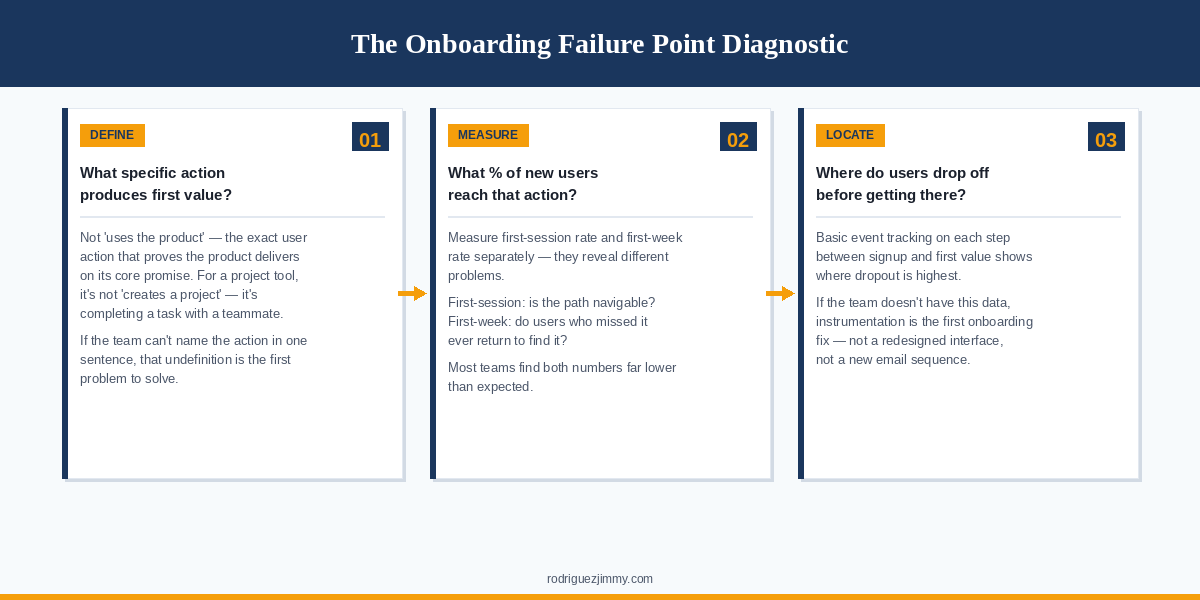
Before any onboarding redesign begins, the team needs to diagnose where the current experience is breaking. Three questions structure that analysis.
Question 1: What specific action produces first value?
Not "uses the product." The precise action. For a project management tool, first value is not "creates a project" — it is completing a workflow: creating a task, assigning it to a teammate, and marking it complete together. That is the moment the product proves it solves the collaboration problem it promises to solve.
For an analytics SaaS, first value is not "connects a data source." It is viewing a report that answers a question the user actually had before they signed up. Define it that specifically. If the team cannot name the action in a single sentence, the moment of value is itself underdefined — and that is the problem to address before any onboarding work begins.
Question 2: What percentage of new users reach that action?
Measure within the first session and within the first week separately. Both numbers matter and reveal different structural problems. First-session rate reveals whether the onboarding path is navigable at all. First-week rate reveals whether users who did not reach value in session one ever returned to find it.
Most teams that run this analysis find the numbers significantly lower than expected. A product with a 25% first-week activation rate and high churn does not have a welcome email problem. It has a structural funnel problem.
Question 3: Where do users drop off before getting there?
Product analytics — even basic event tracking on each step between signup and first value — will show this. Which step has the highest abandonment rate? What percentage of users who reach step three reach step four?
If the team does not have this data, instrumentation is the first onboarding fix. Not a redesigned interface. Not a new email sequence. Tracking the steps in the path to first value is the prerequisite to fixing any of them.
The PLG Onboarding Funnel: What the User Journey Actually Looks Like
In a product-led growth (PLG) model, the product itself is the primary acquisition and conversion mechanism. There is no sales team to onboard the user — the experience has to do that work alone. That makes the onboarding funnel the most consequential surface in a PLG product, and the most common place where companies lose the gains their growth loops create.
The PLG onboarding journey has four stages. Each stage has a distinct job, and conflating them is the source of most tactical onboarding mistakes.
Stage 1: Signup to setup (minutes 0–10)
User intent is highest at the exact moment of signup. The user arrived because something made them believe the product might solve their problem. The job of this stage is not to collect information — it is to confirm that belief as quickly as possible.
Every question asked, every field required, every step before the product opens reduces signup-to-activation conversion. Multi-step pre-value setup flows routinely lose 30–50% of signups before the user ever sees the product. The incentive to collect complete account data from the start is real, but each mandatory pre-value step filters out users who would have activated if they had been allowed to reach the product first.
Stage 2: Setup to first value — the aha moment (session 1)
The aha moment is the specific instant when the product stops being a promise and becomes real to the user. In PLG terms, this is the activation event — the action where the product's core value is personally demonstrated.
The key distinction: the aha moment is defined by the action and the context together. For a messaging tool, it is not "sent a message." It is "received a fast reply from a teammate inside the product." The sequence produces the value, not the individual step. Onboarding flows that teach features before demonstrating outcomes delay the aha moment without improving what happens when users reach it.
First-session design has one constraint: remove every step between signup and the aha moment that is not strictly necessary to make the aha moment possible. Everything else — advanced features, optional integrations, profile completion — belongs after first value is delivered.
Stage 3: Activation to return habit (days 1–7)
The gap between a first moment of value and a second visit is where most PLG churn occurs. A user who activated but did not return within 48–72 hours has experienced the product once, formed an opinion, and moved on. Habit has not formed.
The primary mechanism for converting single-session activators into retained users is behavioral email triggered by what the user did and did not do in their first session. A user who completed a core workflow but has not returned should receive a prompt tied to that workflow. A user who started setup but never activated should receive a message that picks up at the exact step where they stopped — not a re-introduction to the product from the beginning.
Generic time-based drip sequences treat all users as equivalent regardless of activation stage. Behavioral sequences treat activation stage as the primary variable. The difference in day-7 retention between the two approaches is significant and measurable.
Stage 4: First habit to expansion (days 7–30)
A retained user is not yet a successful user. Expansion in a PLG model happens when the user has incorporated the product into a repeating workflow and, in collaborative tools, when they have brought teammates in. Onboarding's job extends into this window: surfacing the next layer of product value at the moment the first-layer habit is established, not before.
Showing advanced features in session one — before a basic habit exists — is a structural mistake. The user cannot perceive the value of deeper functionality when they have not yet confirmed the core value. Premature feature exposure during the aha-moment window increases cognitive load without increasing perceived value, which is one reason feature-rich SaaS products often have worse early activation rates than simpler competitors.
The 4 Most Common SaaS Onboarding Failure Modes
| What Broken Onboarding Looks Like | What the Corrected Approach Does Instead |
|---|---|
|
Failure Mode 1
Too much setup before first value
The user must verify their email, fill out a profile, connect an integration, and invite teammates before the product does anything for them. Every required step before first value is a dropout risk. |
Corrected Approach
Remove every pre-value step that is not strictly necessary
Collect optional data progressively, after first value is delivered. Required steps are limited to what the product must have to function at a basic level. |
|
Failure Mode 2
Onboarding teaches features, not outcomes
Tooltips describe what each button does. Users complete the flow knowing how the UI works but still cannot answer whether the product solves their problem. |
Corrected Approach
Show the outcome first, then introduce the feature
Empty states and guided steps lead with what the user achieves. Features are introduced in the context of the value they produce, not as standalone UI elements to be learned. |
|
Failure Mode 3
Activation metric measures setup, not value
The product counts users as activated when they complete a setup step. Activation numbers look healthy. Churn remains high. The metric is providing false signal about onboarding health. |
Corrected Approach
Redefine activation around the moment of value
Activated = the specific user action that delivers first value. Requires cross-functional agreement and may require new instrumentation. This is the right conversation to have. |
|
Failure Mode 4
Onboarding ends at the product door
Users who sign up and do not return receive generic "log back in" emails. No behavioral logic. No targeting by activation stage. The email function treats onboarding as marketing, not product. |
Corrected Approach
Day 1–7 emails resume the onboarding experience
Behavioral triggers route each user back to their specific point in the activation path. Email sequence logic mirrors the in-app funnel stage, not a calendar-based drip schedule. |
Each pattern in the table above is structurally self-reinforcing. The activation metric that measures setup completion produces data that makes setup-complete look like success — which makes the underlying churn signal harder to connect back to onboarding. The failure modes compound each other, and fixing one in isolation rarely moves retention.
What Good SaaS User Onboarding Actually Looks Like
Effective onboarding is not a feature set. It is a structural commitment to a specific sequence, designed backward from the moment of value. The five principles below are not independent items — each one directly addresses a failure mode in the table above.
1. Define the aha moment first, then design backward from it. Every step in the onboarding flow should exist to move the user toward that moment. Steps that serve the product's operational needs — profile completion, optional integrations — belong after first value is delivered, not before. This requires internal agreement on what the aha moment actually is, which is harder to reach in products serving multiple user types with different entry points.
2. Remove every pre-value step that is not strictly necessary. Progressive disclosure — collecting optional information at the moment it becomes relevant — keeps the path to first value short without sacrificing the data the product eventually needs. The test for each pre-value step: does the user need to complete this in order to experience the product's core value? If the answer is no, it belongs after activation.
3. Show the outcome, then teach the feature. Empty states and guided steps should lead with what the user achieves, not what the interface does. A well-designed empty state shows what a completed workflow looks like, what a populated dashboard reveals, what a finished report enables. Features are introduced in the context of the value they produce — not as standalone capabilities to be learned in isolation.
4. Build activation metrics around the aha moment, not setup completion. Redefining "activated" as the specific action that delivers first value requires cross-functional agreement. This definition may require renegotiating the activation metric with leadership — which is the right conversation to have, because the current metric may be providing false signal about onboarding health.
5. Treat day 1 through day 7 emails as part of the product, not marketing. In a PLG model, behavioral email is the bridge between the first session and the return habit. Sequences should be triggered by activation stage, not by a calendar. A user who completed the aha moment should receive different follow-up than one who started setup and stopped. The email sequence resumes the onboarding journey — it does not restart it.
Is your onboarding problem actually a product strategy problem?
When the aha moment is undefined because the product is serving too many user types with too many distinct use cases, onboarding work alone will not move churn. If your team has iterated on activation repeatedly without durable results, the root cause may be upstream — in how the product is positioned and which users it is optimized for.
Work with me →SaaS Onboarding Audit: 10 Questions to Self-Diagnose Your Experience
Use these questions to identify which failure mode or missing principle is responsible for dropout in your current onboarding flow. Each "No" maps to a specific section above.
SaaS Onboarding Self-Audit
Answer honestly. Each "No" is a specific fix — not a general observation.
What Persistent Early Churn Is Actually Telling You
The best onboarding fix is often not an onboarding fix.
When a product cannot define its moment of value precisely enough to build toward it, the cause is usually upstream: the product is attempting to serve too many user types with too many distinct use cases, and first value looks different for each one. Onboarding cannot bridge that ambiguity — it can only expose it through sustained dropout.
Persistent early churn, despite multiple rounds of onboarding improvement, is a signal that the product has a clarity problem that strategy has not resolved. The diagnostic questions above surface what the product is doing in its first 7 days. What they reveal about why the experience remains unfocused is a product-market fit and strategy question — not an activation question.
Working on the upstream problem?
If your onboarding analysis reveals that the moment of value is unclear because the product is trying to serve too many segments, the next question to work through is a product-market fit question.
Read: Product-Market Fit Isn't Enough →