

OKR Template for Product Teams: How to Set Goals That Actually Drive Decisions
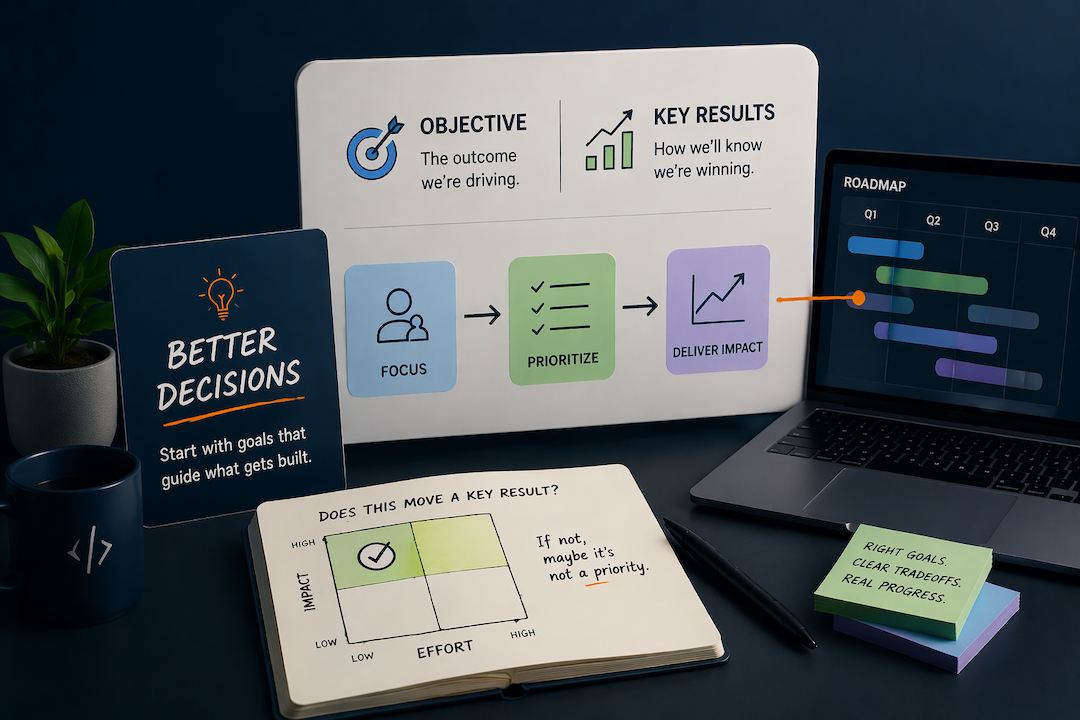
OKRs were set in January. The VP of Product walked through them in the all-hands. A shared document was linked and referenced. The structure was familiar, and the language was aligned.
By March, they were no longer being used to make decisions.
Not because the team lost interest. Not because the work changed direction. Because the OKRs were written at a level of specificity that made them impossible to apply when a real decision needed to be made. The team could not look at the OKRs and answer the question in front of them.
This is the most common failure mode in product OKR adoption. Teams focus on format and alignment during planning and skip the harder work of defining objectives and key results that can actually guide decisions under constraint.
What OKRs Are Actually Supposed to Do
OKRs function as a shared, explicit decision filter. The test of a working OKR is not whether it appears in the planning deck. It is whether a PM can use it to explain a prioritization call — to say, "We are building this and not that because it moves Key Result 2, and Key Result 2 is what the team is responsible for this quarter."
When OKRs work, they reduce the number of decisions that require escalation. Teams can evaluate incoming requests, deprioritization pressure, and scope additions against a shared standard without surfacing every tradeoff to leadership.
When OKRs do not work, they become reporting artifacts. They appear in the quarterly business review, mapped to work that was already planned. They explain what happened rather than guide what gets built. That is not a goal-setting system. It is a documentation system.
The structural distinction between the two: working OKRs have enough specificity to exclude options. Reporting artifacts do not.
OKRs (Objectives and Key Results) are a goal-setting framework where an Objective describes a qualitative outcome you want to achieve, and Key Results are the measurable signals that tell you whether you got there. The framework was popularized by John Doerr and is used by teams from early-stage startups to Google. For the foundational definition, whatmatters.com is the authoritative source.
Why Most Product OKRs Fail
The failure is rarely due to misunderstanding the format. Most teams know how to structure OKRs. The breakdown occurs in how they are written.
Objectives that are projects, not outcomes
Bad example: "Launch the redesigned onboarding flow"
Shipping a feature is not an objective. It is a task. An objective describes a change in the state of the world — something that is true after the work that was not true before. "Launch the redesigned onboarding flow" will be true whether or not the redesign improves anything. It gives the team no basis for deciding whether to prioritize the redesign over the five other things competing for the same capacity.
Key results that measure activity, not impact
Bad example: "Complete 12 onboarding UX tickets" / "Hold 3 user research sessions"
Activity-based key results reward completion, not progress. A team can check every box and the underlying business problem remains untouched. Key results that measure output rather than outcome persist because they are easy to hit, which creates the structural incentive to write them that way — even when they produce no useful signal.
OKRs set top-down with no traceable connection to the team's work
When high-level goals cascade without being translated into team-specific problems, product teams inherit objectives that are too abstract to apply.
“Grow enterprise revenue” does not indicate which problems a product team should prioritize. Teams respond by writing OKRs that formally align upward while practically describing the work they were already planning to do.
The result is alignment in language, but not in decision-making.
Too many OKRs — no priorities, just a list
More than three OKRs per team per quarter is not a sign of ambition. It is a sign that prioritization has not occurred.
When everything is an OKR, nothing functions as a constraint. The team has documented intentions rather than made tradeoffs.
The organizational incentive is to add goals, not remove them. That is why limiting OKRs requires deliberate enforcement, not preference.
How to Write a Product OKR That Actually Works
The objective should describe a condition the world is in, not a thing the team ships. It must be specific enough that the team can look at any initiative and answer whether it is likely to get them closer to that condition.
Key results should measure outcomes, not deliverables. Two to three per objective, maximum. Each should be falsifiable: if the team ships everything it planned and the key result does not move, the key result is measuring the wrong thing.
The most useful test before finalizing a key result: "Can the team execute everything on the roadmap and miss this number?" If yes, the key result is attached to activity rather than outcome. Rewrite it.
Product OKR Examples by Stage
What constitutes a well-written OKR changes across funding stages. The objective structure remains the same. What shifts is the level of abstraction in the objective, the metrics available to measure key results, and the degree of portfolio coordination required to keep OKRs aligned across squads.
At the Seed stage, OKRs are narrow and binary. There is one bet. The KRs either move or they do not — and a miss is signal, not failure.
At Series A, the segment becomes explicit in the objective. KRs connect product motion to the unit economics of the business. "Increase activation" is no longer sufficient; the objective must reflect who the team is activating and why that matters to the growth model.
At Series B, OKRs operate across multiple squads simultaneously. Misaligned KRs at this stage create capacity displacement that compounds each quarter — squads optimizing locally while portfolio-level outcomes stagnate.
| Stage | Objective | Key Results (2–3 max) | What Changes Across Stages |
|---|---|---|---|
| Seed | Prove the core value proposition works for early adopters |
|
Focus is on validation, not scale. KRs are tight and binary. One miss invalidates the bet. No portfolio complexity yet. |
| Series A | Build the conditions for repeatable, scalable growth in the SMB segment |
|
Segment is now explicit in the objective. KRs connect product motion to the revenue model. Scale replaces hand-holding. |
| Series B | Establish product-led growth as the primary acquisition channel in mid-market |
|
Portfolio-level tradeoffs appear. OKRs must hold across multiple squads. Misaligned KRs create capacity displacement that compounds each quarter. |
OKR Template and Framework
An OKR template does not improve thinking on its own. It enforces structural constraints.
A useful template prevents the most common failure modes:
Writing objectives as projects
Defining key results without measurable movement
Expanding the number of OKRs beyond what the team can realistically prioritize
The value of a template is not convenience. It is constraint. It forces clarity where ambiguity would otherwise remain.
A structured template with guided objective-writing prompts, the key result validation test, and stage-specific examples from Seed through Series B. Built for teams who have tried OKRs before and need a format that enforces the right constraints from the start.
Browse all templates and tools →
How OKRs Connect to Roadmap and Prioritization
OKRs that are not reflected in the roadmap are decorative. They exist in a planning artifact that is disconnected from the operational artifact that actually drives execution.
Every initiative on the roadmap should trace to a key result. If a product manager cannot explain which key result an initiative supports, one of two things is true:
The work is maintenance or technical debt and should be labeled and resourced explicitly
The OKR does not capture something the team believes is important
Both are legitimate. Neither should be invisible.
This is the mechanism that connects goal-setting to prioritization under uncertainty: OKRs define the outcomes the team is responsible for moving, and the roadmap reflects the current best hypothesis for how to move them. When a new request arrives mid-quarter, the evaluation is not "is this a good idea" but "does this move a key result more than what it would displace."
OKRs that drift from the roadmap usually share a root cause with strategy that loses authority after the planning cycle: the organization never made decisions specific enough to filter what comes next. Why most product strategies fail before teams start building covers the structural gap upstream of both problems.
OKR Infrastructure, Not OKR Theater
Organizations that use OKRs effectively are not better at writing goals. They have built the system that makes those goals actionable.
That system includes:
A limit on the number of OKRs a team can own
A review cadence focused on movement, not activity
A requirement that roadmap work traces to a key result
Without these constraints, OKRs default to reporting.
They describe what happened. They do not influence what happens next.
If the OKRs your team sets are not guiding the decisions your team makes, the problem is not the OKRs. It is the absence of the system that would make them matter.
I work with product leaders and SaaS founders on the goal-setting and prioritization infrastructure that makes quarterly planning stick beyond the all-hands — OKR design, roadmap alignment, and the governance layer that connects them.
See how I work with teams →