How to Structure a High-Performing Product Organization That Scales
I have built product organizations from scratch and inherited ones that were already broken. Both experiences teach you the same thing eventually: most product org problems are not people problems. They are structural design problems that get attributed to the wrong cause.
When a roadmap keeps shifting, it is usually not because the PM lacks conviction. When cross-team coordination consistently breaks down, it is usually not because people are unwilling to collaborate. When platform work keeps getting delayed, it is rarely because engineering is misaligned. These are symptoms of an organization built without a deliberate design, one that accumulated its shape through hiring decisions, reporting convenience, and proximity to whoever held authority at the time.
I have seen this across every stage. Founders still making product calls when the team hits fifteen engineers. Design reporting into marketing because that is where the first designer was hired. Platform teams that do not exist because no one ever made the deliberate decision to create them. The shape of the org reflects its hiring history more than any deliberate intention.
Product organization structure is a capital allocation decision expressed in organizational form. Where you place ownership, how you configure teams, and where you assign decision authority determines how the organization concentrates its capacity and how quickly it can respond when strategy changes. Getting this wrong is expensive in ways that do not appear in any single sprint's delivery metrics but accumulate across every product cycle until the cost becomes undeniable.
The model that follows explains how product organization structure should evolve across growth stages, the structural mistakes that consistently appear as companies scale, and the infrastructure required for the structure to actually function.
Where to focus based on your stage
If you are early stage, the most important sections are the Early Stage model and the Decision Rights subsection: the problem at this stage is almost always unclear ownership, not insufficient process. If you are at the growth stage, start with the Growth Stage model and the Cross-Squad Coordination subsection: coordination friction is where most growth-stage orgs lose velocity. If you are scaling or diagnosing an existing org, start with the Signals section to locate the structural gaps, then use the infrastructure section to determine what to build next.
Why Product Organizations Drift Into Reactive Structure
Understanding why product organizations so rarely arrive at deliberate structure is the prerequisite for designing them intentionally.
Structure feels like something to revisit when things settle. In the early days, the team is too small to need it. In the growth phase, hiring is moving faster than the organizational model can keep up with. By the time the org is large enough that structure matters visibly, it has already been accumulating for years, and the people in it have adapted their working patterns to whatever emerged.
Three causes produce this drift reliably.
Headcount decisions happen faster than design decisions. A new PM is hired to address a capacity gap. A designer joins whichever team had budget. An engineering manager absorbs product responsibility because the PM left. None of these decisions are made with the structure in mind. Each makes local sense and creates global incoherence.
Reporting lines harden faster than they should. Once a team has adapted its working patterns to a given configuration, the political and operational cost of changing it feels disproportionate to the benefit. The cost of the existing configuration, diffuse and accumulated across dozens of product decisions, is less visible than the cost of the change, which is immediate and concrete. This asymmetry keeps structures in place long after they have stopped serving the organization.
The structural cost of reactive organization is invisible in the short term. Teams can function inside a reactive structure long enough that leadership concludes the structure must be acceptable. The dysfunction surfaces at the next scale inflection, when coordination overhead that was manageable at twenty people becomes untenable at forty.
What I have learned from building these organizations is that the right moment to design structure is before the pressure to hire into it arrives. That almost never happens. The practical question is not how to build from scratch but how to recognize when the accumulated structure is constraining the organization's capacity to execute, and what to do about it.
The Squad as the Structural Unit
Before discussing how product organizations scale, it is worth defining the structural unit they are built from.
The product squad — a small, cross-functional team with a defined problem space and the capability to own outcomes end to end — is the foundational unit of every product organization I have built or advised. The model is near-universal not because it is conceptually elegant but because it solves a specific problem: it creates a unit small enough to move quickly and accountable enough to own consequences.
A functioning squad has three properties that the org chart alone cannot produce.
A defined problem space, not a feature backlog. The squad owns a customer problem, a segment, or a product surface. It does not own a list of things to build. A team organized around a backlog optimizes for delivery against the backlog. A team organized around a problem space optimizes for understanding the problem well enough to determine what to build. Most squads I have encountered are technically organized as the second and actually operating as the first, because the problem space was never defined with enough specificity to make the backlog irrelevant.
End-to-end capability. A squad that cannot move from discovery to delivery without external dependencies will move at the pace of coordination, not the pace of the work. Product, design, and engineering need to sit within the same team boundary, with the authority to make the decisions the problem space requires. Squads that regularly escalate decisions they should own are structurally underpowered, regardless of how well-intentioned the escalation process is.
Stable composition. Frequent reorganization destroys context. Customer understanding, technical familiarity, and team-level trust accumulate over time. Organizations that treat squad composition as a flexible resource allocation problem pay a context tax on every restructuring. The appropriate trigger for reorganization is a strategic change in which problems the organization has decided to solve. Not a short-term capacity reallocation.
Product Organization Structure by Growth Stage
How a product organization should be structured depends on what stage it is at. The composition ratios, reporting model, and governance requirements that work at ten PMs do not work at thirty. The structure that follows reflects what I have seen work — and fail — across product organizations at different stages of growth.
[VISUAL 1 — The Product Org Structure Model — place here]
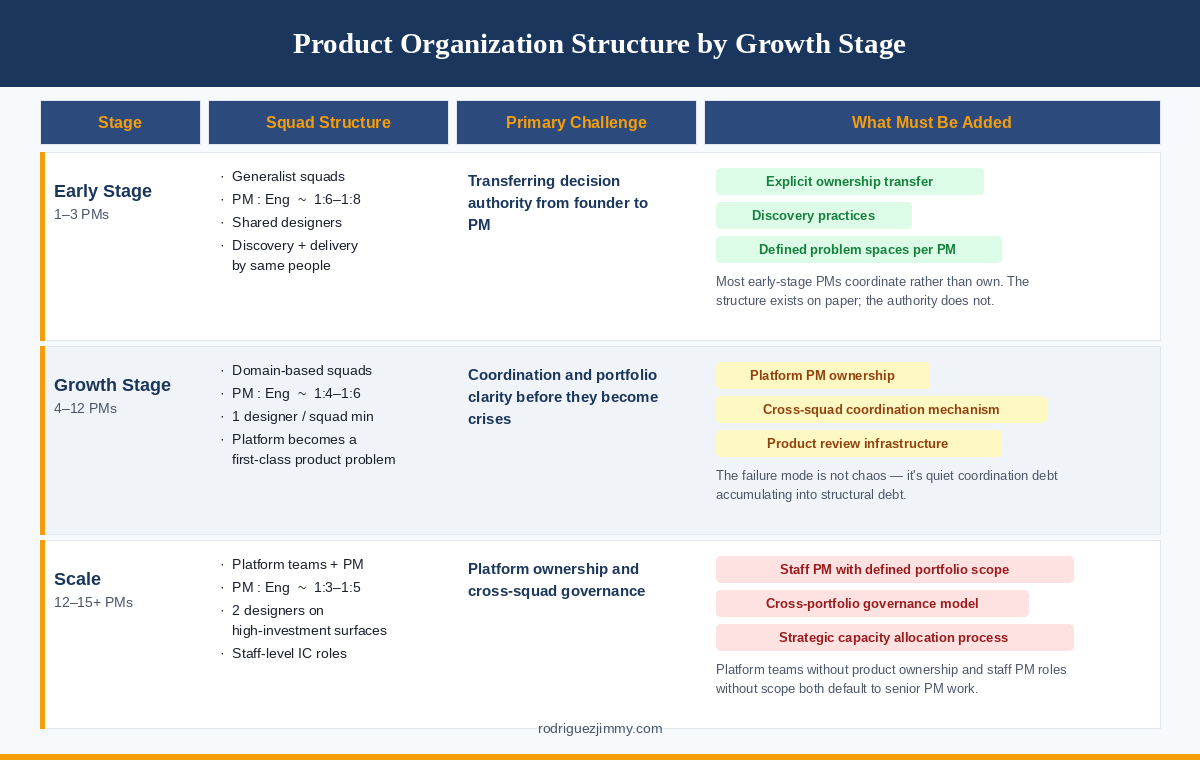
The central challenge shifts at each stage:
Early stage: transferring decision authority from founder to PM
Growth stage: building coordination mechanisms before friction becomes structural debt
Scale: establishing platform ownership and cross-portfolio governance before the absence of both becomes a crisis
Early Stage (1–3 PMs)
The central challenge: decision authority transfer
Characteristics
Generalist squads; discovery and delivery handled by the same people
PM-to-engineering ratio: approximately 1:6 to 1:8
Design thinly staffed, often shared across teams
Product surface narrow enough for one PM to hold full context
Leadership focus
Defining problem ownership before it defaults to whoever is loudest
Establishing discovery practices before the backlog becomes the default input
Transferring product decision authority from founder to PM explicitly
Platform at this stage: Platform is the shared product and technical foundation other squads build on: identity, permissions, data infrastructure, internal APIs. At early stage, it is not yet a structured concern.
Common failure mode: The founder remains the de facto product decision-maker long after the PM has been hired. The PM operates as a coordinator — managing the backlog, running ceremonies, communicating decisions — rather than as the person who makes product calls. This is not the PM's failure. It is a structural failure: decision authority was never transferred explicitly. The PM cannot own outcomes when ownership lives somewhere else.
Growth Stage (4–12 PMs)
The central challenge: coordination and portfolio clarity
Characteristics
Domain-based squads with defined problem space ownership
One dedicated designer per squad minimum; two on high-investment surfaces
PM-to-engineering ratio: approximately 1:4 to 1:6
Senior IC roles starting to emerge
Leadership focus
Portfolio clarity: which bets get concentrated capacity, which get minimal investment
Product review infrastructure: ensuring cross-squad decisions surface before they become execution conflicts
Preventing design from becoming a throughput bottleneck as its responsibilities expand
Platform at this stage: Platform investment begins to appear as a first-class product problem. Individual squads are now building on shared infrastructure and feeling its constraints. Platform does not yet need a dedicated team, but it needs a named owner and a place in planning discussions. Orgs that defer this are building the crisis they will face at scale.
Common failure mode: Cross-squad coordination friction. Two squads share a customer segment or a platform dependency, and the mechanism for resolving priority conflicts does not exist. Conflicts escalate to the VP level, or they get resolved through informal negotiation that produces inconsistent outcomes. The organization accumulates coordination debt that hardens into structural debt.
Scale Stage (12–15+ PMs)
The central challenge: platform ownership and portfolio governance
Structural additions required at this stage
Platform teams with dedicated PM ownership, not engineering stewardship
Staff-level IC roles to own cross-squad portfolio decisions
Cross-portfolio governance: explicit mechanisms for decisions too large for squads and too operational for VP-level leadership
Leadership focus
Strategic capacity allocation: where is the organization concentrating its bets, and is the structure supporting that concentration?
Cross-squad decision infrastructure: the hardest structural problem at scale is not within squads, it is between them
Platform at this stage: Platform becomes a structured product domain with its own PM ownership, roadmap, and investment thesis. The PM owning platform is responsible for defining what the internal systems need to do, prioritizing investment against competing demands from product teams, and making tradeoffs visible at the portfolio level. Without this, platform is permanently underinvested in the areas where downstream teams need it most. The cost surfaces as strategic initiative failures, not as visible platform problems.
Common failure modes: Two appear with near-equal frequency. The first is platform teams that exist but lack product ownership: engineering runs the platform, product teams make requests rather than co-owning investment decisions. The second is staff-level PM roles created without a defined portfolio problem; these default to doing senior PM work rather than the cross-squad infrastructure work the role exists to perform.
At this stage, AI tools compound the risk of structural underinvestment. As option generation becomes cheaper (teams prototype faster, scope more hypotheses per planning cycle, generate more candidate bets), the structural requirement for constraint discipline increases, not decreases. Without tighter portfolio governance, prioritization becomes an evaluation problem that expands faster than the org's capacity to absorb it. The organizations that scale well through AI-accelerated product work are the ones that have already built explicit constraints into how capacity gets allocated.
Structural Mistakes That Appear at Scale
Most product org failures at scale are not hiring failures. They are structural design failures attributed to the individuals operating within the structure. In my experience, four mistakes account for the majority of what goes wrong.
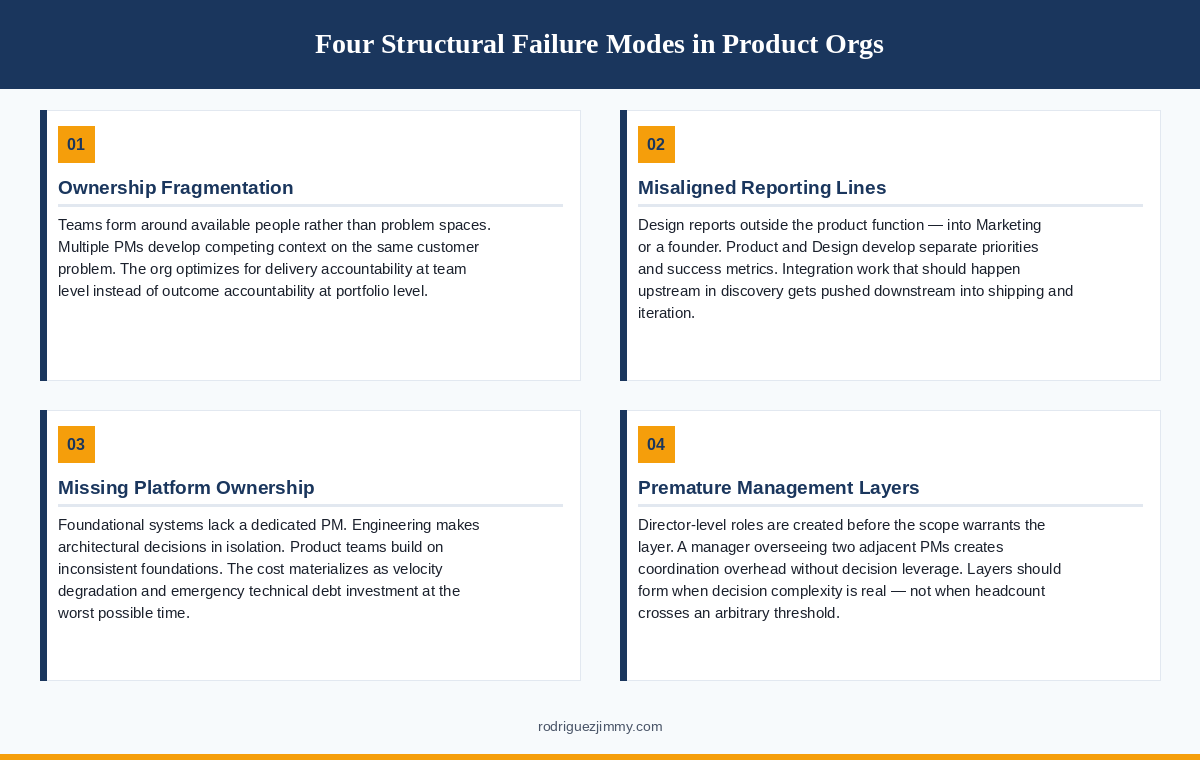
1. Adding management layers too early. Management layers should form when the decision complexity at a given scope is real: one person cannot hold the context required to make good decisions across all the teams reporting to them. A Director managing two adjacent PMs creates coordination cost without creating decision leverage. The signal that a layer is warranted is not headcount crossing a threshold. It is a specific portfolio decision problem that no existing role is structured to own.
2. Treating platform as an engineering concern. Platform teams need product ownership. Without it, platform investment is driven by engineering judgment and ad hoc product team requests. Platform becomes underinvested in exactly the areas where downstream teams need it most. The cost is invisible until it becomes a crisis, usually when a strategic initiative cannot proceed because the foundational system it depends on does not exist.
3. Separating design from product too long. Organizations that grew with Design reporting outside of product resist moving it because the political cost feels disproportionate. It is not. Maintaining the separation means every product decision is made without aligned context. Product and design develop separate customer understanding, separate prioritization logic, and separate success definitions. Integration becomes retrofit work at the shipping stage rather than upstream alignment built into discovery.
4. Scaling headcount before strategy is clear. Adding PMs and designers before the organization has clarity on which problems it is prioritizing produces capacity without direction. Squads make locally reasonable decisions that are globally incoherent. The output is feature volume without strategic concentration: capacity distributed across too many bets without the constraint discipline to allocate it where it creates leverage.
Signals Your Product Org Structure Is Breaking
Structural dysfunction almost never announces itself as a structure problem. It announces itself as a performance problem, a communication problem, or a prioritization problem. The signals below are the ones I have most consistently traced back to structural cause rather than individual failure.
Roadmap conflicts between squads escalate to the VP level regularly. When the mechanism for resolving cross-squad conflicts does not exist, every conflict becomes a leadership decision. This is a cross-squad governance gap.
Platform work is consistently delayed or deprioritized. When platform has no dedicated PM, it competes for priority within squads measured on customer-facing outcomes. It loses. Consistently.
Designers are spread across too many squads to do meaningful discovery. Design becomes a production function rather than a thinking partner. The squad loses the upstream collaboration that produces good early decisions.
Leadership spends significant time resolving cross-team conflicts. When decision rights are undefined, everything requiring coordination escalates upward. This is a decision rights failure, not a people management failure.
Product and design develop different explanations for the same customer problem. When they are not aligned in problem framing, they operate from separate models. Integration happens in QA, not in discovery.
Quick diagnostic
Score each signal: 0 = not true, 1 = sometimes true, 2 = consistently true.
| Signal | Score |
|---|---|
| Roadmap conflicts escalate to VP level regularly | 0 / 1 / 2 |
| Platform work consistently delayed or deprioritized | 0 / 1 / 2 |
| Designers too spread to do meaningful discovery | 0 / 1 / 2 |
| Leadership absorbed in cross-team conflict resolution | 0 / 1 / 2 |
| Product and design explaining the same problem differently | 0 / 1 / 2 |
The right response to any score above 3 is not a reorganization, at least not immediately. It is mapping where ownership is fragmented, where coordination mechanisms are missing, and where decision authority is unclear. Reorganization follows from that analysis. It does not substitute for it.
The Infrastructure That Makes the Structure Work
Structure is necessary but not sufficient. A well-designed org chart with undefined decision rights, inconsistent career criteria, and no product review governance will produce the same dysfunction as a poorly designed one. The org chart defines who sits where. The infrastructure defines how decisions get made.
In every product organization I have helped build or repair, four infrastructure elements determine whether the structure actually functions.
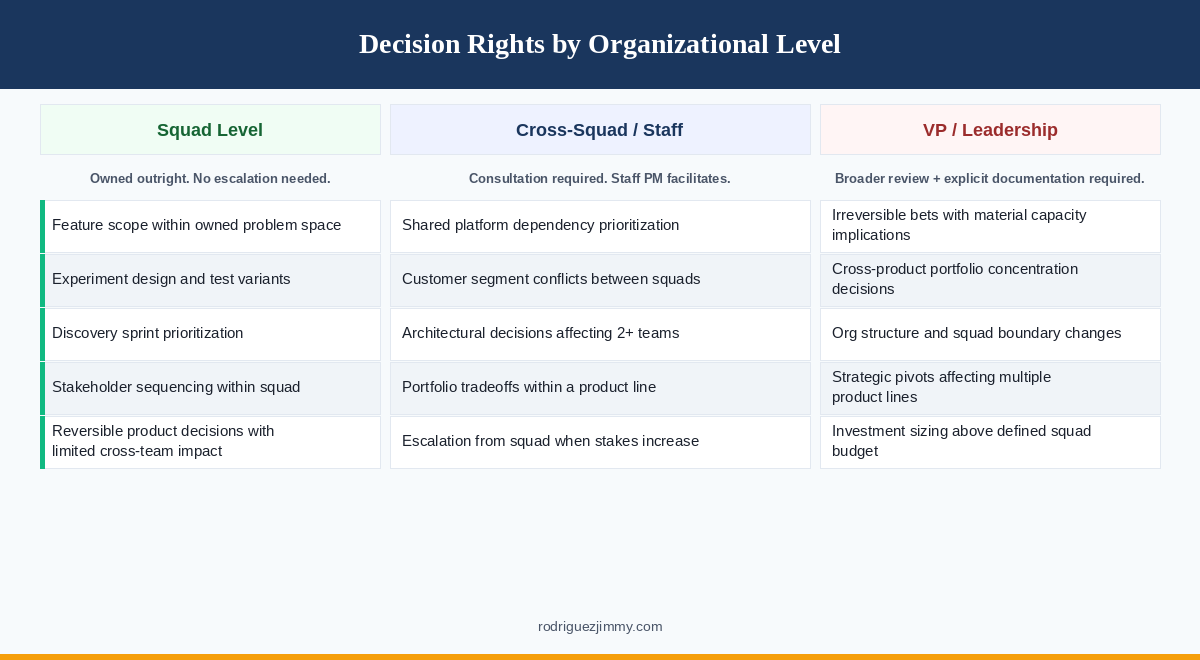
Decision rights. Every squad needs to know which decisions it owns outright, which require consultation, and which require escalation. The boundary between squad-level autonomy and VP-level review should be defined by stakes and reversibility, not by organizational hierarchy.
In practice, this means:
Squad owns outright: experiment design, feature scope within the problem space, discovery sprint prioritization, stakeholder sequencing within the squad's domain
Cross-squad review required: architectural decisions affecting two or more teams, customer segment conflicts between squads, platform dependency prioritization
VP-level escalation required: irreversible bets with material capacity implications, cross-product portfolio concentration decisions, org structure and squad boundary changes
When this boundary is undefined, escalation patterns form based on the personalities involved rather than the governance logic the organization intends to operate by.
Career infrastructure. The PM career ladder is not an HR artifact. It is the mechanism by which the organization defines what it expects product work to look like at each level of scope and complexity. Without it, performance evaluation relies on individual manager judgment rather than shared criteria. PMs optimize for the behaviors their specific manager rewards rather than the behaviors the organization needs at scale. A ladder makes the expectations of each structural layer explicit, which is what allows the structure to hold as headcount grows.
Cross-squad coordination. The hardest structural problem at scale is not within squads. It is between them. When two squads share a customer segment, a platform dependency, or a strategic bet, the mechanism for resolving conflicts between their priorities needs to exist before the conflict does. Shared OKRs, joint planning cadences, and defined escalation paths are structural investments, not process overhead. Their absence creates coordination debt that compounds with every squad added to the organization.
Product review governance. Product review infrastructure defines how portfolio decisions are evaluated and how strategic tradeoffs surface before they become execution conflicts. Without it, review sessions become status updates: teams report on progress without the session producing a decision. Product review governance specifies what decisions the review is designed to produce, what inputs are required to make them, and who has authority to close them. The VP leaves the session having made cross-squad tradeoff decisions, not merely having confirmed awareness of what teams are working on.
Designing the Org Before It Designs Itself
The organizations that build product functions that hold at scale made one decision differently from the ones that struggled: they defined the structural model before the pressure to hire into it made deliberate design impossible.
That means three things in practice.
First, define the structural unit and what it requires to function before configuring it. A squad that is called a squad but lacks end-to-end capability, a defined problem space, and decision authority is a project team with better branding.
Second, configure the portfolio before filling the headcount. Which problems deserve concentrated squad ownership? Where does platform investment need to live? These are capital allocation decisions. They should precede the hiring decisions, not follow them.
Third, build the infrastructure alongside the structure, not after it. Decision rights, career criteria, coordination mechanisms, and product review governance cannot be retrofitted once the org has grown into them. By the time the need is undeniable, the escalation norms and informal coordination patterns have already formed. Those are harder to change than the structure itself.
Product organization structure has three layers:
Structural unit: the squad, defined by its problem space, composition, and capability requirements
Portfolio configuration: domain ownership, reporting lines, and where platform product ownership lives
Operating infrastructure: decision rights, career systems, coordination mechanisms, and product review governance
Organizations that scale their product function successfully design all three deliberately. The ones that struggle almost always have one layer defined and the others accumulated.
The org chart is the beginning of the design problem, not the solution to it.