When Static Product Roadmaps Stop Scaling: A Guide to Product Roadmapping Tools
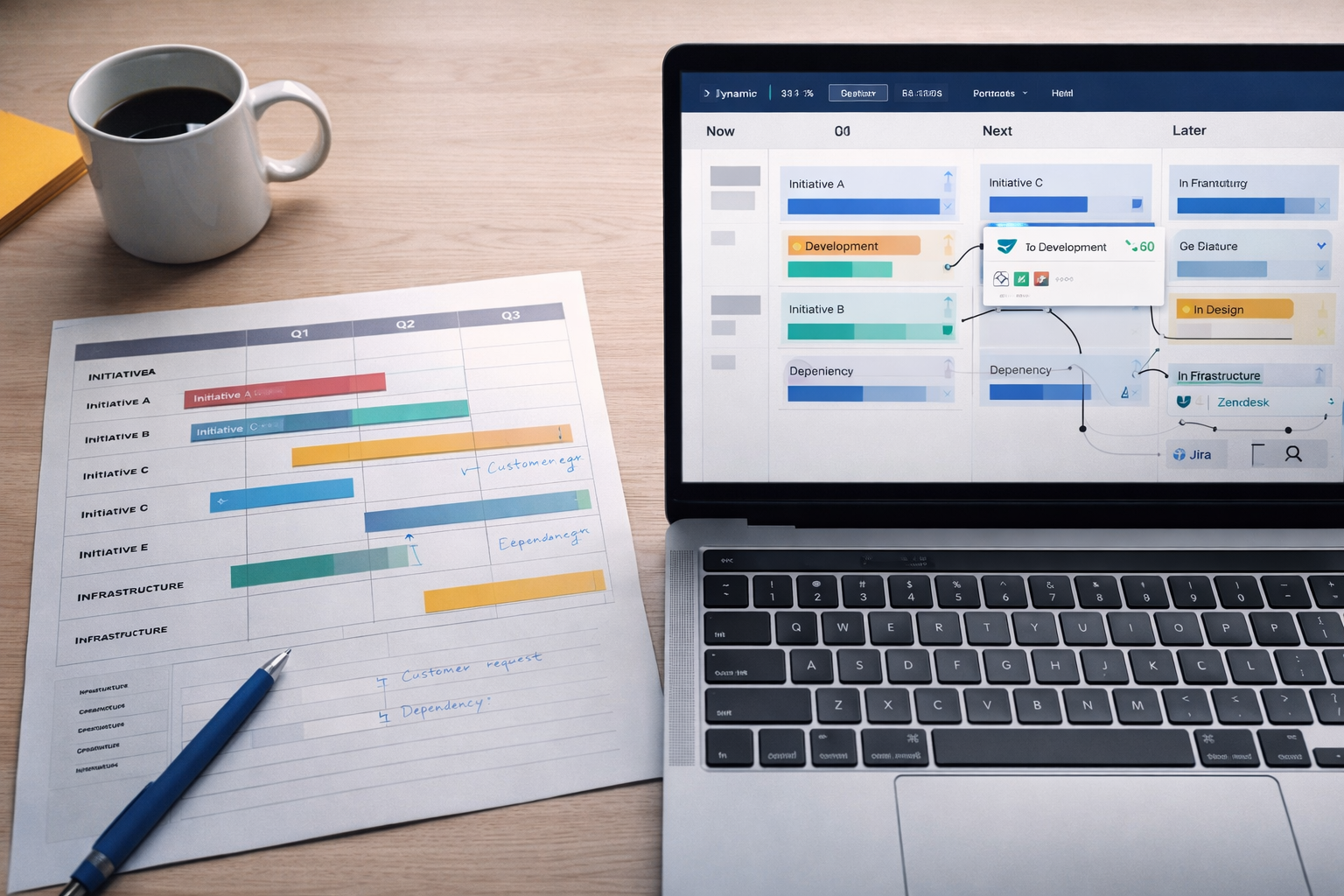
At a certain point in a product organization's growth, the roadmap stops functioning as a coordination system and starts functioning as a record of past intentions.
The artifact still exists. PMs still update it. Reviews still happen. But somewhere between the last update and the moment a stakeholder needs to act on it, the roadmap has already diverged from reality. Engineering is building against a dependency that two other teams never saw. Sales is quoting a timeline that product revised quietly three weeks ago. Customer success learns about a release in the same Slack message as the customer.
These failures get attributed to communication discipline or planning rigor. The actual cause is structural: the roadmap is a static document in an environment that requires a live system.
Static Representation Is the Underlying Problem
A static roadmap captures intent at a point in time. A dynamic roadmap reflects current system state and propagates changes across stakeholders automatically. That distinction, which seems minor at small scale, becomes a significant operational liability as organizational complexity grows.
Static roadmaps come in many forms. The format is less important than the structural limitation they share:
Slide decks prepared for quarterly reviews and distributed as PDFs
Notion documents or Confluence pages maintained by a single PM
Spreadsheets shared via email, where version ambiguity accumulates quietly
Any roadmap artifact that requires manual updating and manual redistribution to remain current
The common thread is that a change to any of these artifacts requires a human to identify every downstream holder of the prior version and manually communicate the update. That process is manageable when one or two people own a single product. It degrades as the number of PMs, stakeholders, and products increases, because the manual propagation layer scales with organizational complexity rather than being replaced by it.
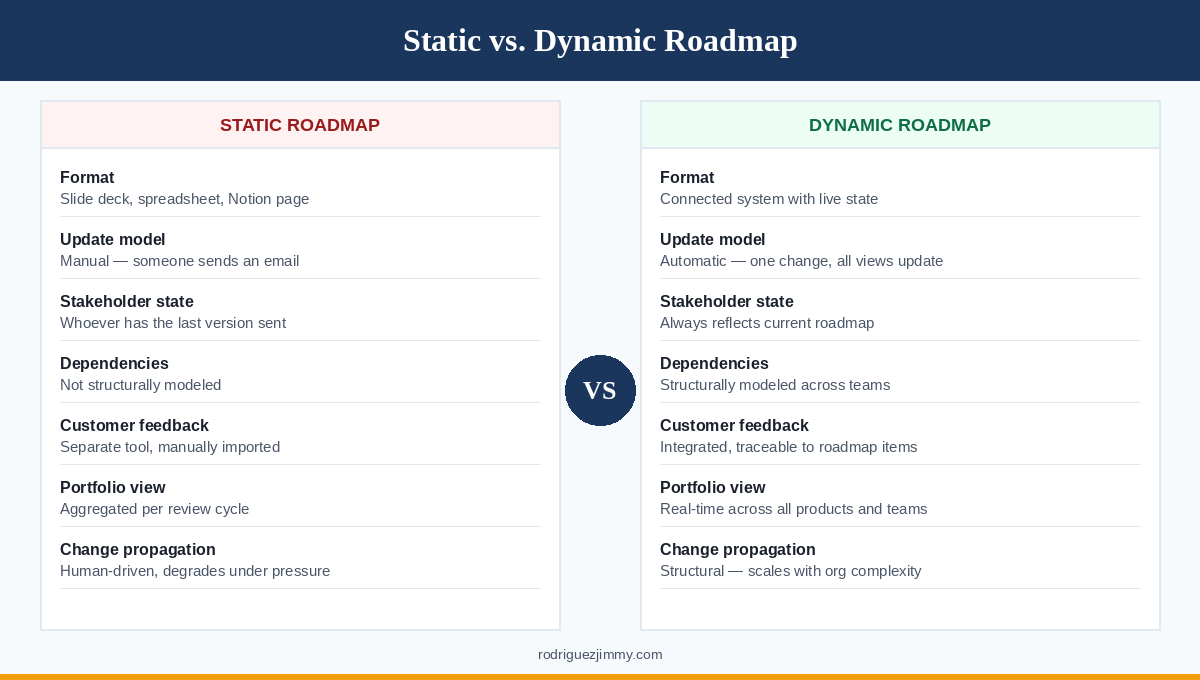
As organizational complexity increases, the representational limits of static artifacts become visible in predictable ways:
Engineering managers discover cross-team dependencies during execution rather than during planning, because relationships were not structurally modeled at the roadmap level
Sales and customer success teams operate from outdated priorities because roadmap updates require manual redistribution, a process that fails under deadline pressure
Customer feedback accumulates in Intercom, Zendesk, and CRM tools without traceable linkage to what is actually on the roadmap
Reprioritization requires manual reconciliation across multiple artifact versions, creating ambiguity about what is current
None of these are catastrophic individually. Together, they signal a coordination system that depends on increasing human effort to remain coherent. That effort scales with headcount, and the more PMs are added, the more coordination overhead accumulates.
The Structural Signals That Indicate You've Outgrown Static Roadmaps
The decision to invest in dedicated product roadmapping tools isn't triggered by team size or product complexity alone. It's triggered by patterns of organizational breakdown that have become recurring rather than occasional.
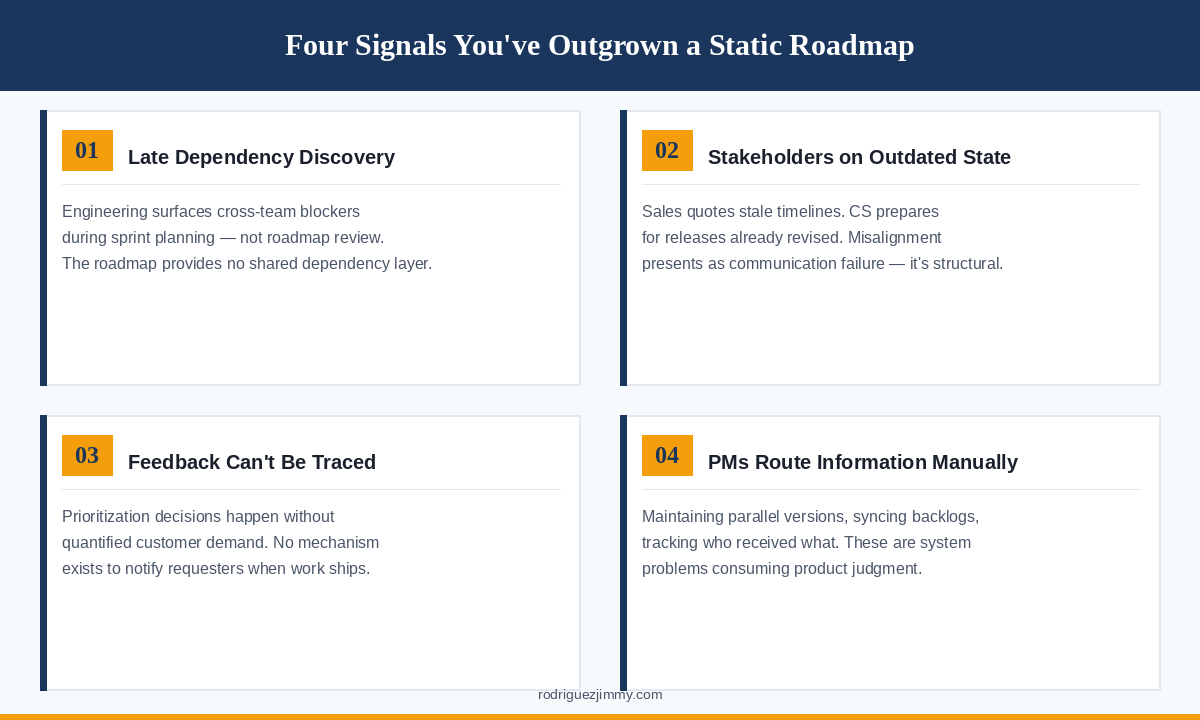
Late dependency discovery
When engineering managers regularly surface cross-team blockers during sprint planning rather than during roadmap review, the roadmap is functioning as a list of work that each team maintains in isolation. No shared layer exists at the roadmap level to make those dependencies visible before commitments are made. Engineering absorbs the reconciliation cost: sprint cycles spent resolving what should have been planned, with delays treated as execution problems rather than planning system failures.
Stakeholder decisions made on outdated roadmap state
Sales leaders commit to customer timelines based on last quarter's roadmap review. Customer success teams prepare for releases based on what was communicated in the last all-hands. When the roadmap changes between those communication events, which it does routinely, stakeholders continue operating from the prior state until someone manually updates them.
The resulting misalignment presents as credibility problems: sales over-promises, customer success is unprepared, executives raise priority questions that product has already resolved internally. Each instance is treated as a communication failure. It is a structural one.
Customer feedback that can't be traced to roadmap decisions
Most product teams believe their roadmap is customer-driven because feedback nominally enters the system somewhere. The gap is traceability. When a prioritization decision is made, key questions often go unanswered:
How many customers have requested this capability?
Which segments do they represent?
What volume of demand exists relative to the alternatives?
When this ships, how will requesting customers be notified?
When those questions can't be answered, customer reality is influencing product decisions by anecdote rather than evidence.
PMs functioning as coordination intermediaries
In static roadmap environments, PMs absorb the overhead of maintaining coherence manually:
Maintaining multiple roadmap versions for different audiences
Copying items between the roadmap and the engineering backlog
Tracking which stakeholders received which version
Following up to confirm the right people know about a release before it ships
These are not product management activities. They are information-routing activities that a connected system should handle automatically. When PMs spend a meaningful portion of their week on this work, the organization is spending product judgment on a system problem.
The Portfolio Layer That Static Roadmaps Can't Serve
For organizations managing multiple products or teams under a single product umbrella, static roadmaps introduce a second structural failure distinct from the coordination failures above: they make investment allocation invisible to the executives responsible for governing it.
A VP of Product reviewing three separate PM roadmaps, each presented as a slide deck or spreadsheet, has no structural visibility into:
Whether 70% of engineering capacity is concentrated in infrastructure while two customer-facing initiatives are understaffed
Whether two teams are building toward the same capability from different angles
Whether the sum of current roadmap commitments is consistent with declared strategic priorities, or has drifted
Executives in this position compensate by inserting themselves more deeply into individual roadmap reviews. Not because they distrust the PMs, but because the static artifact doesn't give them the portfolio-level visibility they need to govern allocation decisions with confidence. That insertion looks like micromanagement from the PM's perspective. It is a rational response to an information gap.
Dynamic roadmapping systems that support portfolio views change this dynamic. When a VP of Product can see investment concentration, cross-product dependencies, and strategic alignment across the full portfolio in one view, the review conversation shifts from "what are you building" to "are we making the right bets." That is what those reviews should be.
How AI-Accelerated Development Increases the Pressure on Static Roadmaps
Product teams integrating AI-assisted development operate at iteration speeds that static roadmaps were not designed to support. When the interval between a product decision and a working prototype compresses from weeks to days:
Roadmaps updated quarterly become outdated before the next update cycle
Cross-team dependencies that were manageable with a two-week buffer become blockers before engineering managers can schedule the conversation to surface them
Stakeholder communication that was adequate in a monthly all-hands cycle now requires near-real-time visibility to remain accurate
As AI tooling enables smaller teams to ship at higher velocity, the coordination surface area expands disproportionately to headcount. A three-person team using AI-accelerated development can create the dependency surface area of a ten-person team operating conventionally. Static artifacts are calibrated for headcount. Dynamic systems are calibrated for surface area.
This doesn't change which tool a product organization should evaluate. It does change how quickly the static roadmap limit arrives, and how costly it becomes to defer the transition.
Strategic Traceability: How Roadmaps Preserve Leadership Trust
One of the less-discussed functions of a product roadmap is that it provides the evidence trail leadership uses to evaluate whether product judgment is sound. When an initiative fails to deliver expected outcomes, the question that follows is whether the reasoning behind the decision was defensible given what was known.
In static roadmap environments, that evidence trail rarely exists. The roadmap shows what was planned. It rarely shows:
Which strategic priority the initiative addressed
What customer demand evidence supported it
What alternatives were considered and deprioritized
What success was expected to look like before it shipped
When results are mixed and no artifact connects the outcome to the reasoning that produced the decision, leadership defaults to increasing oversight: more review gates, more approval steps, more escalation requirements. Product teams experience this as loss of autonomy. The loss is real, and it is a structural consequence of a roadmap system that doesn't preserve decision rationale.
Dynamic roadmapping systems that connect strategic priorities to roadmap items, and roadmap items to supporting customer evidence, create the traceability that sustains trust. When a VP of Product can review a roadmap and see not just what is planned but why, that roadmap becomes a governance artifact, not just a planning one.
What to Look for in a Product Roadmapping Tool
Most product roadmapping tools advertise similar capabilities. The differences that matter reflect the tradeoffs each platform has made about which structural problems it prioritizes solving.
Portfolio-level visibility surfaces investment concentration, cross-product dependencies, and alignment between current roadmap commitments and declared strategic priorities. This matters for organizations managing more than one product or more than one PM team under shared engineering capacity.
Multi-audience views from a single source generate different levels of detail for engineering, leadership, customers, and cross-functional partners from one source of truth, without requiring the PM to maintain separate artifacts for each audience.
Customer feedback integration with traceability connects incoming signals from Intercom, Zendesk, Salesforce, and other sources directly to roadmap items, quantifies demand by segment, and closes the loop with customers when related work ships. Platforms that manage feedback in a disconnected module still require manual translation, which reintroduces the overhead the tool was supposed to eliminate.
Bidirectional development tool integration means changes made to the roadmap propagate to the engineering backlog, and backlog state is visible at the roadmap level. One-way exports require manual synchronization and reproduce the static roadmap problem inside a more expensive tool.
Strategic hierarchy support connects roadmap items upward to initiatives, and initiatives to declared strategic priorities or OKRs. Without it, the roadmap remains a list of planned work rather than a legible expression of product strategy.
Adoption surface and implementation overhead determine whether any of the above capabilities actually get used. A platform that requires a dedicated ops resource to configure, or that PMs route around because the learning curve is too steep, produces no structural improvement regardless of its feature set.
Five Product Roadmapping Tools Worth Evaluating
These five platforms represent the range of approaches to the structural needs above. Each has made different tradeoffs about which problems to solve most directly.
Productboard
Best for: Organizations where customer feedback traceability is the primary gap between incoming signals and roadmap decisions.
Productboard is built around the thesis that most product organizations don't lack roadmapping capability — they lack a structured connection between customer feedback and the decisions that produce the roadmap. Feedback from Intercom, Salesforce, Zendesk, and email enters a centralized repository, gets tagged and segmented, and links directly to roadmap features. When a feature ships, Productboard triggers notifications to the customers who requested it. The feedback-to-decision-to-notification loop runs inside one system rather than across manual handoffs between disconnected tools.
The roadmapping layer — timeline views, customizable columns, stakeholder-facing portals — is functional and sufficient for most organizations, but it's downstream of the feedback layer in terms of differentiated value. An organization evaluating Productboard primarily for roadmap visualization is selecting the wrong tool for the wrong reason.
At enterprise scale, seat-based pricing becomes a meaningful consideration. Product leaders should model full seat count before committing and confirm whether feedback integration will receive active use, because that's where the investment pays back.
Aha! Roadmaps
Best for: Organizations managing multiple products or portfolios that need structural visibility from strategic goals through execution.
Aha! is the most structurally complete platform in this category. It connects OKRs and business goals at the top of the hierarchy through initiatives, features, and releases at the execution level. For a VP of Product or CPO managing multiple product lines, it provides the portfolio-level visibility that makes investment concentration, cross-product tradeoffs, and strategic alignment readable from a single view.
Roadmap views are highly customizable across timeline, kanban, portfolio summary, and release-oriented formats. A customer-facing ideas portal captures and surfaces demand before items enter the roadmap. Reporting across the strategic hierarchy shows where capacity is concentrated relative to declared priorities.
The implementation investment is real. Aha! rewards organizations that engage the strategic planning layer actively. Those that use it primarily as a timeline tool will find the complexity disproportionate to the problem. The decision to deploy Aha! should be driven by whether the portfolio visibility and strategic hierarchy capabilities solve an active governance problem.
ProductPlan
Best for: Teams where stakeholder communication breakdowns are the primary friction and implementation overhead needs to stay low.
ProductPlan is the most accessible entry point in this category. The platform is drag-and-drop, timeline-based, and built to produce roadmaps that non-product stakeholders can read without a PM walking them through it. Roadmaps are shareable via secure links, exportable as images or PDFs, and publishable with audience-controlled visibility. Lane organization, milestones, and basic dependency indicators are supported.
Where ProductPlan earns its position is in organizations where the primary breakdown is presentation-layer: stakeholders receiving slide decks that go stale immediately after review, cross-functional partners unsure which roadmap version is current, executives working from assumptions the product team revised weeks ago.
Its structural ceiling is lower than Productboard or Aha!. It does not provide customer feedback aggregation, portfolio-level strategic visibility, or a goal hierarchy. For teams starting the transition from static roadmaps and needing a working solution quickly, it is a credible first platform with a short time-to-value.
Roadmunk (by Tempo)
Best for: Cross-functional teams that need visual roadmap clarity combined with basic customer feedback and prioritization in a single tool.
Roadmunk built its reputation on visual clarity: roadmaps that are legible to executives and non-product stakeholders without requiring separate design effort. Timeline and swimlane layouts with drag-and-drop editing made it a practical choice for organizations managing the communication overhead of roadmapping.
Beyond visualization, Roadmunk includes customer feedback collection, RICE-based prioritization frameworks, and an idea prioritization module that connects incoming requests to roadmap decisions without requiring a tool switch. This positions it between ProductPlan and Productboard in terms of feedback-to-roadmap integration depth.
Roadmunk was acquired by Tempo Software and has since moved toward enterprise positioning. Teams evaluating it in 2025 should verify current pricing and plan structure directly, as several sources noted changes from its earlier mid-market accessibility. For organizations already in the Atlassian ecosystem, the native Jira integration is a practical advantage.
ProdPad
Best for: Teams that have moved to outcome-oriented planning and need a roadmapping system whose structure enforces that model.
ProdPad is the most opinionated platform in this group. It starts with ideas rather than timelines: feedback and internal proposals enter a backlog, and PMs decide which ideas have earned a place on the roadmap. The roadmap itself is structured as a lean canvas organized by now, next, and later rather than a date-driven timeline.
This has a specific cultural implication. ProdPad enforces a particular model of product management rather than accommodating multiple models simultaneously. For organizations committed to outcome-oriented, evidence-driven PM practice, the platform's architecture is an asset. For organizations that still need to satisfy executive or board stakeholders who evaluate roadmaps by quarterly delivery windows, the default views will require workarounds to produce those artifacts.
The feedback loop is comprehensive: customer requests, internal ideas, and research notes consolidate into a single backlog. Development tool integrations connect backlog items through to execution. ProdPad's value is most concentrated in teams where the practices it assumes are already established.
Matching the Tool to the Structural Problem
The selection decision reduces to identifying where the current roadmapping system produces the most costly recurring failures:
If the primary failure is… Evaluate… Customer signal traceability: decisions made without quantified demand evidence Productboard Portfolio governance: no visibility into investment concentration or cross-product tradeoffs Aha! Stakeholder communication: outdated roadmap state driving misalignment ProductPlan Visual clarity combined with basic feedback aggregation in a Jira-centric stack Roadmunk Tooling that structurally enforces outcome-oriented PM methodology ProdPad
One constraint applies across all five: adoption determines whether any structural improvement materializes. A product roadmapping tool that PMs route around because it's too complex, too slow, or too disconnected from existing workflows produces no improvement over the static artifact it replaced. Implementation overhead, configuration complexity, and the change management required to shift PM workflows are real costs that belong in the evaluation alongside feature capability.
Where the Benefit Actually Appears
The objection to investing in roadmapping tooling is almost always framed as a visibility problem: the cost is a line item, the benefit isn't. That framing is accurate but incomplete.
The benefit appears in specific, traceable places:
Engineering managers stop spending sprint cycles reconciling dependencies that should have been surfaced at planning
Sales leaders stop making commitments based on roadmap state that was revised weeks prior
Customer success representatives stop learning about releases from the same Slack message as the customer
PMs stop maintaining four versions of the same roadmap for different audiences
Leadership stops escalating priority questions that product has already resolved, because the roadmap makes the reasoning visible
None of those costs appear as "static roadmap limitation" in a budget review. They surface as execution problems, communication failures, and team friction. The investment case for dynamic roadmapping tooling requires naming those specific failure modes and estimating their recurring cost honestly, not relying on abstract appeals to efficiency.
The platform evaluation is downstream of that diagnosis. Which tool fits depends entirely on which structural failure is producing the most cost, and which platform was built to solve it.