
How to Build an App: The Founder's Guide to Going from Idea to First Users
Most founders who build apps that fail do not fail because they wrote bad code, picked the wrong tools, or ran out of runway before finding users.
They fail because they built something nobody needed badly enough to pay for.
That is the default outcome when a founder skips validation and goes straight to building. A year of work, real money spent, and a product launch greeted by silence — not because the execution was poor, but because the riskiest question was never answered before construction began. Whether the problem is real and urgent enough that users will change behavior to solve it.
The good news is that this outcome is avoidable. The bad news is that avoiding it requires making a series of decisions — about what to build, what not to build, and when your judgment as a founder is no longer sufficient — before you open any development tool.
That decision layer above the technology is what most "how to build an app" guides skip. This one does not.
The Real Work of Building an App
Building an app is not a linear process from idea to code to launch.
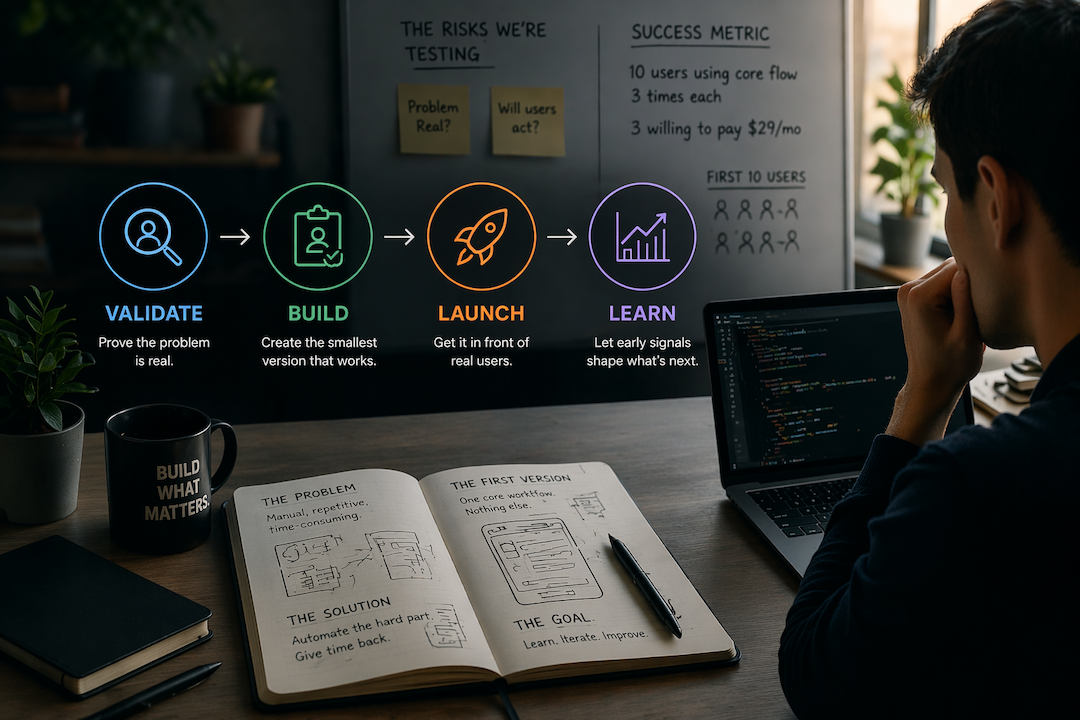
It is a sequence of decisions that reduce uncertainty over time:
Is the problem real?
Will users change behavior to solve it?
What is the smallest version that proves it?
Most founders collapse this sequence into a single step: building.
That is where the failure begins.
When building starts before these questions are answered, every decision that follows becomes guesswork. Features get added without clarity. Scope expands without improving outcomes. Time is spent building a product that was never validated.
The work is not building faster. It is reducing uncertainty before committing effort.
Before You Touch a Tool: The Questions That Determines Everything
No tool, no-code platform, or AI builder will save a product built on a vague problem statement. Before you write a line of code or generate a single screen, you need to be able to answer three questions clearly.
First: What is the specific problem?
Not “people waste time on X” or “there’s no good tool for Y.”
A useful problem statement describes a concrete moment of friction:
Freelance consultants spend 3–4 hours each week manually compiling time logs from multiple tools to create invoices, and late invoices are costing them an average of $800 per month in delayed revenue.
That is actionable. “Invoicing is annoying” is not.
Second: Who is the specific user?
Not “small businesses” or “entrepreneurs.”
A narrow definition improves every downstream decision:
Solo consultants billing $5,000–$15,000 per month who track time in Toggl and send invoices manually.
Precision here determines how validation is run, what gets built first, and where early users are found.
Third: What does success look like in 90 days?
Not “get traction” or “launch and learn.”
A measurable signal defines a real test:
10 users have created and sent at least three invoices each, and three of them have said they would pay $29 per month.
If success cannot be defined, the idea is not testable.
If you cannot answer all three before building, the app is not ready to build. This is not a harsh standard; it is the minimum floor. Founders who skip this step frequently discover 9 months later that they were solving the wrong problem for the wrong person. The structural failure that kills most product strategies — building without answering what choices you are actually making — is the same failure that kills most early apps, just at smaller scale.
How to Validate the Idea Before Writing Code
Validation is not about proving yourself right. It is about finding out, as quickly and cheaply as possible, whether the problem is real and whether users will act to solve it. Three methods, in order of what they tell you.
1. The Problem Interview
Talk to 10–15 people who match the target user.
The goal is not to pitch. It is to understand current behavior and cost.
Ask:
Walk me through the last time this happened
What have you tried already
What does this cost you per month
A strong signal is repetition. Multiple people describing the same friction, in similar terms, with evidence they have already tried to solve it.
2. The Landing Page Test
Build a simple page that:
Describes the problem
Explains the solution
Includes one call to action
Drive 200–500 relevant visitors through:
Paid ads
Community posts
Direct outreach
Measure conversion.
A useful signal is a conversion rate above 10–15 percent from relevant traffic, or enough sign-ups to speak with 20–30 interested users.
3. The Manual Version
Before building the automated product, deliver the outcome manually.
If the product is invoicing, manually create and send invoices. Charge for it, even if the amount is small.
This tests behavior, not intent.
If users do not change behavior for a manual solution, automation will not fix the problem.
The Problem Interview
Timeline
2–3 weeks
Cost
No cost
Positive signal
Users describe the same friction in nearly identical terms and have already paid for an incomplete solution.
The Landing Page Test
Timeline
1–2 weeks
Cost
Under $200
Positive signal
10–15%+ sign-up conversion from relevant traffic. Enough sign-ups to contact 20–30 real prospects.
The Manual Version
Timeline
1–2 weeks
Cost
Near zero
Positive signal
Users complete the workflow and ask when the real product is ready.
Each of these methods takes less than three weeks. Running all three before building anything costs under $500 and gives you more useful information than a completed MVP that nobody uses.
The Technology Decision: Which Build Path Is Right for Your Stage?
This is not a question about which technology is best. It is a question about what gets a working, testable version in front of real users fastest, given where you are right now.
Founders have three distinct paths.
PATH 1 — AI-Native App Builders
Best for: non-technical founders validating an idea, solo builders who want to go from description to working prototype in hours, not months.
Lovable [https://lovable.dev]: Generates full-stack web applications from a plain-language prompt. Best for founders who can describe what the app should do and iterate visually. Strongest for standard SaaS patterns — dashboards, user auth, CRUD interfaces, billing integration. Its biggest limitation is that complex custom logic requires prompt engineering and iteration to get right. Not a point-and-click tool — expect to spend time learning how to prompt it effectively.
Base44 [https://base44.com]: Positioned for builders who want a complete application without managing infrastructure. Handles backend, database, and frontend from a single interface. Well suited for internal tools, lightweight SaaS MVPs, and founders who want one place to manage everything.
Replit [https://replit.com]: A cloud-based development environment with AI code generation built in. Best for founders with some technical comfort who want to deploy a working app without a local dev environment. More control than Lovable or Base44, at the cost of more decisions to make.
Honest trade-off: all three prioritize speed and accessibility over underlying code control. That is the right exchange for validation. You may need to rebuild on a more scalable architecture later — that is a good problem to have, and it is far cheaper than rebuilding a product nobody wants.
PATH 2 — No-Code Builders
Best for: founders whose app fits a specific platform's category with precision — and who can accept the platform's constraints in exchange for its structure.
Bubble [https://bubble.io]: The highest ceiling in no-code. Handles complex web apps with user accounts, relational databases, conditional logic, and custom workflows. Steeper learning curve than the others — expect a few weeks to get productive. Worth it if your app is genuinely complex.
Webflow [https://webflow.com]: The right choice for marketing-heavy products, content-driven apps, and branded web experiences. Not suited for apps with complex logic, user-generated data, or database-driven interactions.
Softr [https://www.softr.io]: Fastest path from Airtable or Google Sheets data to a working, user-facing interface. Best for internal tools, client portals, and simple MVPs built on top of data you already have.
Glide [https://www.glideapps.com]: Mobile-first, fast to set up, and best for straightforward use cases with spreadsheet data behind them. Ideal when you need a mobile experience quickly and the use case does not require complex logic.
Honest trade-off: more structure and predictability than AI builders, but slower initial setup and more constrained by what the platform natively supports. The right choice when category fit is strong. The wrong choice when you are forcing your product idea into a platform's limitations.
PATH 3 — Hire a Developer (or Building it Yourself)
This is the right path in two specific situations:
When the core functionality cannot be built with AI or no-code tools
When the idea has already been validated and the product needs to scale
For technical founders, this does not mean hiring someone. It means writing the code yourself.
The same constraint applies.
Building before validation is still the wrong sequence, regardless of who is writing the code. The cost is not just financial. It is time spent building a system that may never be used.
Technical founders often move faster at this stage, which makes the risk higher, not lower. The ability to build quickly can mask the absence of validation. A working product can be created in weeks without ever confirming whether the problem is real.
The advantage of being technical is not that you can skip validation. It is that once validation exists, you can move faster with more control.
When validation is clear, building it yourself can be the most efficient path. You have full control over architecture, iteration speed, and tradeoffs. You are not constrained by tool limitations or dependent on external timelines.
| Your situation | Best build path | Example tools |
|---|---|---|
| Non-technical founder validating an idea | AI-Native Builder | Lovable, Base44, Replit |
| App fits a specific platform category closely | No-Code Builder | Bubble, Softr, Glide |
| Validated idea requiring custom logic or scale | Hire a Developer | — |
| Marketing site or content-heavy experience | No-Code Builder | Webflow |
| Mobile MVP built on existing spreadsheet data | No-Code Builder | Glide |
Decision rule: If you can describe your MVP (minimum viable product — the simplest version that tests your core assumption) in a sentence without exotic integrations, start with an AI builder. If your app fits a specific no-code platform's category closely, use that. Hands-on development only when you have hit a specific, identifiable ceiling the other paths cannot clear.
Building the First Version Without Feature Creep
The first version of an app has one job: test the one assumption that, if wrong, kills the entire idea.
Every product has a riskiest assumption. It is the thing that has to be true for the rest of the business to make sense. Finding it means asking: "What would have to be false for this entire idea to not work?" The answer to that question is what your first version should test.
Here is a concrete example. Imagine you are building a tool called PlanStack — a SaaS app that helps freelance project managers automatically generate status reports from their task data in Basecamp.
Example: PlanStack
The riskiest assumption is not design quality or integration complexity.
It is whether freelance PMs generate reports often enough, and dislike it enough, to change tools.
The first version should:
Connect to Basecamp
Pull task data
Generate a draft report
That is all.
Everything else is excluded.
No customization
No multiple templates
No dashboards
No additional integrations
Before building even that, document what you are building and why using a PRD (Product Requirements Document). The free PRD template keeps you honest about what is in scope and what is not — and it gives you something concrete to hand to a developer or paste into an AI builder prompt.
When scope expands during the build — and it will — the question is always: "Does this feature test the riskiest assumption, or does it add to the product we assume people will want once the core is validated?" Anything that does not directly test the core assumption gets cut.
Before You Build: Get the Strategy Layer Documented
The failure described earlier, building for months and launching to no meaningful adoption, is rarely a development issue. It is a strategy issue.
The product was never clearly defined at the level that matters. The founder did not explicitly document who the product was for, what problem it solved, or what conditions would need to be true for the product to succeed.
Without that clarity, building becomes execution without direction.
Before opening any tool or writing code, the strategy layer should be explicit.
That includes:
Who the product is for
What problem it solves in a specific context
What you are choosing not to build
What must be true for the product to work
A simple way to enforce this is to write it down before building, fill in the free Product Strategy Template. It takes 30–60 minutes. The sections on strategic choices — who you serve, what you will own, what you will not do — are exactly the questions that prevent the 6-month build mistake. The template is built for this stage, not just for funded teams with full product organizations.
Pricing: What to Charge and Why Most Founders Underprice
Most founders price too low. The reasoning is consistent: lower the barrier to entry, acquire users, and increase pricing later.
In practice, this rarely produces useful signal.
A lower price does not remove objection. It changes its form. Users who do not perceive enough value at $49 per month are unlikely to convert at $9 per month. The constraint is not affordability. It is perceived value.
Low pricing also weakens feedback. A $9 purchase does not indicate meaningful commitment. It does not confirm that the problem is important enough to solve.
Pricing should be anchored to the value created.
If a product saves two hours per week for a user billing $100 per hour, it creates approximately $800 per month in recovered time. Charging $39 per month is a small fraction of that value. It is a reasonable entry point, not an aggressive one.
A higher price forces a real decision. That decision is what makes pricing useful as a validation signal.
If users do not convert at that level, the issue is not pricing strategy. It is either the value proposition, the target user, or the problem itself.
A practical way to test this early is to introduce two pricing tiers during initial validation. Split traffic and observe conversion behavior. The result will not be statistically perfect, but it will indicate whether pricing is a primary source of friction.
At this stage, pricing is not about optimization. It is about learning whether the product creates enough value to justify a decision.
Getting Your First 10 Users
The first 10 users are not acquired through scalable channels. They are reached directly.
The objective at this stage is not growth. It is understanding behavior.
Start with the sources where the problem has already been validated:
Communities where your target users are active
Conversations from your initial interviews
Users who signed up through your landing page
Outreach should be direct and specific. A single message that references the problem and invites them to try a solution is sufficient. This does not scale, and it should not.
Onboarding should also be manual.
Walk each user through the product. Observe where they hesitate, where they ask questions, and what they ignore. These interactions surface gaps that would not appear in a self-serve flow.
The signal to look for is not positive feedback. It is behavior.
Do users complete the core workflow without prompting?
Do they return without reminders?
Do they express frustration when the product is unavailable?
These behaviors indicate that the underlying assumption may be correct.
If they do not occur, the assumption should be revisited before additional features are built.
The purpose of the first 10 users is not validation of the product as a whole. It is validation of the core assumption at the lowest possible cost.
When to Bring in Product Management Help
There are two points where the founder’s ability to drive product decisions becomes constrained. This is not a reflection of capability. It is a change in the nature of the work.
Transition 1: Loss of Decision Clarity
The first signal is a shift from intentional to reactive decisions.
Features are added in response to individual requests, competitor activity, or pressure to demonstrate progress. Prioritization becomes inconsistent because decisions are made without a stable reference point.
This is not a judgment issue. It is a structural issue.
The founder is balancing business decisions and product decisions simultaneously, and the system does not provide enough support for both.
At this stage, the appropriate support is not a full-time hire. It is targeted product leadership.
A fractional CPO or experienced product advisor can introduce:
Decision frameworks
Prioritization constraints
Alignment between product work and business outcomes
This provides structure without adding coordination overhead too early.
Transition 2: Coordination Complexity
The second signal emerges when the team grows beyond a small group.
With multiple engineers, designers, or adjacent functions involved, product decisions must be communicated and coordinated across several people at once.
The founder becomes a bottleneck.
Context is fragmented. Decisions require repeated explanation. Execution slows, not because of lack of effort, but because coordination becomes the limiting factor.
At this point, a dedicated product manager becomes necessary.
The role is no longer just about deciding what to build. It is about ensuring that decisions are consistently understood, executed, and adapted across the team.
Go deeper
For a detailed breakdown of when and how to make that PM hire — including the most common mistakes and the wrong archetypes to hire at each stage — read Hiring Your First Product Manager.
The Decision That Matters Most
Building an app is not primarily a technical problem. It is a sequencing problem.
When validation is skipped, building becomes a way to search for the problem through implementation. Features are added to compensate for uncertainty, and each additional decision increases the cost of correcting the initial assumption. What appears as progress is often accumulation of complexity without clarity.
When validation comes first, building operates under constraint. The product is no longer an open-ended exploration of possibilities, but a focused implementation of a defined hypothesis. Scope remains controlled because each decision is tied to a specific assumption being tested.
The difference between these two paths is not effort. In both cases, time, money, and attention are invested. The difference is where that investment is applied, and whether it reduces uncertainty or amplifies it.
Tools, frameworks, and execution speed only become meaningful once the underlying assumptions are clear. Before that point, speed increases the cost of being wrong. After that point, speed compounds the value of being right.
The work, then, is not to build faster. It is to establish whether the problem, the user, and the value proposition justify building at all.