

Product Roadmap Examples: What Good Looks Like at Each Stage (+ Free Template)

Most SaaS roadmaps have one of two problems. Either they are too granular — a sprint backlog with labels on it, organized by feature and date, giving leadership the impression of a plan while giving the team no way to make independent decisions. Or they are too vague — a slide deck of themes and quarters that sounds strategic but cannot answer a single question about what gets built next week.
Neither version works. The granular roadmap collapses under the first change in priority. The vague one gets bypassed the moment a real decision needs to be made. Both fail for the same underlying reason: they are not built to do the actual job.
If you are a founder or Head of Product at a 5–50 person SaaS company, you have probably felt this. You have some version of a roadmap. Leadership reviews it. The team references it. But when a new customer request comes in, or an engineer asks which of two things to focus on, the roadmap is not the thing people reach for. That is the problem this post addresses directly.
What a Product Roadmap Actually Needs to Do
A roadmap has three jobs, and they have to work simultaneously.
The first is to communicate strategic direction to leadership. Not a list of features. Not a timeline of deliverables. A signal of what the organization is betting on, why those bets are sequenced the way they are, and what is explicitly excluded from the current period. Leaders use this to calibrate confidence in the team and the product direction. When it is missing, they fill the gap with questions, overrides, and side conversations.
The second job is to give the product team enough context to make daily decisions without escalation. This is where most roadmaps fail. A team that has to ask the PM what to do next every time context shifts does not have a roadmap — it has a task list. A functional roadmap encodes the reasoning behind priorities clearly enough that decisions can be made at the squad level without constant check-ins.
The third job is to be honest about uncertainty. Not every bet is equal. Not every outcome is knowable. A roadmap that presents everything with the same level of confidence treats current guesses the same as validated bets, which is how teams build the wrong things with maximum conviction.
This is also where product strategy and roadmapping connect. If the strategy has not made explicit which problems matter most and for whom, the roadmap will inherit that ambiguity. If the strategy has not made explicit which problems matter most and for whom, the roadmap will inherit that ambiguity. Strategy that only exists in a presentation is not operational — it cannot answer the questions that come up during execution.
What Changes by Stage
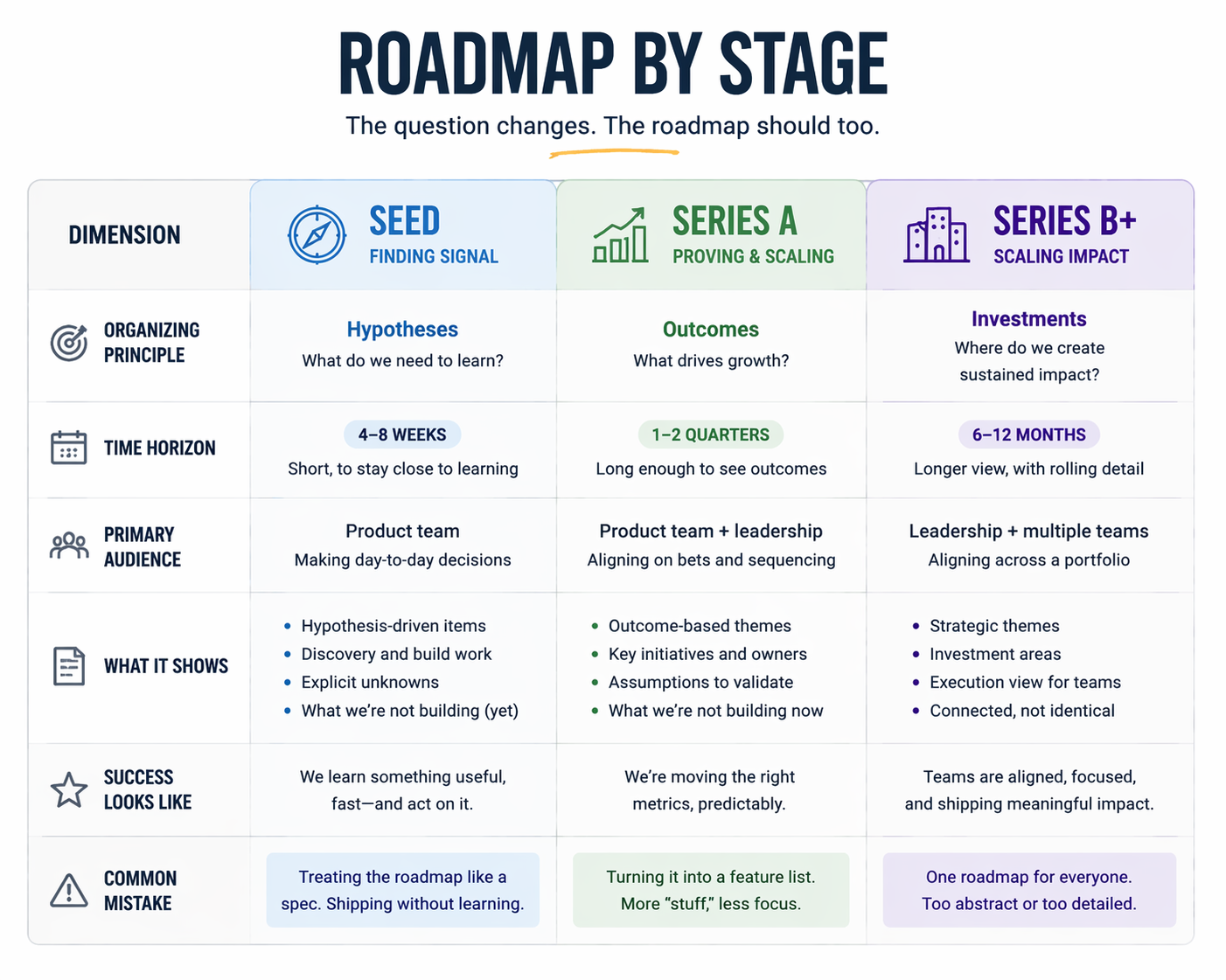
The right roadmap at Seed looks wrong at Series B. Not because one team is more sophisticated than the other, but because the underlying question changes.
Pre-PMF, the question is: what is true about this customer and this problem? The roadmap should reflect that you are in hypothesis-testing mode. Commitments should be short. Unknowns should be visible. The goal is to learn fast, not to deliver against a plan.
Post-PMF, the question shifts to: which bets accelerate growth, and in what order? The roadmap needs to reflect sequencing logic and outcome ownership, not just feature lists. Teams are larger, more dependencies exist, and a roadmap that cannot answer "why this, not that?" stops working.
At scale, the roadmap has to serve two audiences at once: leadership, who needs portfolio-level visibility, and teams, who need enough specificity to execute without constant coordination. Most companies at this stage build one document that works for neither audience.
The three examples below address each of these stages directly.
| Stage | Organizing Principle | Time Horizon | Primary Audience | Common Mistake |
|---|---|---|---|---|
| Seed Pre-PMF |
Hypotheses to test, not features to build | 6–8 weeks, no fixed dates | Founding team | Treating it like a product spec |
| Series A Post-PMF |
Outcomes by theme, with sequencing logic | Rolling 90 days + later view | Team + leadership | Becoming a feature factory as headcount grows |
| Series B Scaling |
Strategic themes + team-level execution layer | 6-month themes + 90-day detail | Two audiences, two views | One document that works for neither audience |
Source: rodriguezjimmy.com — Product Roadmap Examples by Stage
Example 1: The Seed-Stage Roadmap
The company: Formly, a B2B SaaS tool that helps operations teams build internal forms and approval workflows. Six months post-launch, $40K ARR, no PMF signal yet.
| Hypothesis | What We're Testing | Signal We're Looking For | Time Horizon |
|---|---|---|---|
| Ops teams need form routing, not just form creation | Build conditional routing; watch if active users increase submission volume | 30% increase in weekly submissions from existing users | 4 weeks |
| Integration with Slack is table-stakes | Add Slack notification on form submission | Users mention integrations unprompted in NPS comments | 6 weeks |
| Self-serve setup is broken | Rebuild onboarding flow with guided template | Time-to-first-submission under 10 minutes | 6 weeks |
| ⚠ Unknown: Does the problem get worse without approval tracking? | Customer interviews only — no build yet | Clear pattern emerges from 8 interviews | 4 weeks |
Note the amber row: explicit unknowns belong on the roadmap. No dates anywhere.
A few things are worth noting. There are no dates. There are no ticket references. The last row is explicit about what is not being built yet, and why. That is not a placeholder — it is a structural decision. At this stage, building without validation of the underlying problem is the most expensive mistake a team can make.
The common mistake pre-PMF is treating the roadmap as a product spec. Teams fill it with features, assign owners, estimate effort, and then run an execution process against a set of assumptions that have never been tested. The roadmap starts to feel productive while the product drifts away from what customers actually need.
A Seed roadmap organized around hypotheses rather than features forces a different conversation: not "is this shipped?" but "did this teach us something?" The horizon is short — six to eight weeks — because anything longer than that at this stage is an estimate of unknown validity. Discovery work is visible alongside build work, because both are real investments in reducing uncertainty.
Example 2: The Series A Roadmap
The company: Formly, now at $1.2M ARR. PMF signal confirmed: retention is strong in the operations persona, expansion revenue is growing, and the sales cycle is shortening. Team has grown to 12, including three engineers and two PMs.
| Initiative | Theme & Outcome | Outcome Owner | Window |
|---|---|---|---|
| NOW Weeks 1–6 · Theme: Reduce time-to-value for new accounts | |||
| Guided onboarding | Multi-user workspaces can complete setup without PM support | PM1 | Weeks 1–6 |
| Template library | 20 ops-specific form templates available at signup | PM1 | Weeks 3–6 |
| API access | Not building — fewer than 5% of accounts have requested it | — | Deferred |
| NEXT Weeks 7–12 · Theme: Enable cross-team workflow visibility | |||
| Activity dashboard | Managers can view form activity across all departments in one view | PM2 | Weeks 7–10 |
| Role-based permissions | Admins can restrict contributor access per workspace | PM2 | Weeks 9–12 |
| Audit logs | Assumption to validate — interviewing 6 enterprise accounts before committing to build | PM2 | Discovery only |
| LATER Weeks 13–20+ · Theme: Approval chain management | |||
| Multi-step approval routing | Hypothesis: approval workflow is where Formly competes with larger tools. Confidence: Medium | TBD | Pending "Next" outcomes |
Outcome owners are accountable for results, not just delivery. Exclusions and assumptions are documented — not implied.
The difference from the Seed example is significant. The time horizon has extended to 90 days with a rolling view into a later phase. Themes are organized by outcome, not by feature area. Each theme has an owner who is accountable for the result, not just the delivery.
The "Not building" and "Assumption to validate" lines are not polite caveats — they are operational. Any stakeholder reading this roadmap knows what is excluded and why. Any engineer can answer the question "what are we focused on this quarter?" without asking the PM first.
The common mistake at this stage is what I call the feature factory problem. As the team grows, more voices enter the prioritization conversation. Sales has requests. Customer success has escalations. Engineering has technical debt. Each input is legitimate. Without an outcome-oriented roadmap structure, the response is to add work rather than sequence it. The roadmap expands, the team fragments, and the strategic focus that created PMF starts to erode.
Example 3: The Series B Roadmap
The company: Formly, now at $8M ARR, 60-person company. Three product teams (onboarding, core workflow, integrations). VP of Product plus two engineering managers.
Strategic themes (6-month leadership view):
ThemeOutcomePrimary teamInvestment sizingEnterprise readinessReduce enterprise sales cycle from 60 to 30 daysCore workflow60% of core team capacityIntegration ecosystem10 native integrations live; 30% of accounts using at least oneIntegrationsFull team capacitySelf-serve growthIncrease trial-to-paid conversion from 12% to 18%OnboardingFull team capacity
| Initiative | Outcome | Owner | Confidence | Trade-off Documented |
|---|---|---|---|---|
| SSO and SCIM provisioning | Enterprise accounts can self-provision users | Eng Manager A | High | Delays audit log work by 6 weeks |
| Audit log for compliance | Enterprise can export full activity history | PM3 | High | — |
| Advanced approval routing | Multi-step, conditional routing with SLA tracking | PM3 | Medium | Requires 3-week UX discovery before build |
Source: rodriguezjimmy.com — Series B roadmap structure for a 60-person SaaS company
The structure here has to serve two audiences simultaneously. Leadership needs the 6-month strategic view to evaluate whether the bets are coherent and whether resources are allocated in proportion to strategic importance. Teams need the 90-day execution view with enough specificity to make decisions without escalating every uncertainty.
Most Series B companies build one document that tries to do both. The result is either too abstract for the team or too granular for leadership. The solution is not one longer roadmap — it is two views of the same prioritization logic, presented at the right level of detail for each audience.
The common mistake at this stage is roadmaps that function as project plans with product language layered on top. Timelines are precise. Delivery dates are committed. Every item is owned. The roadmap looks like a serious management artifact. But the outcome logic — why these bets, in this sequence, given what we know — has been replaced by delivery confidence. When something slips, the conversation is about schedule, not about whether the underlying bet is still valid.
The 3 Things Every Roadmap Should Make Obvious
Regardless of stage, a roadmap that cannot immediately answer these three questions is not doing its job.
What problem are we solving, and for whom? Not the feature description. Not the business goal. The specific customer problem, in the language of the customer experiencing it. If this is not visible in the roadmap, the team is optimizing for output rather than outcome.
What are we explicitly not doing right now, and why? This is where most roadmaps fail by omission. Leaving out the "not doing" column creates the impression that everything is in scope except what is currently in progress. It invites scope additions. It makes prioritization conversations harder because nothing has been formally excluded. What gets written down as "not now" is a commitment, not a rejection.
What would have to change for this to be different? Every roadmap represents a set of bets made under current conditions. When those conditions change — a competitive move, a retention signal, a change in customer segment behavior — the roadmap should be revisited explicitly, not silently revised. Naming the conditions upfront makes updates principled rather than reactive.
These three questions also connect to the prioritization infrastructure that makes roadmaps improvable over time. Decisions made without documenting the reasoning behind them cannot be evaluated or updated in a useful way. These three questions connect to the prioritization infrastructure that makes roadmaps improvable over time. Decisions made without documenting the reasoning behind them cannot be evaluated or updated in a useful way — and the ones that are hardest to revisit are always the ones where the original logic was never made explicit.
Free Product Strategy Template
The structure across these three examples — hypotheses organized by outcome, explicit trade-offs, visible unknowns — reflects how product strategy translates into a functional roadmap. If your roadmap is solid but your strategy is still implicit, the template at the link below covers both.
The Product Strategy Template includes the complete framework for defining customer focus, explicit choices, and sequencing logic — the inputs a roadmap needs to be more than a list of features. It is free to download.
Common Mistakes Across All Three Stages
Outputs substituted for outcomes. The roadmap lists features and delivery dates, not problems and expected behavior changes. Teams ship on schedule and cannot explain why retention did not improve. The structural cause is that success was defined as delivery, not as customer outcome. Both need to be on the roadmap for accountability to be real.
Exclusions left implicit. The roadmap communicates what is being built without communicating what is not. This is not a transparency failure — it is a prioritization failure. When what is deprioritized is not documented, it is not actually deprioritized. Stakeholders continue to advocate for excluded items because there is no shared record of the decision to defer them. The roadmap needs an explicit "not now" column with documented reasoning.
Updated at planning intervals, ignored in between. A roadmap that is only referenced during quarterly planning is not a planning tool — it is a presentation artifact. The test of whether a roadmap is working is whether teams consult it between planning cycles when new information arrives. If they do not, the roadmap has not been built to the right level of specificity, or the reasoning behind its decisions has not been shared clearly enough to be usable.
Owned by product, understood by no one else. Engineering builds to the roadmap. Sales expects features from it. Leadership approves it. But if only the PM can explain what is on it and why, the roadmap is functioning as a translation service rather than a shared operating artifact. A functional roadmap reduces the number of questions the PM has to answer, not increases them.
How to Know When Your Roadmap Is Working
The clearest signal is this: people outside the product team can use the roadmap to make decisions without asking you first.
An account executive can tell a prospect which capability is coming and when without getting the PM on a call. An engineer can decide between two implementation approaches based on what the roadmap signals about the next six weeks. A CS manager can prioritize escalations by comparing customer requests against documented roadmap decisions rather than lobbying for everything at once.
When a new request arrives, the roadmap is the first place people check — not to find an excuse to say no, but because the documented priorities give them a frame for the decision. If the roadmap does not make that possible, the problem is structural: either the strategic reasoning is not visible, the time horizon is not calibrated to the decisions being made, or the "not doing" layer is missing.
A roadmap that requires the PM to interpret it is a draft. A roadmap that others can use independently is an operational artifact. The gap between those two things is not design or format — it is the clarity of the underlying decisions.
If the Roadmap Problem Is Actually a Strategy Problem
A well-structured roadmap can only do so much. If leadership is continuously overriding the roadmap, if the team cannot use it to make decisions independently, or if every new request reopens the prioritization conversation from scratch — those are signals that the roadmap is inheriting a problem that lives upstream.
Roadmaps inherit ambiguity from strategy. When the strategy has not made explicit choices about customer segment, about which problems matter most, and about what the organization is not doing right now, the roadmap fills that void. And when the roadmap carries the full weight of alignment, it breaks under the load.
If that is where you are, the conversation is not about roadmap format. It is about whether the organization has made the foundational decisions a roadmap is supposed to reflect. I work with SaaS founders and product leaders on exactly this problem — not just the roadmap, but the strategic infrastructure that makes it functional.
If that work would be useful, the details of how I engage are here.