

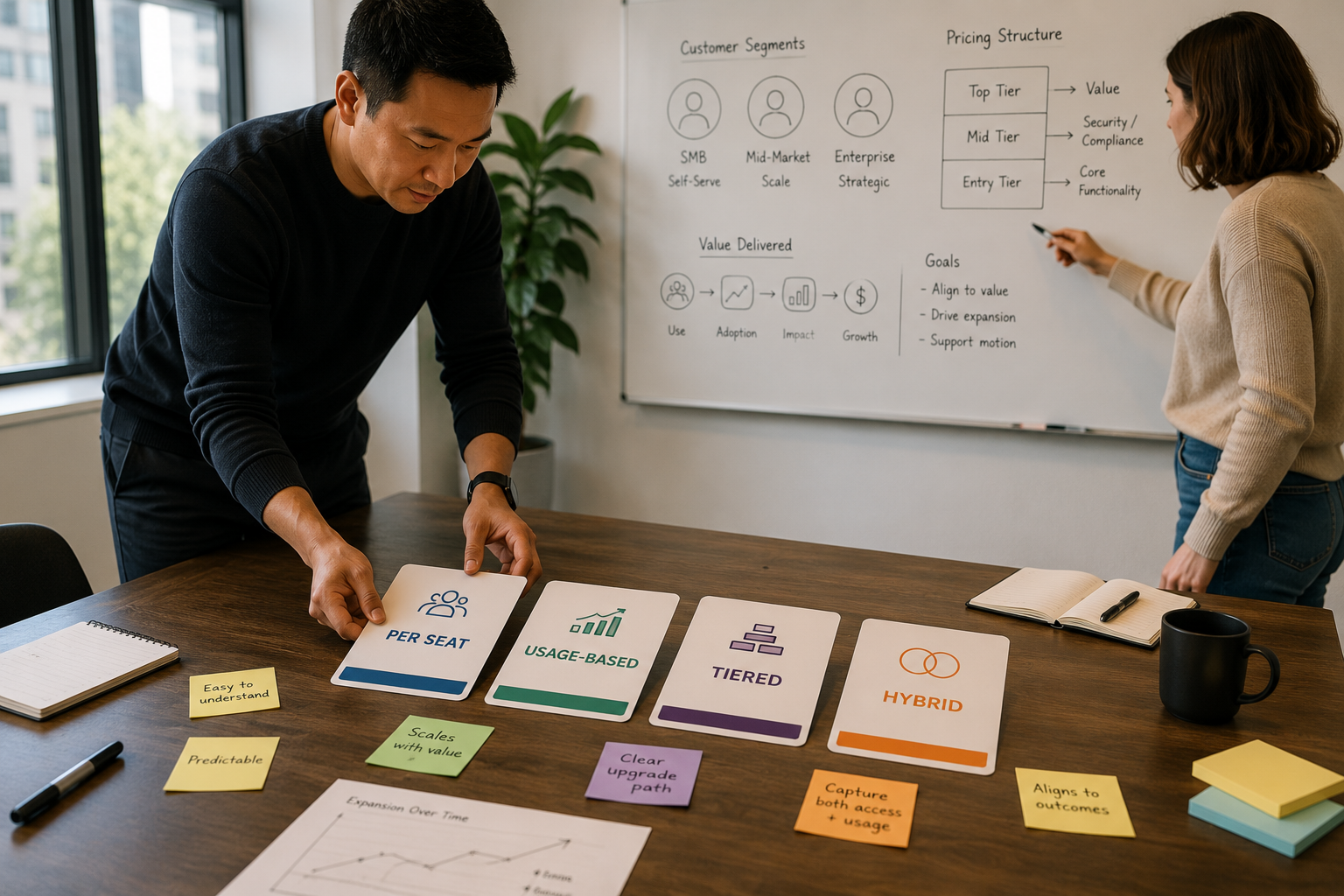
Pricing is the highest-leverage decision in your SaaS pricing strategy, and the one most teams resolve by copying a competitor's tiers. A flawed feature can be rebuilt and a weak onboarding flow can be rewritten, but a pricing model that misaligns what customers pay for from the value they receive distorts acquisition cost, expansion revenue, and the unit economics investors underwrite.
This guide answers the question directly: how to price a SaaS product. It compares the five main pricing models, shows which model fits a self-service SMB motion versus a sales-led enterprise motion, and covers how to build tiers that expand with usage instead of leaking revenue. Work through it in order — value metric first, model second, price last.
Start With the Value Metric: What You're Actually Charging For
Before you pick a model or a number, decide your value metric — the unit a customer is billed against. It is the single most important pricing decision because it determines whether your revenue grows when the customer succeeds.
A value metric works when three conditions hold:
It scales with value received. Accounts getting more out of the product pay more, automatically.
It is predictable. A buyer can estimate their bill before they sign, without anxiety.
It aligns growth. Expansion happens through ordinary usage, not a renegotiation.
Common value metrics, by what the product delivers:
Per seat — value scales with the number of people using it (collaboration, CRM, design tools).
Per usage unit — value scales with consumption (API calls, GB stored, messages sent, compute).
Per outcome — value scales with a result (leads generated, tickets resolved, revenue influenced).
Per record/entity — value scales with what's managed (contacts, properties, endpoints).
The diagnostic question is simple: when a customer triples the value they get from your product, does your revenue from that account grow on its own? If yes, the metric is doing its job. If the bill stays flat, the metric has decoupled from value and you are leaving expansion revenue uncaptured.
This is also where pricing depends on having real product–market fit — until customers agree on what the product is worth, no value metric will hold.
The 5 Main SaaS Pricing Models (and When Each One Fits)
Most teams default to per-seat pricing because it is simple to forecast, not because it reflects how their product creates value. There are five primary SaaS pricing models, and the right choice follows from your value metric and your customer.
| Model | How it scales | Best fit | Main trade-off |
|---|---|---|---|
| Flat-rate | One price, no variable | Single-segment, simple products | Leaves money on larger accounts |
| Per-seat | By number of users | Collaboration tools, value in access | Breaks down when value is usage; shrinks as AI cuts seats |
| Usage-based | By consumption | Infra, APIs, AI, variable value | Less predictable bills; cost anxiety |
| Tiered | By packaged bundle | Most SaaS; multiple segments | Tier design is easy to get wrong |
| Hybrid | Platform fee + usage/seats | Infra & AI products; enterprise | More complex to explain and bill |
In practice, the trade-offs break down like this:
Flat-rate — one price, one product. Easy to sell, easy to understand, but leaves money on the table with larger accounts and struggles to serve multiple segments.
Per-seat (per-user) — predictable and easy to forecast. Breaks down when value is concentrated in usage rather than headcount, and increasingly as AI-assisted products let customers do the same work with fewer seats.
Usage-based — revenue tracks consumption, so expansion is automatic. Strongest alignment to value, but bills are less predictable and can create cost anxiety for buyers.
Tiered — packaged bundles (Starter / Pro / Business) that segment customers by need. The most common model because it balances simplicity with expansion paths.
Hybrid (platform fee + usage, or seats + usage) — a base subscription plus a usage or outcome component. Captures both access and consumption value; now the default for many infrastructure and AI products.
A useful rule: if value is concentrated in access, lean toward seats or tiers; if value is concentrated in consumption, lean toward usage or hybrid. The more your product's value varies widely across accounts, the more a usage component pays off.
Self-Service vs. Sales-Led Pricing: Match the Model to Your ICP
Your pricing model is inseparable from who you sell to. The same product priced for a 5-person startup and a 5,000-person enterprise needs two different motions. Decide which your ideal customer profile requires before you publish a pricing page.
- Low ACV, high volume of accounts
- Individuals or small teams can adopt without IT
- Time-to-value is fast (minutes to days)
- Buyer expects to self-checkout
- Growth is bottom-up inside accounts
- High ACV, fewer, larger accounts
- Security, compliance, or SSO are requirements
- Procurement and legal are in the buying loop
- Value justifies a custom, negotiated quote
- Deals are annual with committed usage
Self-Service / PLG Pricing for SMB
Self-service pricing is built for volume, low touch, and fast time-to-value. It fits SMB and bottom-up product-led growth.
Publish your prices. Public, transparent tiers with self-checkout. Hiding prices kills self-service conversion.
Keep the entry point low. A free trial or free tier that gets users to value quickly, supported by strong self-service onboarding.
Design for expansion without a salesperson. Usage limits, seat counts, and feature gates that prompt upgrades as the account grows.
Optimize for activation, not negotiation. Revenue comes from many accounts converting and expanding, not from individual deals.
Sales-Led Custom Pricing for Enterprise
Enterprise buyers have procurement, security reviews, and budget cycles. Pricing here is negotiated, not self-served.
Use "Contact Us" for the top tier. Custom quotes let you price to the value of a large account and avoid anchoring enterprise budgets to your SMB list price.
Bundle around requirements, not features. SSO, audit logs, SLAs, dedicated support, and security/compliance are the upgrade triggers, not minor functionality.
Price on a hybrid basis. Enterprise deals often combine a platform fee with seats and/or usage to capture value as the account scales.
Expect annual contracts. Longer terms and committed-use discounts trade some flexibility for revenue durability.
Most SaaS companies that scale run both motions: published self-service tiers for SMB acquisition, and a sales-led custom tier for enterprise. The decision is rarely either/or — it's where you draw the line between them. Getting that line right is a core part of your product strategy, not a pricing-page afterthought.
How to Build Tiers That Drive Expansion (and Limit Contraction)
Net revenue retention — how much an account's spend grows or shrinks over time — separates SaaS businesses that compound from those stuck on a treadmill of new acquisition. Tiers and mechanics decide which one you are.
To drive expansion:
Tie at least one pricing dimension to a metric that grows naturally with usage, so revenue expands without a renegotiation.
Build clear upgrade paths between tiers — each tier should have an obvious reason a growing account moves up.
Add expansion levers beyond the core subscription: add-ons, premium modules, and overage on usage.
To limit contraction:
Watch for value metrics that shrink as the product improves. If AI features let customers do the same work with fewer seats, a seat-based metric contracts precisely as you deliver more value — a structural reason many teams are moving to usage or hybrid models.
Constrain discounting to defined thresholds. Unstructured, per-deal discounting erodes the integrity of your entire price list, because informed buyers learn the published price is a fiction.
Make downgrades a deliberate step, not a one-click default, and instrument why they happen.
The payoff for getting the value metric right shows up here: a well-chosen metric turns expansion into a default rather than a campaign, and softens contraction when usage dips.
Map your value metric, tiers, and expansion levers before you commit to a price. Get the pricing worksheet.
How to Set Your Price: A 5-Step Process
Only after the model and tiers are settled does the actual number become answerable. Run this sequence:
Quantify the value. Identify the value your product creates that the customer can measure — hours saved, a tool replaced, revenue influenced.
Anchor to value, not cost. Set the price as a fraction of that quantified value. Cost-plus pricing underprices software, where marginal cost is near zero.
Sense-check against the market. Use competitor prices as a sanity boundary, not a target — your model and packaging are different, so their number is not yours.
Set tier boundaries by segment. Each tier should map to a customer segment's must-haves, not an internal feature list.
Pressure-test before launch. Run the price against the checklist below; if any answer is "no," the work is in the model or tiers, not the number.
Before committing, confirm:
When a customer gets more value, does their bill grow without a renegotiation?
Can an SMB buyer estimate their cost and check out without talking to sales?
Does each tier map to a segment rather than a feature list?
Is the price a fraction of value the customer can quantify, not your cost?
Does revenue expand through usage rather than only through annual procurement?
How to Choose Your SaaS Pricing Model: A Quick Decision Rule
If you take one rule from this guide: price against the value your customer can measure, on a metric that grows when they succeed, through a motion that matches who they are. Concretely:
Value is in access and your buyer is SMB → published tiered pricing with self-checkout.
Value is in consumption → usage-based or hybrid, with predictable estimates.
Buyer is enterprise → a sales-led custom top tier on a hybrid basis, with SMB tiers below it.
Pricing does not become easy once you work in this order. It becomes answerable, which is the more useful property. The number was never the hard part. The hard part was deciding what the number was attached to, who you were charging, and how it would grow.
If you're choosing a pricing model, restructuring tiers, or moving from seats to usage, I help SaaS teams get the value metric and packaging right before it shows up in churn and CAC.
Explore working together →